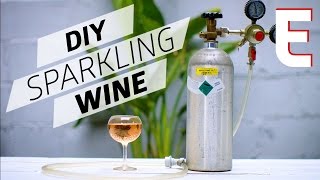
How to Make Your Own SodaStream
video description
Date: 2020-05-20
Related videos


Comments and reviews: 10
Ham
I've carbonated soda with this setup for several years and it works great and is SAFE if you follow a few rules. NEVER force carbonate in a soda bottle at more than 45 psi. Use a machined stainless steel carbonation cap. NEVER use those cheapo plastic ones! Use PET bottles. They are tuff! I've never had one pop, even after hundreds of uses. ALWAYS connect the ball lock to the bottle & cap with the CO2 ball valve at the tank CLOSED! Press out the air in the bottle and tighten the cap. Connect the ball lock and slowly open the ball valve. It will gently pop with pressure and you can start shaking. I usually give 20 or so shakes then wait a few seconds and repeat 4 or 5 times. Turn off the tanks main valve! Disconnect your wine and slowly bleed off the internal pressure! Remove the carbonation cap and screw a cap on your bottle. Now depressurize the line and regulator by pushing the button inside the ball lock. I use an old sharpie (non pointed side) to do the trick. Works great. One more thing ALWAYS carbonate REFRIGERATED COLD LIQUIDS! I cannot over stress this point. OK, have at it and have fun!
reply
I've carbonated soda with this setup for several years and it works great and is SAFE if you follow a few rules. NEVER force carbonate in a soda bottle at more than 45 psi. Use a machined stainless steel carbonation cap. NEVER use those cheapo plastic ones! Use PET bottles. They are tuff! I've never had one pop, even after hundreds of uses. ALWAYS connect the ball lock to the bottle & cap with the CO2 ball valve at the tank CLOSED! Press out the air in the bottle and tighten the cap. Connect the ball lock and slowly open the ball valve. It will gently pop with pressure and you can start shaking. I usually give 20 or so shakes then wait a few seconds and repeat 4 or 5 times. Turn off the tanks main valve! Disconnect your wine and slowly bleed off the internal pressure! Remove the carbonation cap and screw a cap on your bottle. Now depressurize the line and regulator by pushing the button inside the ball lock. I use an old sharpie (non pointed side) to do the trick. Works great. One more thing ALWAYS carbonate REFRIGERATED COLD LIQUIDS! I cannot over stress this point. OK, have at it and have fun!
reply
Ravaxr
I rarely dislike videos. This is one of them. Yeah, it's funny, but the practices are dangerous. You need to use food grade CO2, since lubricants for fittings and valves are put in with the gas, and you end up drinking those. The pertinent info, like pressure of the cylinder and pressure past the regulator are omitted. The hose is almost guaranteed not to be rated for high pressure, and fits like a circus tent to a hot dog. And after one use of those pliers, the regulator is already chewed up. You don't even need a mechanic's fixed spanner. An adjustable would be WAY better. The tea incident and the lack of proper tools just shows me that the presenter did research from a moving car, and when dealing with gas canisters, that is really bad.
reply
I rarely dislike videos. This is one of them. Yeah, it's funny, but the practices are dangerous. You need to use food grade CO2, since lubricants for fittings and valves are put in with the gas, and you end up drinking those. The pertinent info, like pressure of the cylinder and pressure past the regulator are omitted. The hose is almost guaranteed not to be rated for high pressure, and fits like a circus tent to a hot dog. And after one use of those pliers, the regulator is already chewed up. You don't even need a mechanic's fixed spanner. An adjustable would be WAY better. The tea incident and the lack of proper tools just shows me that the presenter did research from a moving car, and when dealing with gas canisters, that is really bad.
reply
migodbe
I have a question about removing the oxygen from the plastic bottle (by squeezing out the air): how necessary is this step? I ask because I want to do this using the nice big glass GT kombucha bottles, but want to make sure it's safe. Obviously you cannot squeeze out the air from a glass bottle. If it is safe to use a glass bottle made for carbonated beverages like a GT Kombucha bottle, should I fill the water all the way to the top before carbonating, or leave some air in the bottle? Also what is a safe pressure to you if carbonating glass bottles like this? Thanks!
reply
I have a question about removing the oxygen from the plastic bottle (by squeezing out the air): how necessary is this step? I ask because I want to do this using the nice big glass GT kombucha bottles, but want to make sure it's safe. Obviously you cannot squeeze out the air from a glass bottle. If it is safe to use a glass bottle made for carbonated beverages like a GT Kombucha bottle, should I fill the water all the way to the top before carbonating, or leave some air in the bottle? Also what is a safe pressure to you if carbonating glass bottles like this? Thanks!
reply
Roberto
Clifford Endo, Can I ask you a Favor, I am a Disabled US ARMY Veteran Currently living in the philippines. where I CAN AFFORD to live, I was wondering If you could do a set up like you have there, leave the Tank EMPTY and ship it to my Daughter in Reno Nevada! Let me know the Cost & what you think your time is worth and I will send you a check from Bank Of America in California. I ask because here they dont have this stuff you have only the 5 foot tall commercial tanks, and they won't help me here? Can we hook up and can you please help me? ThanksRob
reply
Clifford Endo, Can I ask you a Favor, I am a Disabled US ARMY Veteran Currently living in the philippines. where I CAN AFFORD to live, I was wondering If you could do a set up like you have there, leave the Tank EMPTY and ship it to my Daughter in Reno Nevada! Let me know the Cost & what you think your time is worth and I will send you a check from Bank Of America in California. I ask because here they dont have this stuff you have only the 5 foot tall commercial tanks, and they won't help me here? Can we hook up and can you please help me? ThanksRob
reply
Kojak
I like the fact that you showed your bottle explosion. Many manufacturers have started using thinner-walled bottles. As an experiment, you should always start with lower pressures from your regulator as you found out. One thing I'd point out is that while this might be cheap per bottle to carbonate compared to the price per bottle with Sodastream, it's definitely not cheap to get started. The tank, regulator, and assorted parts will set you back over 100 as a general rule. Great vid!
reply
I like the fact that you showed your bottle explosion. Many manufacturers have started using thinner-walled bottles. As an experiment, you should always start with lower pressures from your regulator as you found out. One thing I'd point out is that while this might be cheap per bottle to carbonate compared to the price per bottle with Sodastream, it's definitely not cheap to get started. The tank, regulator, and assorted parts will set you back over 100 as a general rule. Great vid!
reply
katodevon
Eater - why are you even posting this crap. Yes, it'll work, but so damn amateur. Should remake this with the assistance of someone who actually knows about safe gas handling and proper fittings (maybe a high school teacher. Could also be much better if parts required were linked to (Mcmaster Carr. Following this could potentially cause people to be injured (dry-ice bomb, or hoses popping off.
reply
Eater - why are you even posting this crap. Yes, it'll work, but so damn amateur. Should remake this with the assistance of someone who actually knows about safe gas handling and proper fittings (maybe a high school teacher. Could also be much better if parts required were linked to (Mcmaster Carr. Following this could potentially cause people to be injured (dry-ice bomb, or hoses popping off.
reply
zero
you're using the wrong hose, it's supposed to be braided vinyl rated at 220psi. the hose you're using is not rated for high pressure c02 and is also the incorrect diameter, it's supposed to be 1/4 not 3/8. the clamps you use are supposed to be o-clamps or a crimp on hose ferrule but never a phillips or slotted hose clamp.
reply
you're using the wrong hose, it's supposed to be braided vinyl rated at 220psi. the hose you're using is not rated for high pressure c02 and is also the incorrect diameter, it's supposed to be 1/4 not 3/8. the clamps you use are supposed to be o-clamps or a crimp on hose ferrule but never a phillips or slotted hose clamp.
reply
MarzNet256
It's a good idea to check for any leaks at connections and tank valve using soapy water. Any leaks will form bubbles. A large leak in an enclosed space can elevate CO2 to levels which can be fatal. If you want to be super safe, get a CO2 detector or store apparatus outside
reply
It's a good idea to check for any leaks at connections and tank valve using soapy water. Any leaks will form bubbles. A large leak in an enclosed space can elevate CO2 to levels which can be fatal. If you want to be super safe, get a CO2 detector or store apparatus outside
reply
Andre
Please don't follow this. So many bad practices. 1st: get a CO2 detector and put in the vicinity of where your tank will be. 2nd: use proper connections, like swagelok. 3rd: learn to use the regulator to regulate! 4th: get proper bottles. 5th: enjoy safe carbonation.
reply
Please don't follow this. So many bad practices. 1st: get a CO2 detector and put in the vicinity of where your tank will be. 2nd: use proper connections, like swagelok. 3rd: learn to use the regulator to regulate! 4th: get proper bottles. 5th: enjoy safe carbonation.
reply
Scanning
The purpose of the regulator is to dial down the working pressure so you don't blow the bottoms out of your bottles or possibly hurt someone. 30 to 40 pounds working pressure is more than enough to carbonate anything, I would stay at the low end of 30 to be safe.
reply
The purpose of the regulator is to dial down the working pressure so you don't blow the bottoms out of your bottles or possibly hurt someone. 30 to 40 pounds working pressure is more than enough to carbonate anything, I would stay at the low end of 30 to be safe.
reply
Add a review, comment
Other channel videos