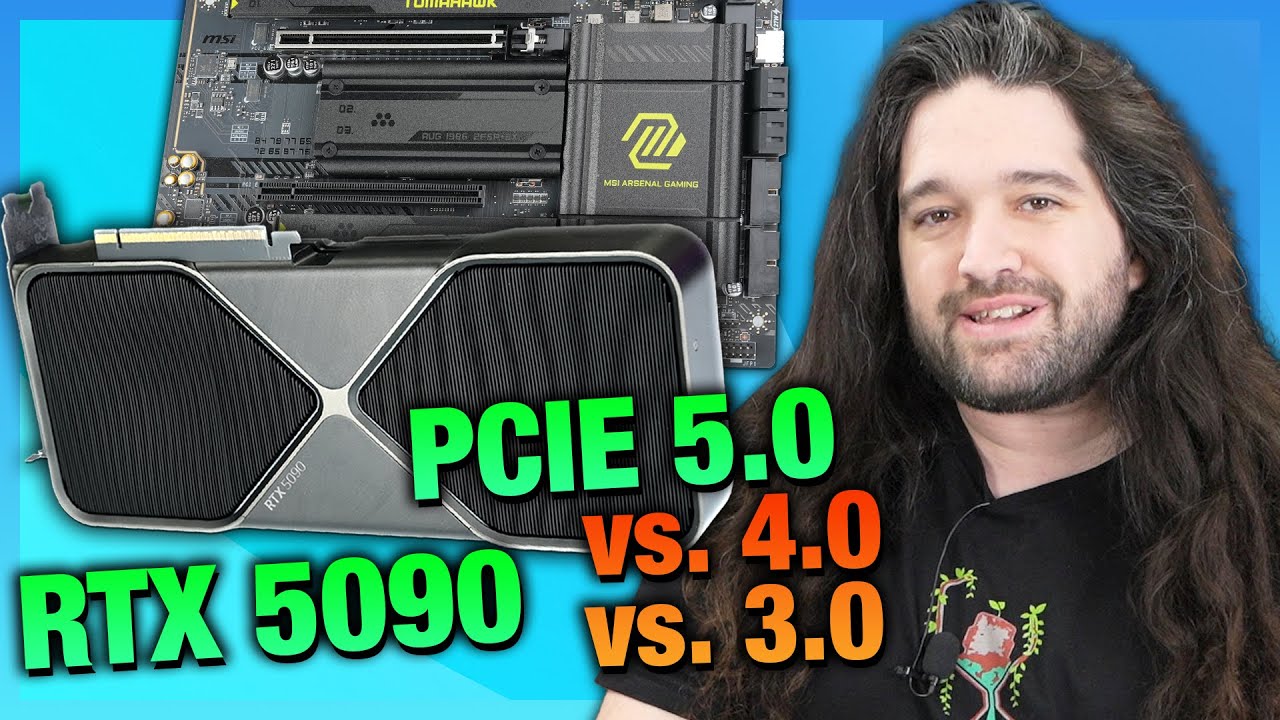
NVIDIA RTX 5090 PCIe 5.0 vs. 4.0 vs. 3.0 x16 Scaling Benchmarks
video description
Date: 2025-01-30
Related videos


Comments and reviews: 20
gamersnexus
Most Deep Learning applications must be bottlenecked by the PCIe. I think to isolate the bottleneck, you have to train a small to medium sized CNN (for image processing) so the CUDA cores wouldn't have an issue calculating the output and the gradients, but the PCIe would take a while to communicate the gradient information back to the CPU and then the new input batch from the CPU to the CUDA cores. I think it will affect LLMs less than CNNs or bare MLPs, since there's less parallelization possibilities for LLMs (because of the sequential dependencies in LLMs) and therefore the LLMs would have less data to communicate back to the CPU and more data to communicate in the cards own memory bus (among cores). I'd like to point out that training a neural network is more intense than running it on inference mode since there isn't a need to communicate gradients back to the CPU and also the CPU won't have to handle any update calculations. But all these I'm saying are theoretical and I'd love to see you test it.
(I've seen that the CUDA cores are not the bottleneck for most AI use cases I've worked on throughout the years, and more interestingly, the VRAM isn't the bottleneck either. This is where this theory came to me that the PCIe could be the actual issue here.)
reply
Most Deep Learning applications must be bottlenecked by the PCIe. I think to isolate the bottleneck, you have to train a small to medium sized CNN (for image processing) so the CUDA cores wouldn't have an issue calculating the output and the gradients, but the PCIe would take a while to communicate the gradient information back to the CPU and then the new input batch from the CPU to the CUDA cores. I think it will affect LLMs less than CNNs or bare MLPs, since there's less parallelization possibilities for LLMs (because of the sequential dependencies in LLMs) and therefore the LLMs would have less data to communicate back to the CPU and more data to communicate in the cards own memory bus (among cores). I'd like to point out that training a neural network is more intense than running it on inference mode since there isn't a need to communicate gradients back to the CPU and also the CPU won't have to handle any update calculations. But all these I'm saying are theoretical and I'd love to see you test it.
(I've seen that the CUDA cores are not the bottleneck for most AI use cases I've worked on throughout the years, and more interestingly, the VRAM isn't the bottleneck either. This is where this theory came to me that the PCIe could be the actual issue here.)
reply
cbdemented
About what I expected.
What I'd like to see graphically is what's the performance hit of going from x16 to x8 in Gen 5. I've got an MSI MAG Z790 TOMAHAWK MAX WIFI. According to MSI M.2 Slot 1: This slot is directly connected to the CPU and supports PCIe 5.0. However, if you populate this slot with an M.2 NVMe drive, it will reduce the GPU PCIe slot (PCI_E1) from x16 to x8. This occurs with any NVMe drive, regardless of they PCIE version.
I've seen several other boards with the same setup, and it seems to be something you have to live with unless you want to go up a teir in cost to a higher end board (particularly if you hve the i/o requirements for USB that I do). So I haven't populated that M2 slot and thus effectively have lost one slot (not that I need it for PCIE 5.0 storage). I've read a little about it, but have gotten inconsistent information about how much this will affect real world performance. I'd like to get that slot back to add more storage to my rig, but would like to have a better indication of the peformance hit I'd have in games or encoding by running the GPU at x8.
If you guys could (or have an I just haven't seen it) cover this at some point, I'd appreciate it.
Thanks again.
reply
About what I expected.
What I'd like to see graphically is what's the performance hit of going from x16 to x8 in Gen 5. I've got an MSI MAG Z790 TOMAHAWK MAX WIFI. According to MSI M.2 Slot 1: This slot is directly connected to the CPU and supports PCIe 5.0. However, if you populate this slot with an M.2 NVMe drive, it will reduce the GPU PCIe slot (PCI_E1) from x16 to x8. This occurs with any NVMe drive, regardless of they PCIE version.
I've seen several other boards with the same setup, and it seems to be something you have to live with unless you want to go up a teir in cost to a higher end board (particularly if you hve the i/o requirements for USB that I do). So I haven't populated that M2 slot and thus effectively have lost one slot (not that I need it for PCIE 5.0 storage). I've read a little about it, but have gotten inconsistent information about how much this will affect real world performance. I'd like to get that slot back to add more storage to my rig, but would like to have a better indication of the peformance hit I'd have in games or encoding by running the GPU at x8.
If you guys could (or have an I just haven't seen it) cover this at some point, I'd appreciate it.
Thanks again.
reply
EMETRL
PCIe generation support is a bit difficult to keep track of, but thankfully spec sheets are usually written well. I have a Ryzen 5 3600 on the MSI B550 A-Pro motherboard. My CPU has up to 24 lanes of PCIe gen 4, and my motherboard allows as many gen 4 lanes as the B550 chipset was made for, which is 20 PCIe gen 4 lanes. As is typical for B550 boards, that's split up between 4 lanes to the primary M.2 slot and 16 to a full PCIe 4.0x16 slot. My motherboard has a second M.2 slot and three more PCIe slots (1 is a 16x, two are 1x) but those go through the chipset and can't all be used at once, since the M.2 slot shares some lanes with the other 16x slot, but regardless, all these extra slots only support up to PCIe gen 3.
So I could support a gen4 SSD and a full gen 4 x16 gpu despite being on a nearly 5 year old build. Had to take a couple minutes to parse through all of the spec sheets of my components to make sure, but it's nice to know that the PCIe generation of components will basically never be the bottleneck that motivates an upgrade or rebuild (for what I need from a pc).
reply
PCIe generation support is a bit difficult to keep track of, but thankfully spec sheets are usually written well. I have a Ryzen 5 3600 on the MSI B550 A-Pro motherboard. My CPU has up to 24 lanes of PCIe gen 4, and my motherboard allows as many gen 4 lanes as the B550 chipset was made for, which is 20 PCIe gen 4 lanes. As is typical for B550 boards, that's split up between 4 lanes to the primary M.2 slot and 16 to a full PCIe 4.0x16 slot. My motherboard has a second M.2 slot and three more PCIe slots (1 is a 16x, two are 1x) but those go through the chipset and can't all be used at once, since the M.2 slot shares some lanes with the other 16x slot, but regardless, all these extra slots only support up to PCIe gen 3.
So I could support a gen4 SSD and a full gen 4 x16 gpu despite being on a nearly 5 year old build. Had to take a couple minutes to parse through all of the spec sheets of my components to make sure, but it's nice to know that the PCIe generation of components will basically never be the bottleneck that motivates an upgrade or rebuild (for what I need from a pc).
reply
MDxGano
Audible HA! for Unless you're a SUPER GAMER . Love the content and suggest you at some point prove or disprove if a fancy power cord (psu to wall) can improve overclocking performance in any way shape or form. Think audiophile equipment repurposed,. It is common in the audio industry to either think an expensive cord can bring a system together, or alternatively, that they are snake oil for suckers. I only have anecdotal experience with marginally better overclock stability and higher Unigine valley benchmark results that were just outside margin of error, but also not groundbreaking under air cooling. The most noteworthy aspect of said fancy cord was nearly double wire gauge vs stock cable, which is likely the leading cause of any system change. Not worth 10-1000x the price of a basic power cord though for non world record breaking use...but maybe, just maybe...
reply
Audible HA! for Unless you're a SUPER GAMER . Love the content and suggest you at some point prove or disprove if a fancy power cord (psu to wall) can improve overclocking performance in any way shape or form. Think audiophile equipment repurposed,. It is common in the audio industry to either think an expensive cord can bring a system together, or alternatively, that they are snake oil for suckers. I only have anecdotal experience with marginally better overclock stability and higher Unigine valley benchmark results that were just outside margin of error, but also not groundbreaking under air cooling. The most noteworthy aspect of said fancy cord was nearly double wire gauge vs stock cable, which is likely the leading cause of any system change. Not worth 10-1000x the price of a basic power cord though for non world record breaking use...but maybe, just maybe...
reply
luthermetke8851
So are the cards not utilizing all the bandwidth, or does is really take double bandwidth to make only a 4 percent difference I get that this is the first gen 5 card, and that it probably won't utilize the bandwidth as much as say a 6090 or 7090 in the future, but i feel like the performance difference would have been more dramatic between gen 3 and 5. If they support gen 5 then that means that they MUST be over the bandwidth need for gen 4, which would mean that they have more then DOUBLE the bandwidth need for gen 3, but there is only a 4 percent performance boost between 3 and 5 Just curious if this is all just marketing for bigger numbers to put on the box.
reply
So are the cards not utilizing all the bandwidth, or does is really take double bandwidth to make only a 4 percent difference I get that this is the first gen 5 card, and that it probably won't utilize the bandwidth as much as say a 6090 or 7090 in the future, but i feel like the performance difference would have been more dramatic between gen 3 and 5. If they support gen 5 then that means that they MUST be over the bandwidth need for gen 4, which would mean that they have more then DOUBLE the bandwidth need for gen 3, but there is only a 4 percent performance boost between 3 and 5 Just curious if this is all just marketing for bigger numbers to put on the box.
reply
james2042
You should try with an older platform with 4.0/3.0 as the standard, like am4 with a 5800x3d, due to the physical lesser quality traces needed to meet the spec. You obviously won't be able to get top notch performance, but it would highlight signal degradation a little bit better.
Also if you want to do a quick test of x8 configurations if you get bored. I've seen weird behavior with cards being re-routed to 8x, mainly with stutters and hitches. I do miss the days of multiple expansion slots being used for customization of a computer vs everything baked in
reply
You should try with an older platform with 4.0/3.0 as the standard, like am4 with a 5800x3d, due to the physical lesser quality traces needed to meet the spec. You obviously won't be able to get top notch performance, but it would highlight signal degradation a little bit better.
Also if you want to do a quick test of x8 configurations if you get bored. I've seen weird behavior with cards being re-routed to 8x, mainly with stutters and hitches. I do miss the days of multiple expansion slots being used for customization of a computer vs everything baked in
reply
dho
nice, good to see gen3 mostly keeping up. i say this because there’s still a good amount of pcie 3 risers out there for certain cases and pcie 4 risers can be finnicky, and pcie 5 risers are expensive. another thought is that even though it’s a few percent, i feel that there’s a lot of small percentage gains out there, and together i feel that it can make a noticeable difference. chasing low hanging fruit is still rewarding when you have the time for it.
reply
nice, good to see gen3 mostly keeping up. i say this because there’s still a good amount of pcie 3 risers out there for certain cases and pcie 4 risers can be finnicky, and pcie 5 risers are expensive. another thought is that even though it’s a few percent, i feel that there’s a lot of small percentage gains out there, and together i feel that it can make a noticeable difference. chasing low hanging fruit is still rewarding when you have the time for it.
reply
DwynAgGaire
Loved this video. Always wondered if running a gen 4x16 card on a gen 3 x16 slot made a difference. A better question though, especially given how most motherboards use pcie switching when the second x16 slot is populated, does running the 5090 in a slot that due to switching runs gen5 x8 kill performance. I know that gen4 x16 is logically half the bandwidth of gen5 x16 but is it apples and apples
reply
Loved this video. Always wondered if running a gen 4x16 card on a gen 3 x16 slot made a difference. A better question though, especially given how most motherboards use pcie switching when the second x16 slot is populated, does running the 5090 in a slot that due to switching runs gen5 x8 kill performance. I know that gen4 x16 is logically half the bandwidth of gen5 x16 but is it apples and apples
reply
dho
curious if you guys would do a video on good value silent setups. it’s generally hard to find an affordable setup that’s near silent. i think with some careful planning, yiu can bring down the cost, but silent builds can get really expensive really fast. with fanless power supplies, noctua edition gpu and psu’s, it’s an interesting space now, but certainly not cheap.
reply
curious if you guys would do a video on good value silent setups. it’s generally hard to find an affordable setup that’s near silent. i think with some careful planning, yiu can bring down the cost, but silent builds can get really expensive really fast. with fanless power supplies, noctua edition gpu and psu’s, it’s an interesting space now, but certainly not cheap.
reply
Banshee07Man
Gaming at 3440x1440p 144hz. 5800x x570 32gig 3200mhz. 2tb 980pro 7800xt 16g. Want to upgrade to a 4090 or 5090. Is it worth upgrading anything else I was thinking for gen 5 pcie or maybe ddr5 but seems like it's not worth spending the money for 1-4%. I would only need to get a power supply and 5090 if I can keep my core pc. GamersNexus
reply
Gaming at 3440x1440p 144hz. 5800x x570 32gig 3200mhz. 2tb 980pro 7800xt 16g. Want to upgrade to a 4090 or 5090. Is it worth upgrading anything else I was thinking for gen 5 pcie or maybe ddr5 but seems like it's not worth spending the money for 1-4%. I would only need to get a power supply and 5090 if I can keep my core pc. GamersNexus
reply
you2be839
I'm surprised the difference is almost nonexistent!
I mean, I'm from a time when the graphics bus type had such an impact on performance (PCI->AGP->PCI-E) in the timespan of just over a decade (1992-2004), and now PCI-E 3.0, which was introduced in 2010 (15 years ago), is still proving 96% of the performance of PCI-E 5.0... at worst!!
reply
I'm surprised the difference is almost nonexistent!
I mean, I'm from a time when the graphics bus type had such an impact on performance (PCI->AGP->PCI-E) in the timespan of just over a decade (1992-2004), and now PCI-E 3.0, which was introduced in 2010 (15 years ago), is still proving 96% of the performance of PCI-E 5.0... at worst!!
reply
GatecrasherSlim
thinking of getting a 5080 however on a 5800x. Seeing how the 5090 is bottlenecked by even a 9800x3d I'm guessing not a good idea. I'm guessing if I put a big Arctic AIO (damn cheap right now) on my 5800x it might overclock it a tiny bit or is overclocking totally pointless now (currently has an HTPC sized cooler - Noctua nh-c14s)
reply
thinking of getting a 5080 however on a 5800x. Seeing how the 5090 is bottlenecked by even a 9800x3d I'm guessing not a good idea. I'm guessing if I put a big Arctic AIO (damn cheap right now) on my 5800x it might overclock it a tiny bit or is overclocking totally pointless now (currently has an HTPC sized cooler - Noctua nh-c14s)
reply
supertrix6628
No, this test is FAKE - dude dont mislead your viewers - the ASUS ROG Crosshair X670E Hero motherboard does not support PCI Gen 3, but it does support PCI Express 4.0 / 5.0 (PCIe 5.0).
cant test vs gen 3 because its entirely different hardware - since the x670E cant do PCI gen 3. this testing is pretty much INVALID and FALSE.
reply
No, this test is FAKE - dude dont mislead your viewers - the ASUS ROG Crosshair X670E Hero motherboard does not support PCI Gen 3, but it does support PCI Express 4.0 / 5.0 (PCIe 5.0).
cant test vs gen 3 because its entirely different hardware - since the x670E cant do PCI gen 3. this testing is pretty much INVALID and FALSE.
reply
Stubbies2003
Heh rather silly that people would fret putting a 5090 into a Gen 3 PCIe system and sweating the PCIe generation figuring that the huge loss wouldn't be due to the generation of PCIe but the slow ass CPU that would be screaming trying to keep up with the 5090. The CPU would be the real bottleneck not PCIe. :)
reply
Heh rather silly that people would fret putting a 5090 into a Gen 3 PCIe system and sweating the PCIe generation figuring that the huge loss wouldn't be due to the generation of PCIe but the slow ass CPU that would be screaming trying to keep up with the 5090. The CPU would be the real bottleneck not PCIe. :)
reply
franklyf1641
I currently have a 10700k on a PCIe 3.0 board, DDR4 and a 2080s. Plan is to jump to a 5070 when released but should i be concerned with the inevitable CPU bottleneck Id rather not have to ugrade CPU/MB/MEM just yet....
Im sure the % gained would faaaaar outweigh whats lost in the bottleneck
reply
I currently have a 10700k on a PCIe 3.0 board, DDR4 and a 2080s. Plan is to jump to a 5070 when released but should i be concerned with the inevitable CPU bottleneck Id rather not have to ugrade CPU/MB/MEM just yet....
Im sure the % gained would faaaaar outweigh whats lost in the bottleneck
reply
dirklanduyt
Knowing the human eye c.q. brain can't get over 60fps, I'd like to know what is the purpose of bragging about fps-testing. There's more interesting hardware to test (CPU, AI, ...) instead of pushing overpriced GPU's that are absolutely not worth looking at. Even iGPU's are more efficient.
reply
Knowing the human eye c.q. brain can't get over 60fps, I'd like to know what is the purpose of bragging about fps-testing. There's more interesting hardware to test (CPU, AI, ...) instead of pushing overpriced GPU's that are absolutely not worth looking at. Even iGPU's are more efficient.
reply
Raiggonaxes
Yes please to more AI deep dive content. There is so much misinformation and scaremongering going around with AI it'll be really nice to know EXACTLY what is happening with AI and how it's used in consumer products. Distill it into specs and processes, as the team does best.
reply
Yes please to more AI deep dive content. There is so much misinformation and scaremongering going around with AI it'll be really nice to know EXACTLY what is happening with AI and how it's used in consumer products. Distill it into specs and processes, as the team does best.
reply
trackgg586
I do appreciate that FPS is a solid measurement that allows for drawing of conclusions, but I believe you'd see more of a difference of you measured loading times between 3/4/5 gen including compatible NVMe drives, as direct storage would actually benefit there.
reply
I do appreciate that FPS is a solid measurement that allows for drawing of conclusions, but I believe you'd see more of a difference of you measured loading times between 3/4/5 gen including compatible NVMe drives, as direct storage would actually benefit there.
reply
angrynimbus270
Blackwell: 30% perf 30% tdp
underwhelming, disappointing
Ada: 60-70% perf at 20% tdp, but only in xx90 segment, reintroduced by Ampere
Ampere: 50% perf, 50% tdp
YOYOYO GENERATIONAL LEAP HYPEHYPE
The forgotten hypocrisy of ampere-hype...
reply
Blackwell: 30% perf 30% tdp
underwhelming, disappointing
Ada: 60-70% perf at 20% tdp, but only in xx90 segment, reintroduced by Ampere
Ampere: 50% perf, 50% tdp
YOYOYO GENERATIONAL LEAP HYPEHYPE
The forgotten hypocrisy of ampere-hype...
reply
gotscroogled
I wonder if it makes more of a difference in big open world games that are constantly loading in more textures Either way, it seems like your going to be bottle necked far more with the CPU than the older PCIE lanes if you are still running a 3.0 board.
reply
I wonder if it makes more of a difference in big open world games that are constantly loading in more textures Either way, it seems like your going to be bottle necked far more with the CPU than the older PCIE lanes if you are still running a 3.0 board.
reply
Add a review, comment
Other channel videos


 33:21
33:21

 34:27
34:27