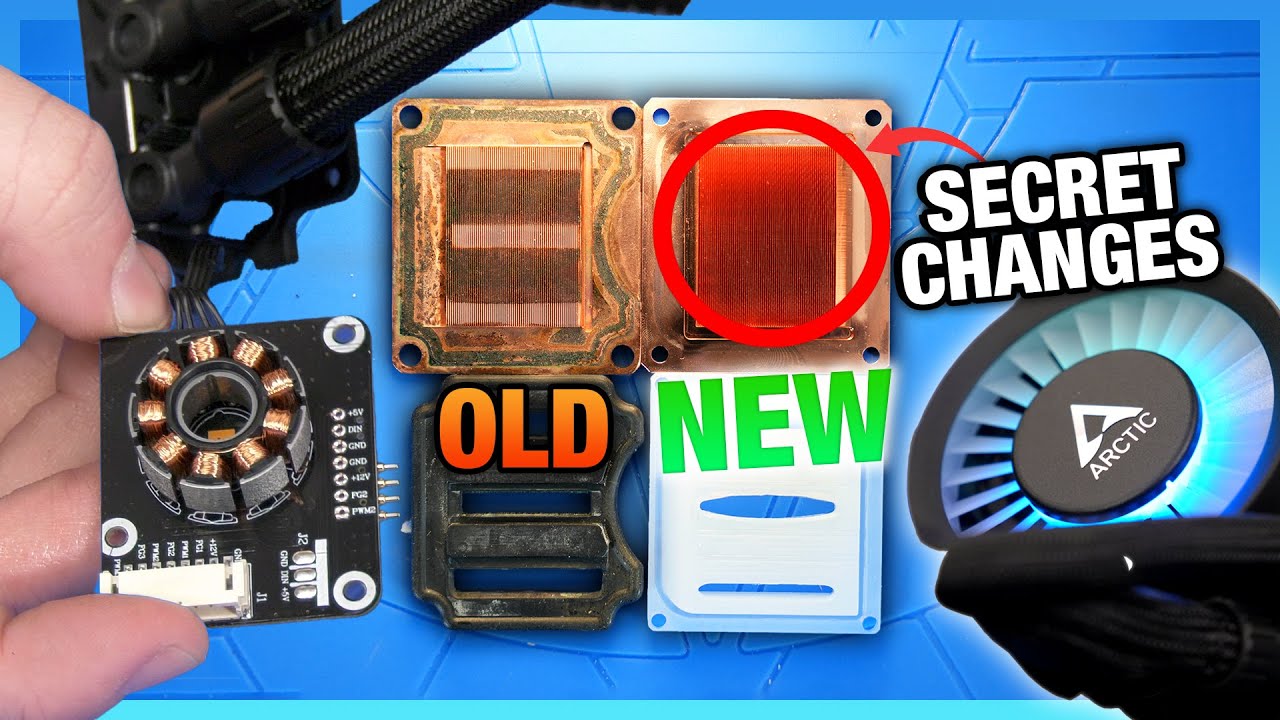
Hidden Changes: Tear-Down of Arctic's Liquid Freezer III CPU Cooler & Disassembly
video description
Date: 2024-02-22
Related videos




Comments and reviews: 19
cppctek
Thank you so much for giving us such great insight on the inter workings of this AIO and many others. No one else is doing things like this, and I absolutely love a good tear down because I like to see how things take and I like to see the nuances between various models to see which one will suit my needs better. I myself a huge Aio fan. No pun intended, although I’ve had several fail over the years because I do quite often push my computers pretty hard but it’s never deter me from buying another AIO. However, I do learn from every failure and I try to find what possibly caused the failure and which one to buy to avoid it happening again in that particular instance. Yesterday when I saw you review this AIO, I was immediately impressed and I saw several things that I liked to see and I ordered one myself.
I do have a question though is there any risk to lapping the cold plate on a AIO versus a water block I’ve done it a few times and I haven’t had any issues per se, but I’m just wondering if there is a chance of deformation. Also, also, if you use a lapped plate on a non lapped cpu is there any harm or risk there as well I typically always lap my CPU and Coldplates plates, but from time to time I need to test a different CPU in that particular test bench that has not been lapped and I’m just wondering if that would either impact the temperature is negatively or put too much pressure on the IHS. Thanks for all your hard work. You guys are absolutely amazing and I continue to thank you for all the years of inspiration and education.
reply
Thank you so much for giving us such great insight on the inter workings of this AIO and many others. No one else is doing things like this, and I absolutely love a good tear down because I like to see how things take and I like to see the nuances between various models to see which one will suit my needs better. I myself a huge Aio fan. No pun intended, although I’ve had several fail over the years because I do quite often push my computers pretty hard but it’s never deter me from buying another AIO. However, I do learn from every failure and I try to find what possibly caused the failure and which one to buy to avoid it happening again in that particular instance. Yesterday when I saw you review this AIO, I was immediately impressed and I saw several things that I liked to see and I ordered one myself.
I do have a question though is there any risk to lapping the cold plate on a AIO versus a water block I’ve done it a few times and I haven’t had any issues per se, but I’m just wondering if there is a chance of deformation. Also, also, if you use a lapped plate on a non lapped cpu is there any harm or risk there as well I typically always lap my CPU and Coldplates plates, but from time to time I need to test a different CPU in that particular test bench that has not been lapped and I’m just wondering if that would either impact the temperature is negatively or put too much pressure on the IHS. Thanks for all your hard work. You guys are absolutely amazing and I continue to thank you for all the years of inspiration and education.
reply
victorhughgo2376
Check it out, dude takes it apart.
What I do not like about this particular AIO, this brand, is that it has only two mounting screws, why not four Then there's the issue of installation being more difficult than it needs to be.
Then there's the fact that I have a brand new Noctua NH-D15S on the shelf waiting for my next build. I've had it for about 3 years, it's getting dusty.
So it keeps a CPU a couple degrees cooler than a Corsair, I like Corsair products. Their RGB AIO's are cool.
I've got an H115i Pro RGB, cooling an i7-8700k going on 5 years, never had a problem, current CPU temp is 33 Celsius. I prefer the larger fans, with the 140mm fans you only need two.
The pump cap on that thing is enormous and if the fan fails, your CPU is fk'ed. With the Corsair AIO you don't see that 'tiny fan' that could need replacing in the near or distant future because of dust or for whatever reason. With Corsair AIO's it's all contained in a smaller, less obtrusive tighter package or Block. I've used Corsair AIO's on two builds and I like their products.
this thing looks sketchy to me, regardless of how it performs in 'testing'. Corsair for me is proven, both for reliability and longevity.
My next build will be air cooled, an air cooled i5-13600k. Noctua.
reply
Check it out, dude takes it apart.
What I do not like about this particular AIO, this brand, is that it has only two mounting screws, why not four Then there's the issue of installation being more difficult than it needs to be.
Then there's the fact that I have a brand new Noctua NH-D15S on the shelf waiting for my next build. I've had it for about 3 years, it's getting dusty.
So it keeps a CPU a couple degrees cooler than a Corsair, I like Corsair products. Their RGB AIO's are cool.
I've got an H115i Pro RGB, cooling an i7-8700k going on 5 years, never had a problem, current CPU temp is 33 Celsius. I prefer the larger fans, with the 140mm fans you only need two.
The pump cap on that thing is enormous and if the fan fails, your CPU is fk'ed. With the Corsair AIO you don't see that 'tiny fan' that could need replacing in the near or distant future because of dust or for whatever reason. With Corsair AIO's it's all contained in a smaller, less obtrusive tighter package or Block. I've used Corsair AIO's on two builds and I like their products.
this thing looks sketchy to me, regardless of how it performs in 'testing'. Corsair for me is proven, both for reliability and longevity.
My next build will be air cooled, an air cooled i5-13600k. Noctua.
reply
Hulkeq2
The idea, with electronics in general is to phase out moving parts not introduce more. For the amount of extra cooling this gives it's not worth adding more complexity and more points of failure. In air cooling the fan is the only moving bit, with water cooling quite a few more get introduced. JTMAX is real, you don't need to be at 50 celsius for a processor to have a good long life. Just like jay's 2 cent suddenly realising out of the blue what every engineer has known his whole life ane making a spectacle of himself making fans turn with compressors, one day desktop users will take the time to read the datasheets provided with their electronic components.
Turning a system that should be running in a stable state with minimal maintenance and user interaction required into a quasi permanent laboratory experiment is not a positive evolution.
reply
The idea, with electronics in general is to phase out moving parts not introduce more. For the amount of extra cooling this gives it's not worth adding more complexity and more points of failure. In air cooling the fan is the only moving bit, with water cooling quite a few more get introduced. JTMAX is real, you don't need to be at 50 celsius for a processor to have a good long life. Just like jay's 2 cent suddenly realising out of the blue what every engineer has known his whole life ane making a spectacle of himself making fans turn with compressors, one day desktop users will take the time to read the datasheets provided with their electronic components.
Turning a system that should be running in a stable state with minimal maintenance and user interaction required into a quasi permanent laboratory experiment is not a positive evolution.
reply
Kromaatikse
On the topic of the motor design, this appears to be a 9-pole brushless DC type - the rotor will incorporate a corresponding multipole permanent magnet for the stator coils to interact with. The 9-pole design, which should give nice smooth torque, and it may well be related to the new fan motors which Arctic have recently introduced, which additionally have smooth driving waveforms for each coil (rather than just turning them hard on and off). You might find some interesting similarities if you tear down a P14 MAX to expose the motor. Suffice it to say that Arctic know what they're doing with propeller-law motors, and can implement their ideas effectively, even at the modest end of the price range.
reply
On the topic of the motor design, this appears to be a 9-pole brushless DC type - the rotor will incorporate a corresponding multipole permanent magnet for the stator coils to interact with. The 9-pole design, which should give nice smooth torque, and it may well be related to the new fan motors which Arctic have recently introduced, which additionally have smooth driving waveforms for each coil (rather than just turning them hard on and off). You might find some interesting similarities if you tear down a P14 MAX to expose the motor. Suffice it to say that Arctic know what they're doing with propeller-law motors, and can implement their ideas effectively, even at the modest end of the price range.
reply
Surms41
Looks extremely well made!
I always wondered why companies always use such small fins, when taller fins definitely make performance better. I like the addition of VRM fan.
Getting better, but air is still king imo. Only thing to fail is you dropping it, bending it all up, and fan failure. And of course, a lot of liquid coolers forget VRM needs cooling.
As for hardware DLC, there's a bad way and a good way. The good way is all cosmetic, and the bad, if they leave out the hardware that makes or breaks it.
A better route would be completely modular, like selling an after-market cold-plate with different performance levels, etc. So you could upgrade it later with a thicccc micro-fin design.
reply
Looks extremely well made!
I always wondered why companies always use such small fins, when taller fins definitely make performance better. I like the addition of VRM fan.
Getting better, but air is still king imo. Only thing to fail is you dropping it, bending it all up, and fan failure. And of course, a lot of liquid coolers forget VRM needs cooling.
As for hardware DLC, there's a bad way and a good way. The good way is all cosmetic, and the bad, if they leave out the hardware that makes or breaks it.
A better route would be completely modular, like selling an after-market cold-plate with different performance levels, etc. So you could upgrade it later with a thicccc micro-fin design.
reply
Sandriell
I am honestly surprised there is not existing cabling and support built in to swap out the VRM fan assembly with one that has an LCD on the top. Though maybe it will have a swap one day, and it will simply have it's own separate PCB, so the LCD is entirely stand-alone. You call it DLC, but I think it would be the better what to do it. Those that don't want the LCD and cost that goes with it, don't have to get it, and those that do, can buy the upgrade separately.
Also good for Arctic as they don't have to maintain even more product lines (all the variations with and without it) and instead just have one LCD upgrade that can be swapped onto any of the LF3's.
reply
I am honestly surprised there is not existing cabling and support built in to swap out the VRM fan assembly with one that has an LCD on the top. Though maybe it will have a swap one day, and it will simply have it's own separate PCB, so the LCD is entirely stand-alone. You call it DLC, but I think it would be the better what to do it. Those that don't want the LCD and cost that goes with it, don't have to get it, and those that do, can buy the upgrade separately.
Also good for Arctic as they don't have to maintain even more product lines (all the variations with and without it) and instead just have one LCD upgrade that can be swapped onto any of the LF3's.
reply
stennan
Actually, I ordered a 280 unit just now when they have their birthday sale on their site. I had some issues with payment and left them a message along with a modest amount of praise for how they handled Gunk-gate proactively.
Companies aren't your friends and the products need to stand on their own merits. But I think we as enthusiasts can influence companies with both the whip and the carrot. I also left a suggestion that they might want to look why the Intel results don't match the AMD. Kitguru actually has the Freezer III 360 second to last on the Intel 300W test. It might be an issue with mounting pressure or cold plate GN observed.
reply
Actually, I ordered a 280 unit just now when they have their birthday sale on their site. I had some issues with payment and left them a message along with a modest amount of praise for how they handled Gunk-gate proactively.
Companies aren't your friends and the products need to stand on their own merits. But I think we as enthusiasts can influence companies with both the whip and the carrot. I also left a suggestion that they might want to look why the Intel results don't match the AMD. Kitguru actually has the Freezer III 360 second to last on the Intel 300W test. It might be an issue with mounting pressure or cold plate GN observed.
reply
dikbozo
arctic strikes again. I imagine the standard 6 year warranty applies to this. I have made a claim against it and they do indeed back up their products. I broke the clip in my air cooler and they asked for photos of it and then shipped the replacement to me at no cost. From the very detailed tear down above, Steve, we can see a meticulous attention to detail at work. I agree the cap is likely to be monetized in such a way that who knows, perhaps a second fan could be mounted there. Certainly RGB bling and possibly one of those mini displays for the terminally spendthrift among us.
reply
arctic strikes again. I imagine the standard 6 year warranty applies to this. I have made a claim against it and they do indeed back up their products. I broke the clip in my air cooler and they asked for photos of it and then shipped the replacement to me at no cost. From the very detailed tear down above, Steve, we can see a meticulous attention to detail at work. I agree the cap is likely to be monetized in such a way that who knows, perhaps a second fan could be mounted there. Certainly RGB bling and possibly one of those mini displays for the terminally spendthrift among us.
reply
Zarcondeegrissom
I was sort of thinking, why can't they make the micro-fin area larger to cover all of the IHS instead of forcing an offset mount to get 'some' dies centered on some CPUs. the spring-sheet aside, the AMD mount Looks great for the 5950X yet a bit hit or miss for single-chip things like the 8700G.
I'm sort of thinking something like the Arctic Cooling Freezer 64 Pro may be better for AMD APUs, if the pipes can handle the TDP. (edit: oh, that also predates 4-pin PWM fans, so you will have to swap out the fan, that will be fun with how it's mounted to the cooler, lol)
reply
I was sort of thinking, why can't they make the micro-fin area larger to cover all of the IHS instead of forcing an offset mount to get 'some' dies centered on some CPUs. the spring-sheet aside, the AMD mount Looks great for the 5950X yet a bit hit or miss for single-chip things like the 8700G.
I'm sort of thinking something like the Arctic Cooling Freezer 64 Pro may be better for AMD APUs, if the pipes can handle the TDP. (edit: oh, that also predates 4-pin PWM fans, so you will have to swap out the fan, that will be fun with how it's mounted to the cooler, lol)
reply
botagasss
I recall buying Arctic Liquid Freezer 2 based on your reviews and the price. That was for my Ryzen 3 1200. It has also served well a Ryzen 7 2700 and now I own a Ryzen 7 5800X3D, and that cooler still manages it magnificently, at pretty much no noise whatsoever!
Only after I became older did I realize how much I appreciate the quietness of the cooler, to the point that the only thing that makes sound within my case is the GPU, which is absolutely awful.
Arctic really deserves more love because they seem to really care about their products.
reply
I recall buying Arctic Liquid Freezer 2 based on your reviews and the price. That was for my Ryzen 3 1200. It has also served well a Ryzen 7 2700 and now I own a Ryzen 7 5800X3D, and that cooler still manages it magnificently, at pretty much no noise whatsoever!
Only after I became older did I realize how much I appreciate the quietness of the cooler, to the point that the only thing that makes sound within my case is the GPU, which is absolutely awful.
Arctic really deserves more love because they seem to really care about their products.
reply
illi-the-wolf
Great teardown and review folks - thorough as always!
Maybe it's just parallax, but it seems that the new cooler has roughly as many fins, though slightly thinner than the previous gen If the relative fin density is the same, but the fins are thinner, this would make the gaps between fins wider, thus increasing fluid flow and decreasing drag between fins. Making the fins taller would offset - and probably improve - any losses of heat capacity due to thinner fins. But Im sure a laser scan to compare them would tell for sure _
reply
Great teardown and review folks - thorough as always!
Maybe it's just parallax, but it seems that the new cooler has roughly as many fins, though slightly thinner than the previous gen If the relative fin density is the same, but the fins are thinner, this would make the gaps between fins wider, thus increasing fluid flow and decreasing drag between fins. Making the fins taller would offset - and probably improve - any losses of heat capacity due to thinner fins. But Im sure a laser scan to compare them would tell for sure _
reply
EmDzei
AIO's copper plate is almost square. Is the disk enough to cover Intel's long processors You would have had the opportunity to adjust this in your video. Another thing that I didn't see in the video or that you didn't present, i.e. which way are the copper plate heatsinks facing, are they in the direction of flow in relation to the Intel CPU (longitudinal direction) or does the liquid flow from the long side to the other long side, i.e. the shortest distance (crosswise). This layout must also be important for cooling.
reply
AIO's copper plate is almost square. Is the disk enough to cover Intel's long processors You would have had the opportunity to adjust this in your video. Another thing that I didn't see in the video or that you didn't present, i.e. which way are the copper plate heatsinks facing, are they in the direction of flow in relation to the Intel CPU (longitudinal direction) or does the liquid flow from the long side to the other long side, i.e. the shortest distance (crosswise). This layout must also be important for cooling.
reply
AndreasA.S.
the impeller is the rotor of the motor, has to be metal. the stator coil windings in their new build is much better than the apparent old sloppyness of LF2, hope they stick to that quality, as it looks like it should have some more torque. the build looks so damn good, id build it like this if i had the tools.
we need this kind of air cooling solution, these 2foot tall noctua needs to go back to the 90s, i own one and it works great , but its larger than my 4070 dual. i want the new arctic but dont need it.
reply
the impeller is the rotor of the motor, has to be metal. the stator coil windings in their new build is much better than the apparent old sloppyness of LF2, hope they stick to that quality, as it looks like it should have some more torque. the build looks so damn good, id build it like this if i had the tools.
we need this kind of air cooling solution, these 2foot tall noctua needs to go back to the 90s, i own one and it works great , but its larger than my 4070 dual. i want the new arctic but dont need it.
reply
kz360
How is surface contact pattern and pressure impacted by thermal distortion from assymetries in cooler internal geometry, heat transfer variations, cooling flow, variable heat load from cpu, etc Is it possible that perfectly flat at room temp may not be best case during operating conditions Perhaps perfectly flat at operating temperatures is the better goal to improve cooling effectiveness and something to verify. Can you test for that with simulated cooling loop heat load or simulated cpu heat load
reply
How is surface contact pattern and pressure impacted by thermal distortion from assymetries in cooler internal geometry, heat transfer variations, cooling flow, variable heat load from cpu, etc Is it possible that perfectly flat at room temp may not be best case during operating conditions Perhaps perfectly flat at operating temperatures is the better goal to improve cooling effectiveness and something to verify. Can you test for that with simulated cooling loop heat load or simulated cpu heat load
reply
MattMills91
I know you appreciate accuracy so very minor correction Steve. In the VRM fan section you said that it was a squirrel cage fan, however it is not. A squirrel cage fan would draw air in centrally and expel outwards thru centrifugal motion. This funny name is derived from the appearance of the impeller, resembling the exercise wheel found in hamster cages.
Now I'm going to have to let you down because, even tho this is Fanuary, I don't know what exact type of fan this is
reply
I know you appreciate accuracy so very minor correction Steve. In the VRM fan section you said that it was a squirrel cage fan, however it is not. A squirrel cage fan would draw air in centrally and expel outwards thru centrifugal motion. This funny name is derived from the appearance of the impeller, resembling the exercise wheel found in hamster cages.
Now I'm going to have to let you down because, even tho this is Fanuary, I don't know what exact type of fan this is
reply
bluephreakr
The other great thing about this hardware being held together with screws rather than glue if you can find _pieces_ of it or buy a few bum units with different issues, you can _in theory_ be able to piecemeal your own unit together. Its always going to be more economical time-wise to buy _new_ rather than used old stock but provided Arctic is selling their own pieces to go with it, you can piece together your own unit like one would a Framework-branded laptop.
reply
The other great thing about this hardware being held together with screws rather than glue if you can find _pieces_ of it or buy a few bum units with different issues, you can _in theory_ be able to piecemeal your own unit together. Its always going to be more economical time-wise to buy _new_ rather than used old stock but provided Arctic is selling their own pieces to go with it, you can piece together your own unit like one would a Framework-branded laptop.
reply
flyingtam
Great review! Thank you. I've used AIO's for years now, and to tell the truth, I just replace them every 3-5 years or if I see a big degrade in cooling performance. It would be great to see a video on maintaining an AIO- how to see a potential failure, how to replace components, and most importantly, how to service or refill the coolant. I know every AIO will be different, but major components should be about the same (fan, pump, hoses, etc).
reply
Great review! Thank you. I've used AIO's for years now, and to tell the truth, I just replace them every 3-5 years or if I see a big degrade in cooling performance. It would be great to see a video on maintaining an AIO- how to see a potential failure, how to replace components, and most importantly, how to service or refill the coolant. I know every AIO will be different, but major components should be about the same (fan, pump, hoses, etc).
reply
shanewalker6451
i like the over all design of this all in one cooler but still needs a built in fill port on radiator which is easy to do for manufacture by installing threads and use a o-ringed plug and screw into radiator. then it would truly be a true rebuildable unit by end user. i am curious to see if lapping the cold plate on the side that contacts cpu if it increases contact pressure's on cpu and how much it would improve performance.
reply
i like the over all design of this all in one cooler but still needs a built in fill port on radiator which is easy to do for manufacture by installing threads and use a o-ringed plug and screw into radiator. then it would truly be a true rebuildable unit by end user. i am curious to see if lapping the cold plate on the side that contacts cpu if it increases contact pressure's on cpu and how much it would improve performance.
reply
PAPO1990
The easily swappable top may be less about DLC and more about optimising manufacturing of multiple SKU's. If they only have 1 production line for the main part of the cooler, and just slap on an RGB or non-RGB, or maybe even LCD cap at the end, it reduces the cost and complexity of having multiple SKU's. They may have also had a bunch of RMA's of the VRM fans dying on the old ones so it was worth it to make it easy to fix.
reply
The easily swappable top may be less about DLC and more about optimising manufacturing of multiple SKU's. If they only have 1 production line for the main part of the cooler, and just slap on an RGB or non-RGB, or maybe even LCD cap at the end, it reduces the cost and complexity of having multiple SKU's. They may have also had a bunch of RMA's of the VRM fans dying on the old ones so it was worth it to make it easy to fix.
reply
Add a review, comment
Other channel videos