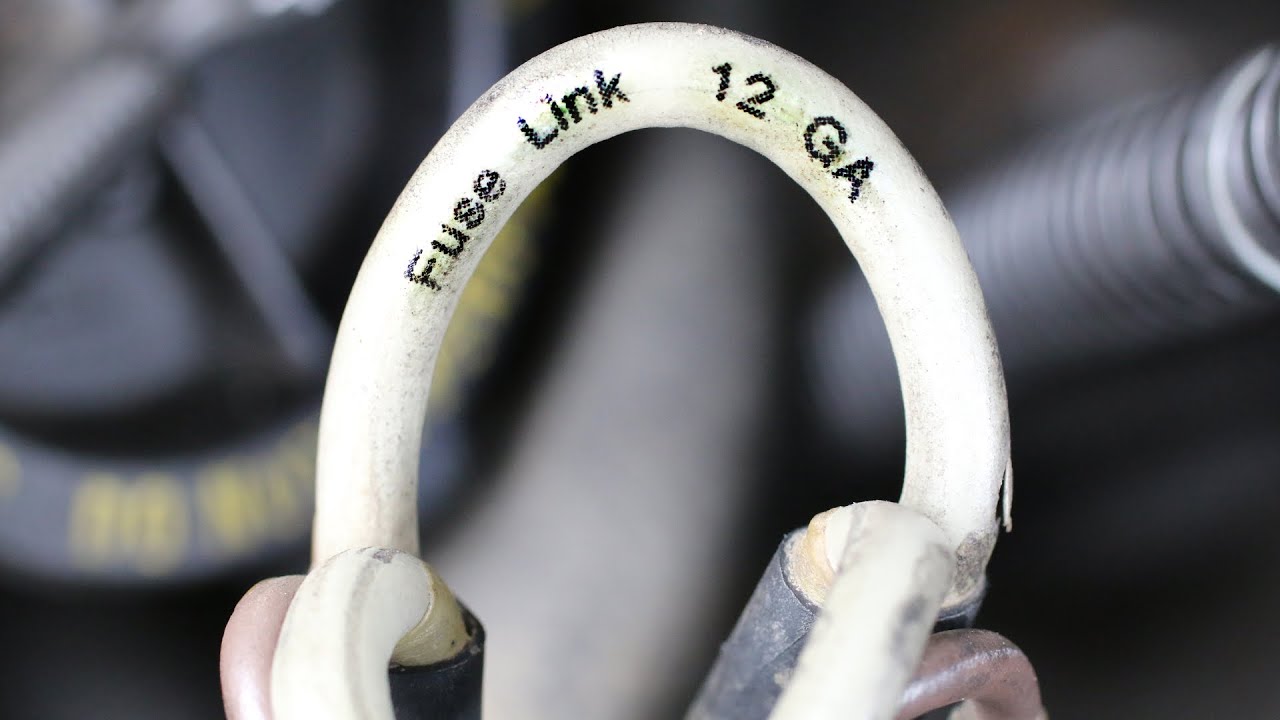
How to Replace a Fusible Link (Car won't Start)
video description
Date: 2021-02-01
Related videos


Comments and reviews: 10
Steve
No disrespect intended but your video shows some bad practices. You mention that the solder job you did doesn't look pretty but it also looks cold which means not effective. Fortunately you did show how a proper hot solder joint should look. On this same subject though, the reason solid core wire is not used in anything which moves, car, boat, plane, etc, is that solid wire will break from vibration. A solder joint makes flexible stranded wire into solid core wire. I was taught by a Marine electrician that a better connection in cars and boats, etc, is to use a proper crimping tool to make a crimp connection to join wires/connectors so they are less vulnerable to breaking at the joint.
Also when you used heat shrink you put it over electrical tape on one end instead of extending it all the way past the electrical tape to the wire insulation itself. Electrical tape, while insulating, is not waterproof. Wire insulation serves 2 purposes. One is to insulate the wire from grounding out against metal and the other is to protect the wire from moisture which causes corrosion. to accomplish this though the any break in the insulation has to be covered with heat shrink which has glue inside to waterproof the break. This includes any connectors at the ends of wires. I always use marine grade heat shrink which has epoxy glue/sealer inside. When you use this over clean insulation it actually glues the heat shrink to the wire insulation making a waterproof seal which will stand up to being submerged in seawater so obviously this makes a car wiring connection pretty bulletproof against corrosion. Ideally you want to make the insulation, using marine heat shrink, waterproof continuously from metal end connector to metal end connector so that the wire can't corrode since no moisture can get to the wire itself. I have stripped insulation back on copper wire to find it black 2, 3, 4 feet up the wire from corrosion because it travels up the wire from the ends where it's not sealed. Using tinned marine wire makes this type of corrosion even less of a possibility but marine wire is more expensive.
I always like to fix it once so that the problem can't reoccur.
Just my 2 cents.
reply
No disrespect intended but your video shows some bad practices. You mention that the solder job you did doesn't look pretty but it also looks cold which means not effective. Fortunately you did show how a proper hot solder joint should look. On this same subject though, the reason solid core wire is not used in anything which moves, car, boat, plane, etc, is that solid wire will break from vibration. A solder joint makes flexible stranded wire into solid core wire. I was taught by a Marine electrician that a better connection in cars and boats, etc, is to use a proper crimping tool to make a crimp connection to join wires/connectors so they are less vulnerable to breaking at the joint.
Also when you used heat shrink you put it over electrical tape on one end instead of extending it all the way past the electrical tape to the wire insulation itself. Electrical tape, while insulating, is not waterproof. Wire insulation serves 2 purposes. One is to insulate the wire from grounding out against metal and the other is to protect the wire from moisture which causes corrosion. to accomplish this though the any break in the insulation has to be covered with heat shrink which has glue inside to waterproof the break. This includes any connectors at the ends of wires. I always use marine grade heat shrink which has epoxy glue/sealer inside. When you use this over clean insulation it actually glues the heat shrink to the wire insulation making a waterproof seal which will stand up to being submerged in seawater so obviously this makes a car wiring connection pretty bulletproof against corrosion. Ideally you want to make the insulation, using marine heat shrink, waterproof continuously from metal end connector to metal end connector so that the wire can't corrode since no moisture can get to the wire itself. I have stripped insulation back on copper wire to find it black 2, 3, 4 feet up the wire from corrosion because it travels up the wire from the ends where it's not sealed. Using tinned marine wire makes this type of corrosion even less of a possibility but marine wire is more expensive.
I always like to fix it once so that the problem can't reoccur.
Just my 2 cents.
reply
John
Mr. Fix, please add a small can of resin to your toolbox. If your are soldering a thick section of wires (or joining two wires together at their ends) apply a small amount of resin, with a plastic bristle brush, to the wire(s) before soldering. This will help the solder flow through the wires better. Also, use a soldering gun, and not a soldering iron. Soldering irons are for 18 awg or smaller wire. Guns can get too hot for the wires insulation, use clip on heat sinks commonly called rheostats. Happy soldering! Remember it hurts a lot to get the soldering gun too close to your fingers. :)
reply
Mr. Fix, please add a small can of resin to your toolbox. If your are soldering a thick section of wires (or joining two wires together at their ends) apply a small amount of resin, with a plastic bristle brush, to the wire(s) before soldering. This will help the solder flow through the wires better. Also, use a soldering gun, and not a soldering iron. Soldering irons are for 18 awg or smaller wire. Guns can get too hot for the wires insulation, use clip on heat sinks commonly called rheostats. Happy soldering! Remember it hurts a lot to get the soldering gun too close to your fingers. :)
reply
Thomas
You know a lot about fixing cars. Thanks for the videos. When you are soldering, like you say, keep the heat on the wires and not the solder. but youd do better to keep your heat on the wires after your solder melts. That way it wicks up under the insulation and the joint is 100x stronger at least. lots of flux helps.
Building a few hundred nav harnesses for jet aircraft helps too. Haha 5 miles of wire in an airplane bro.
reply
You know a lot about fixing cars. Thanks for the videos. When you are soldering, like you say, keep the heat on the wires and not the solder. but youd do better to keep your heat on the wires after your solder melts. That way it wicks up under the insulation and the joint is 100x stronger at least. lots of flux helps.
Building a few hundred nav harnesses for jet aircraft helps too. Haha 5 miles of wire in an airplane bro.
reply
Dylan
Does your 50 amp fuse break as well and have to replace?
This is the same thing my truck is having problems with but wont crank.
Have to keep replacing my 50 amp fuse every time and when I do my dash lights up but when I go to crank it the same thing happens it goes dark and seems like its the battery.
New battery new starter put in recently.
reply
Does your 50 amp fuse break as well and have to replace?
This is the same thing my truck is having problems with but wont crank.
Have to keep replacing my 50 amp fuse every time and when I do my dash lights up but when I go to crank it the same thing happens it goes dark and seems like its the battery.
New battery new starter put in recently.
reply
Michael
All right so I have a 1985 Monte Carlo SS and I am a new beginner on fixing my car and so I forgot to disconnect the battery when I was putting in a brand new starter and the little red wire that connects to my starter made a little zap and I dont know if it was that or what but no lights or no nothing will turn on help is much appreciated
reply
All right so I have a 1985 Monte Carlo SS and I am a new beginner on fixing my car and so I forgot to disconnect the battery when I was putting in a brand new starter and the little red wire that connects to my starter made a little zap and I dont know if it was that or what but no lights or no nothing will turn on help is much appreciated
reply
RunV5
You should never solder a fusible link, even a professional solder can increase resistance and actually make the fuse blow out at a higher rating then what it should, for ex a 15A link might not blow until 16A or more due to the increased resistance which would then fry anything that fuse is protecting
reply
You should never solder a fusible link, even a professional solder can increase resistance and actually make the fuse blow out at a higher rating then what it should, for ex a 15A link might not blow until 16A or more due to the increased resistance which would then fry anything that fuse is protecting
reply
Ron
Dear Chris, Can you eliminate the fusible links and instead wire them to mega fuses. I have an Auxillary fusebox out of a 1997 Monte Carlo. It has 4 mega fuse places in it. I want to update my 95 Buick Century's wiring so that is why I am asking the question.
reply
Dear Chris, Can you eliminate the fusible links and instead wire them to mega fuses. I have an Auxillary fusebox out of a 1997 Monte Carlo. It has 4 mega fuse places in it. I want to update my 95 Buick Century's wiring so that is why I am asking the question.
reply
Llia
Are these wires the same as the Fuse links in the fuse panel? They look like a box with the wire inside and a clear cover on top that say 30A, 40A and are different colors. Could you swap a fuse link wire with a plug in style fuse link?
reply
Are these wires the same as the Fuse links in the fuse panel? They look like a box with the wire inside and a clear cover on top that say 30A, 40A and are different colors. Could you swap a fuse link wire with a plug in style fuse link?
reply
theysrone
This might be the exact issue for my 2004 Ford Expedition Eddie Bauer. Your description of how the car acts with the fusible link disengaged, is exactly what I'm experiencing. Thanks Chris Fix. I'll let you know if it works out!
reply
This might be the exact issue for my 2004 Ford Expedition Eddie Bauer. Your description of how the car acts with the fusible link disengaged, is exactly what I'm experiencing. Thanks Chris Fix. I'll let you know if it works out!
reply
Bob
After I solder the wires, I use a pair of pliers and go round the connection and flatten all the stray wires so they are smooth and do not poke thru the shrink tubing. I want to prevent it from shorting out again.
reply
After I solder the wires, I use a pair of pliers and go round the connection and flatten all the stray wires so they are smooth and do not poke thru the shrink tubing. I want to prevent it from shorting out again.
reply
Add a review, comment
Other channel videos