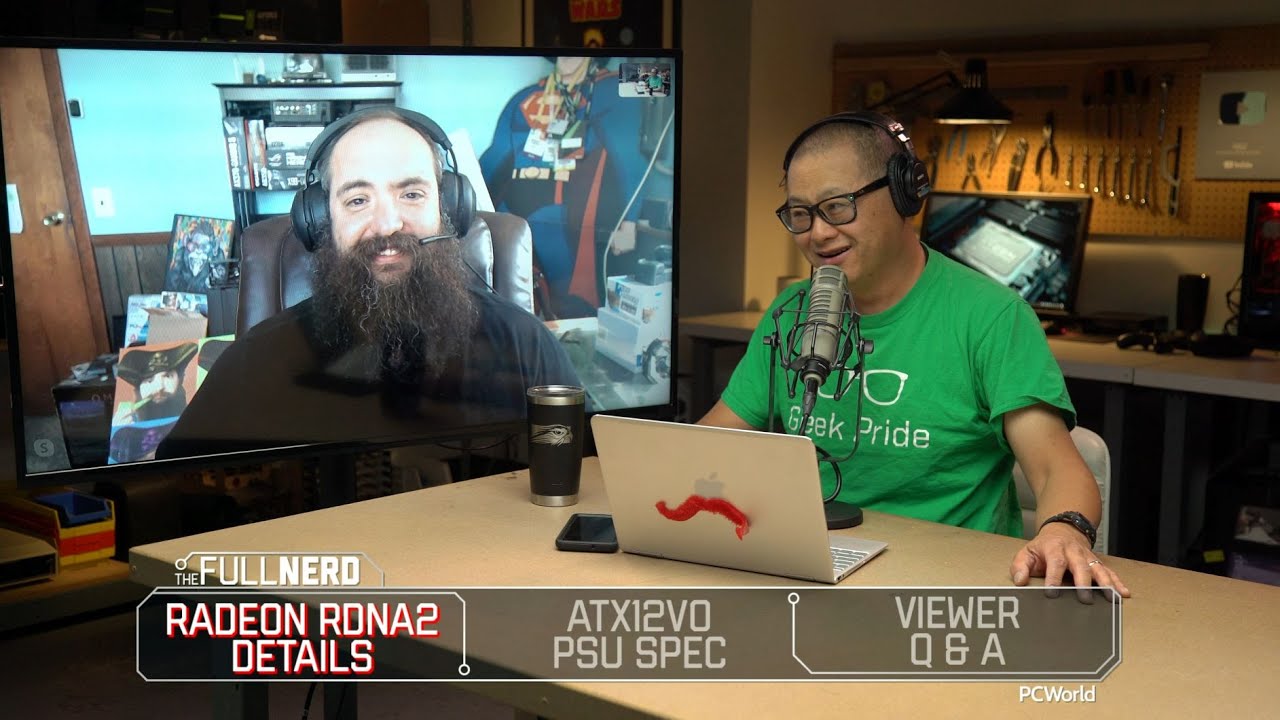
Radeon RDNA2 details, ATX12VO PSU spec, Q&A - The Full Nerd ep. 128
video description
Date: 2022-03-15
Related videos


Comments and reviews: 10
TheDarthTux
-15: 15, Not that I have any kind of information or anything but my gut tells me AMD aren't going to get rid of rapid packed math. There are applications for it in gaming that were exploited in the PS4 and it was mentions at I believe E3 or Computex last year (may be even at CES this year, whenever AMD unveiled that massive roll out of laptops using Ryzen 3000 APU laptops and I tihnk it was the CEO at ASUS brought up the topic of Rapid Packed Math with excitement. And in fact Navi does carry over support for rapid-packed math from Vega, with AMD citing half-precision or FP16 performance of up to 19. 5 TFLOPS on the RX 5700XT.
Also you do need lower level compute for ray tracing. Ray tracing, based on my professional background using algorithms in compute tasks, is ultimately in the realms of a k-d tree search algorithm when it comes to the BVH traversal. You really don't want to be doing that with FP32 precision, it will generate WAY too much unnecessary data and require more memory and data movement. You already need a ton of cache to store the BVH data. Also remember that AMD's shaders/CU are multi-purpose and they specifically said when Turing launched that they didn't believe Nvidia's ASIC approach was optimal since having specific CUs doing specific compute tasks was a waste of space on the chip and when not ray tracing or upscaling, the RT-cores and Tensor cores lay idle.
When we also look at AMD's ray tracing patent from last year, assuming that is anything to go by, it is more likely that AMD will use multi-purpose CUs with larger cache for ray tracing. What is likely is that the CDNA cards will have amongst other things, much more CUs and cache, be much bigger, packed with infinity fabric support for multi-GPU over PCIe and use more power. CDNA will essentially be packed with a lot of features in MI60 and MI50 that were stripped out of the Radeon VII. The data centre thing was also sort of obscured because Lisa Su repeatedly mentioned cloud gaming in the same section of her presentations as she spoke about CDNA. What we may have here is the Zen 2 Ryzen vs Threadripper analogy brought to the Radeon side of AMD. Vega being Zen1 and RDNA 1. 0 being Zen 1+
We also should keep in mind that the 7nm was clarified as TSMC's updated nomenclature that covers all their 7nm nodes. This was clarified by Lisa Su during the Q&A at the end of the 3hrs of presentations. She did not say where it was 7nm, enhanced 7nm, or the EUV 7nm+ all she said was that what they did in the slides was to align their road map charts to TSMC's nomenclature. Presumably, RDNA 2X and CDNA will both be on 7nm+ as in the previous road maps.
reply
-15: 15, Not that I have any kind of information or anything but my gut tells me AMD aren't going to get rid of rapid packed math. There are applications for it in gaming that were exploited in the PS4 and it was mentions at I believe E3 or Computex last year (may be even at CES this year, whenever AMD unveiled that massive roll out of laptops using Ryzen 3000 APU laptops and I tihnk it was the CEO at ASUS brought up the topic of Rapid Packed Math with excitement. And in fact Navi does carry over support for rapid-packed math from Vega, with AMD citing half-precision or FP16 performance of up to 19. 5 TFLOPS on the RX 5700XT.
Also you do need lower level compute for ray tracing. Ray tracing, based on my professional background using algorithms in compute tasks, is ultimately in the realms of a k-d tree search algorithm when it comes to the BVH traversal. You really don't want to be doing that with FP32 precision, it will generate WAY too much unnecessary data and require more memory and data movement. You already need a ton of cache to store the BVH data. Also remember that AMD's shaders/CU are multi-purpose and they specifically said when Turing launched that they didn't believe Nvidia's ASIC approach was optimal since having specific CUs doing specific compute tasks was a waste of space on the chip and when not ray tracing or upscaling, the RT-cores and Tensor cores lay idle.
When we also look at AMD's ray tracing patent from last year, assuming that is anything to go by, it is more likely that AMD will use multi-purpose CUs with larger cache for ray tracing. What is likely is that the CDNA cards will have amongst other things, much more CUs and cache, be much bigger, packed with infinity fabric support for multi-GPU over PCIe and use more power. CDNA will essentially be packed with a lot of features in MI60 and MI50 that were stripped out of the Radeon VII. The data centre thing was also sort of obscured because Lisa Su repeatedly mentioned cloud gaming in the same section of her presentations as she spoke about CDNA. What we may have here is the Zen 2 Ryzen vs Threadripper analogy brought to the Radeon side of AMD. Vega being Zen1 and RDNA 1. 0 being Zen 1+
We also should keep in mind that the 7nm was clarified as TSMC's updated nomenclature that covers all their 7nm nodes. This was clarified by Lisa Su during the Q&A at the end of the 3hrs of presentations. She did not say where it was 7nm, enhanced 7nm, or the EUV 7nm+ all she said was that what they did in the slides was to align their road map charts to TSMC's nomenclature. Presumably, RDNA 2X and CDNA will both be on 7nm+ as in the previous road maps.
reply
itech
I don-t know what was said is entirely accurate about dx12 dxr and rt api. If api are the end all be all then there is no need for new hardware. Both RDNA2 and ampere or next gen Nvidia are two different architecture. GPU in its basic form are gloried math crunching hardwares. Gtx 1080 has a more efficient architecture then gcn Radeon 7. This leads me to my point that is developers will having access to low level api on consoles to better optimize for that architecture more so then the will have on Nvidia. That optimization that happens on console RDNA2 will translate very well to RDNA2 pc GPU. How much of that will developers spend on pc to optimize for Nvidia architecture vs letting Microsoft DXR API do the heavy lifting to get the game release in its unoptimizable form and possibly release patches/driver down the road to better optimize it later. I still say AMD is in a better position as it will be a unified architecture on all fronts.
reply
I don-t know what was said is entirely accurate about dx12 dxr and rt api. If api are the end all be all then there is no need for new hardware. Both RDNA2 and ampere or next gen Nvidia are two different architecture. GPU in its basic form are gloried math crunching hardwares. Gtx 1080 has a more efficient architecture then gcn Radeon 7. This leads me to my point that is developers will having access to low level api on consoles to better optimize for that architecture more so then the will have on Nvidia. That optimization that happens on console RDNA2 will translate very well to RDNA2 pc GPU. How much of that will developers spend on pc to optimize for Nvidia architecture vs letting Microsoft DXR API do the heavy lifting to get the game release in its unoptimizable form and possibly release patches/driver down the road to better optimize it later. I still say AMD is in a better position as it will be a unified architecture on all fronts.
reply
Lexie
it was navi 1x, 2x etc. I would guess thats denoting Navi 10, Navi 20 etc like RDNA 2 will be used for the Navi 20 or 2X cards. Perhaps needed to denote a difference now where it was assumed Navi 20 would be -Big Navi- as part of the same gen/architecture as Navi 10. Internal codenames will never not be confusing and weird.
I also stand by the assumption that by the time it matters whether or not you chose between RT or not with a 2080 or a 1080ti. every one of both owners will be on a 4080 or an AMD competitor and RT will be a different beast post consoles, ergo the argument will never have actually mattered and never will. I bought a 1080ti, it needed to be RMAd and I was sent a 2080. I still haven't actually used RT beyond a quick look and I won't until I'm still getting 1440p144fps with it on.
reply
it was navi 1x, 2x etc. I would guess thats denoting Navi 10, Navi 20 etc like RDNA 2 will be used for the Navi 20 or 2X cards. Perhaps needed to denote a difference now where it was assumed Navi 20 would be -Big Navi- as part of the same gen/architecture as Navi 10. Internal codenames will never not be confusing and weird.
I also stand by the assumption that by the time it matters whether or not you chose between RT or not with a 2080 or a 1080ti. every one of both owners will be on a 4080 or an AMD competitor and RT will be a different beast post consoles, ergo the argument will never have actually mattered and never will. I bought a 1080ti, it needed to be RMAd and I was sent a 2080. I still haven't actually used RT beyond a quick look and I won't until I'm still getting 1440p144fps with it on.
reply
Anthony
I'm not sure about moving 5V/3. 3V to the motherboard, especially on ITX where it's already cramped. 2 buck converters, 4 associated input/output capacitors, SATA power connectors, that's not a small amount of space. Maybe they make all SATA ports horizontal standard and stack the data and power connectors vertically.
If they could move SATA power and data to the same connector by double-siding it with pins, that would be better, but EMI could be a problem. In the OEM space, they just may skip the 3. 3V SATA power line, and only provide say 1 SATA data/power connector on mobo and move all the base storage to M. 2
reply
I'm not sure about moving 5V/3. 3V to the motherboard, especially on ITX where it's already cramped. 2 buck converters, 4 associated input/output capacitors, SATA power connectors, that's not a small amount of space. Maybe they make all SATA ports horizontal standard and stack the data and power connectors vertically.
If they could move SATA power and data to the same connector by double-siding it with pins, that would be better, but EMI could be a problem. In the OEM space, they just may skip the 3. 3V SATA power line, and only provide say 1 SATA data/power connector on mobo and move all the base storage to M. 2
reply
boria0
1080ti will go down as one of the best and 2080 as one of the worst. Although performance is pretty much identical 2080 at launch costed 100 to 150 more for an fe card vs 1080ti board partners card. And the idea that anyone futureproofed by buying 2080 is ridiculous. Even now there are hardly any games with ray tracing and 2080 can barely play them. By the time new titles come out 2080 will be too weak to do 1080p with ray tracing so no different to 1080ti but for extra cost. I just hope nobody wasted their money following Gordon's advice. -
reply
1080ti will go down as one of the best and 2080 as one of the worst. Although performance is pretty much identical 2080 at launch costed 100 to 150 more for an fe card vs 1080ti board partners card. And the idea that anyone futureproofed by buying 2080 is ridiculous. Even now there are hardly any games with ray tracing and 2080 can barely play them. By the time new titles come out 2080 will be too weak to do 1080p with ray tracing so no different to 1080ti but for extra cost. I just hope nobody wasted their money following Gordon's advice. -
reply
William
The lack of uplift for the 2000 series is the reason I'm still sitting on a GTX 970. I was planning to skip a generation, then upgrade, but if I had wanted to spend $400 on a 1080 level graphics card, I would have bought a 1080 or 1070Ti a year before they released the RTX 2070. I still have a 1080p monitor and mostly play older games, so I just decided to wait. I'll look for the best bang for the buck $300-500 card and then get the best bang for the buck 1440p monitor and get them both at the same time.
reply
The lack of uplift for the 2000 series is the reason I'm still sitting on a GTX 970. I was planning to skip a generation, then upgrade, but if I had wanted to spend $400 on a 1080 level graphics card, I would have bought a 1080 or 1070Ti a year before they released the RTX 2070. I still have a 1080p monitor and mostly play older games, so I just decided to wait. I'll look for the best bang for the buck $300-500 card and then get the best bang for the buck 1440p monitor and get them both at the same time.
reply
Oscar
Gordon or Brad. Whatever happened to AMD's Project Skybridge? Hybrid x86/ARM CPU for the datacenter sharing the same socket. It appeared to be far along, in design at least, but it was killed like a year after it was announced, and nobody seemed to even notice. Was it intentionally killed? Did Apple buy up patents? Native legacy x86 support, but also native ARM apps as they became available. It seemed to be the perfect transitional platform.
reply
Gordon or Brad. Whatever happened to AMD's Project Skybridge? Hybrid x86/ARM CPU for the datacenter sharing the same socket. It appeared to be far along, in design at least, but it was killed like a year after it was announced, and nobody seemed to even notice. Was it intentionally killed? Did Apple buy up patents? Native legacy x86 support, but also native ARM apps as they became available. It seemed to be the perfect transitional platform.
reply
Freckled
Pro tip on Omelets and eggs at home. Omelets and eggs don't have great taste because of the lower quality of eggs. Go to whole foods by the most expensive pack of free range eggs and do a taste test. It's rather large difference in taste between high quality free range eggs and the generic white eggs. The yolks are almost orange or golden on a free range egg versus a light yellow from a mass produced white egg.
reply
Pro tip on Omelets and eggs at home. Omelets and eggs don't have great taste because of the lower quality of eggs. Go to whole foods by the most expensive pack of free range eggs and do a taste test. It's rather large difference in taste between high quality free range eggs and the generic white eggs. The yolks are almost orange or golden on a free range egg versus a light yellow from a mass produced white egg.
reply
Watto
Prices will decrease for PSUs but increase for motherboards because they will have to add more tech to compensate. The saving money argument is misleading.
And good luck at trying to get Intel, AMD and Microsoft to sit down together to work out a new PSU system; they can't even agree on a universal RGB format!
reply
Prices will decrease for PSUs but increase for motherboards because they will have to add more tech to compensate. The saving money argument is misleading.
And good luck at trying to get Intel, AMD and Microsoft to sit down together to work out a new PSU system; they can't even agree on a universal RGB format!
reply
PE4Doers
Gordon - RAID-0 with multiple drives will both increase SATA throughput and chain them together into one contiguous drive. I am working on highlighting that in my next video by adding a second WD Blue SATA SSD 1TB, with the exact same drive I have in the same editing rig (as my source scratch.
reply
Gordon - RAID-0 with multiple drives will both increase SATA throughput and chain them together into one contiguous drive. I am working on highlighting that in my next video by adding a second WD Blue SATA SSD 1TB, with the exact same drive I have in the same editing rig (as my source scratch.
reply
Add a review, comment
Other channel videos