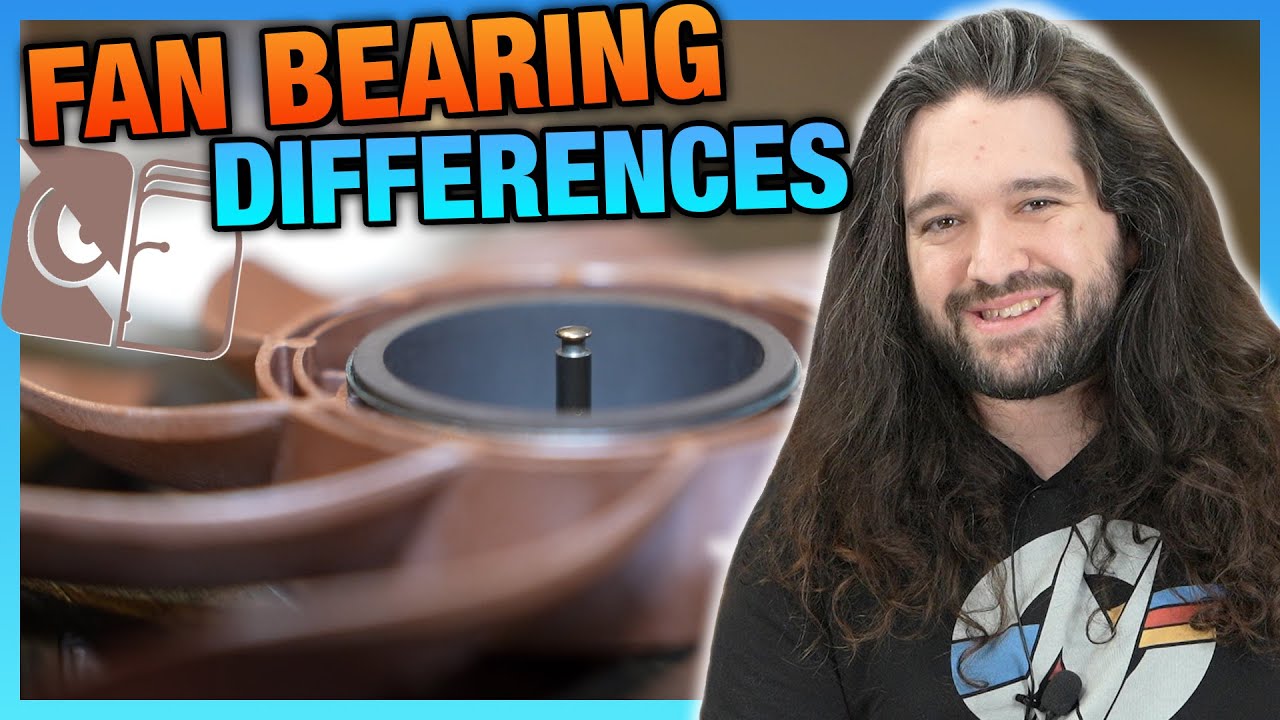
Fan Bearing Differences: Fluid Dynamic, Ball, Hydro Dynamic, & Sleeve Explained, ft. Noctua
video description
Date: 2024-06-28
Related videos


Comments and reviews: 20
blahorgaslisk7763
as an old computer technician I have a few preferences when it comes to bearings in fans. Magnetic levitation is the king of bearings. With no mechanical contact at all at full speed these will live a long time. Dual ball bearings is the next. Noisy buggers but with a long life. FDB bearings are a step above simple sleeve bearings. Now I have to say I have worked the most with serve grade hardware, and things like bearing noise is not something you think of. And fan speeds are high. I damaged my hearing just by the sound of fans in servers, so I'm not joking about not caring about noise.
About ball bearings. Some manufacturers fake the bearings a bit by using one ball bearing and one sleeve bearing. Those fans will have a lifetime that's limited by the sleeve bearing. Once that is worn out it's game over and you have to replace the fan. So make sure the fan has dual ball bearings, that is two ball bearings, not two balls in the bearing...
Magnetic levitation bearings are the least common, but theoretically they should not wear out. Now the truth is that it still happens. Usually it happens if the fan get real dirty over a long times use. They tend to loose the balance and then bad shit happens to the surfaces in the bearings. As they aren't supposed to have to rub against each other they tend to wear quickly when that happens.
At one time four 120mm fans blew up in a server. If I remember correctly they were made by Nidec. Usually these were real good, but it seems an entire batch of their fans had a manufacturing fault. So remember that fans are mechanical products and some times they will break. Keeping them clean is a good way to increase the chance that the fans will keep working for a long time.
FDB fans is a thing I haven't worked a lot with. They simply doesn't exists in the server world. Not the perfect truth, but close to it. And sleeve bearings you just won't see in a server, ever. Something interesting is that FDB fans used to have a lower time to failure rating than ball bearings. But that has changed over the years and now fans with fluid dynamic bearings tend to top most if not all ball bearings fans. Still fans with FDB are not something you see in servers.
The first fans with magnetic levitation bearings I encountered I think was manufactured by Sunon. I remember they had a demonstration video to inform their customers about these bearings. From what I remember they had a LED that was powered by a lead that wiped the shaft in the fan, the power was supplied to the metallic bore of the bearing. When the fan was still the shaft would touch the bore and the LED would light up. But as soon as the fan started moving it would ride the magnetic fields and levitate in the middle of the bore and there were no mechanical contact between the shaft and the bore and the LED would go dark. I just tried to find that video and it seems Sunon has taken it down, so no video to show...
reply
as an old computer technician I have a few preferences when it comes to bearings in fans. Magnetic levitation is the king of bearings. With no mechanical contact at all at full speed these will live a long time. Dual ball bearings is the next. Noisy buggers but with a long life. FDB bearings are a step above simple sleeve bearings. Now I have to say I have worked the most with serve grade hardware, and things like bearing noise is not something you think of. And fan speeds are high. I damaged my hearing just by the sound of fans in servers, so I'm not joking about not caring about noise.
About ball bearings. Some manufacturers fake the bearings a bit by using one ball bearing and one sleeve bearing. Those fans will have a lifetime that's limited by the sleeve bearing. Once that is worn out it's game over and you have to replace the fan. So make sure the fan has dual ball bearings, that is two ball bearings, not two balls in the bearing...
Magnetic levitation bearings are the least common, but theoretically they should not wear out. Now the truth is that it still happens. Usually it happens if the fan get real dirty over a long times use. They tend to loose the balance and then bad shit happens to the surfaces in the bearings. As they aren't supposed to have to rub against each other they tend to wear quickly when that happens.
At one time four 120mm fans blew up in a server. If I remember correctly they were made by Nidec. Usually these were real good, but it seems an entire batch of their fans had a manufacturing fault. So remember that fans are mechanical products and some times they will break. Keeping them clean is a good way to increase the chance that the fans will keep working for a long time.
FDB fans is a thing I haven't worked a lot with. They simply doesn't exists in the server world. Not the perfect truth, but close to it. And sleeve bearings you just won't see in a server, ever. Something interesting is that FDB fans used to have a lower time to failure rating than ball bearings. But that has changed over the years and now fans with fluid dynamic bearings tend to top most if not all ball bearings fans. Still fans with FDB are not something you see in servers.
The first fans with magnetic levitation bearings I encountered I think was manufactured by Sunon. I remember they had a demonstration video to inform their customers about these bearings. From what I remember they had a LED that was powered by a lead that wiped the shaft in the fan, the power was supplied to the metallic bore of the bearing. When the fan was still the shaft would touch the bore and the LED would light up. But as soon as the fan started moving it would ride the magnetic fields and levitate in the middle of the bore and there were no mechanical contact between the shaft and the bore and the LED would go dark. I just tried to find that video and it seems Sunon has taken it down, so no video to show...
reply
alphaomega154
i just found out that the most PRO EARTH fan bearing type is the SLEEVE BEARING. no im not talking about the guy who prefer to save cats over humans, no, but one of the most cheapest fan bearing in the market.
i have an old chromebook type of mobile device that come with that type of fan. and after 13 years, i just find out that the 13 years old fan dont really need to be replaced when its start to acting up and wont ramping up in rpm. all i need to do is to open the tiny laptop up, and open the casing that encages the fan turbine, and i realize i could remove the rotor/turbine simply by pulling it out. so smooth. and cleaning up the rotor shaft, and adding a tiny single drop of sewing machine oil into the bearing slot and put it back in, and i just drop nearly 40 degrees and function like new. a THIRTEEN YEARS OLD SLEEVE BEARING FAN.
for those who care about the planet, this is the type of fan you want. so you dont have to make unnecessary E WASTE.
(i dont hold any candle lit for those who prefer its MY PLEASURE FIRST! type of human)
reply
i just found out that the most PRO EARTH fan bearing type is the SLEEVE BEARING. no im not talking about the guy who prefer to save cats over humans, no, but one of the most cheapest fan bearing in the market.
i have an old chromebook type of mobile device that come with that type of fan. and after 13 years, i just find out that the 13 years old fan dont really need to be replaced when its start to acting up and wont ramping up in rpm. all i need to do is to open the tiny laptop up, and open the casing that encages the fan turbine, and i realize i could remove the rotor/turbine simply by pulling it out. so smooth. and cleaning up the rotor shaft, and adding a tiny single drop of sewing machine oil into the bearing slot and put it back in, and i just drop nearly 40 degrees and function like new. a THIRTEEN YEARS OLD SLEEVE BEARING FAN.
for those who care about the planet, this is the type of fan you want. so you dont have to make unnecessary E WASTE.
(i dont hold any candle lit for those who prefer its MY PLEASURE FIRST! type of human)
reply
gamersnexus
The thing i want from feature fans is to either sonwhow get rid of the usual 4 hub holder(lines) or actualy double them up so they can become thinner and then at the same time reverse the fan blade so they are easier to clean, is you do this whe holder (line) can be so thin the suction eeffect may so insignificant both performance and acoustically-wise, or do the craziest thing and add 4 small motors in each of the 4 sides/corners of the fan to spin the blades (which will have a flat-like cicle cap around then like some new Arctic ines do), that way you can lock the fan blades in such way you don need a center motor anymore so you can reduce the cycle-like center of the fan by a lot significantly amd it so much easier to clean, what i am not sure about tis design is the noise and possible RPM target, i think there was a company man many years ago who made such types of fans now that i remmber it but they didn't get enough attention for some reason.
reply
The thing i want from feature fans is to either sonwhow get rid of the usual 4 hub holder(lines) or actualy double them up so they can become thinner and then at the same time reverse the fan blade so they are easier to clean, is you do this whe holder (line) can be so thin the suction eeffect may so insignificant both performance and acoustically-wise, or do the craziest thing and add 4 small motors in each of the 4 sides/corners of the fan to spin the blades (which will have a flat-like cicle cap around then like some new Arctic ines do), that way you can lock the fan blades in such way you don need a center motor anymore so you can reduce the cycle-like center of the fan by a lot significantly amd it so much easier to clean, what i am not sure about tis design is the noise and possible RPM target, i think there was a company man many years ago who made such types of fans now that i remmber it but they didn't get enough attention for some reason.
reply
enlightendbel
I have several fans that have been in use for over 2 decades and they still do fine.
But I seem to be one of those rare people that actually fully cleans and does maintenance on his systems every 2-3 months.
For most people, including me, the bearings going bad isn't the limiter to a fans life.
A fan taking a chunk of your finger and loosing a piece or a whole blade in the process seems to be the primary reason for their life to end.
I still have and use a Antec Ninehundred.
They were famous for having a 200mm top fan.
I've had to replace that top fan 4 times over the years because it lost blades on the regular, twice all on its own and twice from some finger biting action.
I replaced it with a Noctua model and haven't had a single blade break since (have had even bigger chunks of meat being extracted from my fingers though.)
reply
I have several fans that have been in use for over 2 decades and they still do fine.
But I seem to be one of those rare people that actually fully cleans and does maintenance on his systems every 2-3 months.
For most people, including me, the bearings going bad isn't the limiter to a fans life.
A fan taking a chunk of your finger and loosing a piece or a whole blade in the process seems to be the primary reason for their life to end.
I still have and use a Antec Ninehundred.
They were famous for having a 200mm top fan.
I've had to replace that top fan 4 times over the years because it lost blades on the regular, twice all on its own and twice from some finger biting action.
I replaced it with a Noctua model and haven't had a single blade break since (have had even bigger chunks of meat being extracted from my fingers though.)
reply
phillee2814
What about Maglev bearings
Ball and other types of rollers all pump the lubricant in the bearing around in circles, but are inherently lower friction (so cooler running), as you can easily tell if you drag a book across your desk then repeat the task but with round pencils between book and desk. But they tend to last a shorter length of time. Plain/sleeve bearings or bushes (grooved or otherwise) depend entirely on the quality of the seals for their durability. The plain bearing can be made to outdo rolling types on the load capacity, and normally do in automotive use, but it requires the lubricant to be pumped to high pressure. Maglev are just two magnets facing each other NN or SS, so that they repel each other (no good for hard disks). No friction at all, no contact even at rest, so no wear.
reply
What about Maglev bearings
Ball and other types of rollers all pump the lubricant in the bearing around in circles, but are inherently lower friction (so cooler running), as you can easily tell if you drag a book across your desk then repeat the task but with round pencils between book and desk. But they tend to last a shorter length of time. Plain/sleeve bearings or bushes (grooved or otherwise) depend entirely on the quality of the seals for their durability. The plain bearing can be made to outdo rolling types on the load capacity, and normally do in automotive use, but it requires the lubricant to be pumped to high pressure. Maglev are just two magnets facing each other NN or SS, so that they repel each other (no good for hard disks). No friction at all, no contact even at rest, so no wear.
reply
CalgarGTX
Great content, sad to say we are lucky to still have companies like Noctua and imo Seasonic on the PSU side, that care about what they are doing in the DYI industry, since the rest is a marketing gimmick clown show of rgb exploding PSUs and rgb headers that burn your house down (but now with 50% more AI in it !)
When the owners of both of these retire and they get in the hands of private equity we are done for.
Corsair used to properly build their products too but from what I'm hearing these past years... not so much anymore.
It's usually a strong indication of quality when you have products with 10 years warranty while everyone else tries to get away with the minimum legally possible duration imo.
reply
Great content, sad to say we are lucky to still have companies like Noctua and imo Seasonic on the PSU side, that care about what they are doing in the DYI industry, since the rest is a marketing gimmick clown show of rgb exploding PSUs and rgb headers that burn your house down (but now with 50% more AI in it !)
When the owners of both of these retire and they get in the hands of private equity we are done for.
Corsair used to properly build their products too but from what I'm hearing these past years... not so much anymore.
It's usually a strong indication of quality when you have products with 10 years warranty while everyone else tries to get away with the minimum legally possible duration imo.
reply
gamersnexus
I love it when i clean fans and the bearings' pole is accessible by fans being removable and i can lubricate it and the holding hole with mechanical oil and mix it up with some lubricant grease at the same time, it usually makes a fan go even faster and makes it so much more silent, i have done this to countless fan for 22 years now it's such a kneet trick since it works so well.
I have many many old fans which still work perfectly because of that for more than a decade, 1 specifically the older i have, i got it back in 2006 (14cm fan) and it still works perfectly because i maintain it like that.
reply
I love it when i clean fans and the bearings' pole is accessible by fans being removable and i can lubricate it and the holding hole with mechanical oil and mix it up with some lubricant grease at the same time, it usually makes a fan go even faster and makes it so much more silent, i have done this to countless fan for 22 years now it's such a kneet trick since it works so well.
I have many many old fans which still work perfectly because of that for more than a decade, 1 specifically the older i have, i got it back in 2006 (14cm fan) and it still works perfectly because i maintain it like that.
reply
wordsandtech
I've always been curious about the bearing differences in Silverstone's AP181 and AP183 180mm fans which have MTBF ratings of 15,000 and 70,000 hours respectively. Silverstone liked to include the AP181's with their cases, and sure enough around that 2 year mark (15,000 hours = 1.7 years), those fans would start rattling and making horrid noises and I'd have to replace them with AP183's.
I think that MTBF spec is good to reference, but the problem is transparency. I had to dig to find that info, and I imagine I wouldn't find it at all for a lot of fans out there.
reply
I've always been curious about the bearing differences in Silverstone's AP181 and AP183 180mm fans which have MTBF ratings of 15,000 and 70,000 hours respectively. Silverstone liked to include the AP181's with their cases, and sure enough around that 2 year mark (15,000 hours = 1.7 years), those fans would start rattling and making horrid noises and I'd have to replace them with AP183's.
I think that MTBF spec is good to reference, but the problem is transparency. I had to dig to find that info, and I imagine I wouldn't find it at all for a lot of fans out there.
reply
FrenziedManbeast
Jakob rocks. I can't tell you how many junk or no-brand fans I've seen shatter or scream bloody murder after short runtime. Money well spent on a company that puts performance and research first. Yeah their fans are expensive, but there's definitely a level of insured trust at work here when you see how just one person obsesses over bearing specs. Well done everyone. Oh and Steve I bet your 200mm exploding fan was that massive Antec...900 or something I believe it was I had the pre usb3.0 version of that bad boy and got lucky by having the dipswitch set to low.
reply
Jakob rocks. I can't tell you how many junk or no-brand fans I've seen shatter or scream bloody murder after short runtime. Money well spent on a company that puts performance and research first. Yeah their fans are expensive, but there's definitely a level of insured trust at work here when you see how just one person obsesses over bearing specs. Well done everyone. Oh and Steve I bet your 200mm exploding fan was that massive Antec...900 or something I believe it was I had the pre usb3.0 version of that bad boy and got lucky by having the dipswitch set to low.
reply
stompreaper
Its telling we can get these discussions with Jakob and by the quiet confident way he talks about the topic and the depth of knowledge shown I naturally now prefer noctua from a fan buying standpoint based on perceived quality without him having to shill for a second. It’s the same with the AMD CPU guys and Tom with ARC GPUs. Engineers who love the area they work in and care about their products can influence me all day.
Big company marketers! Watch and learn how to sell your product! It’s not slap AI on it or more RGB.
reply
Its telling we can get these discussions with Jakob and by the quiet confident way he talks about the topic and the depth of knowledge shown I naturally now prefer noctua from a fan buying standpoint based on perceived quality without him having to shill for a second. It’s the same with the AMD CPU guys and Tom with ARC GPUs. Engineers who love the area they work in and care about their products can influence me all day.
Big company marketers! Watch and learn how to sell your product! It’s not slap AI on it or more RGB.
reply
tyrian869
I can't believe you guys actually made a video about bearings inside of fans. Are you kidding me, It's the least liable component to fail and if people would just know how to hold their fans while they blow them with air to clean the dust off, there's no issue here. I don't understand the point of this video. There's nothing wrong with the fans or the noise they produce or bearings going bad. I mean gosh damn I'd be dead before these bearings go bad, sorry am the only one who thinks this
reply
I can't believe you guys actually made a video about bearings inside of fans. Are you kidding me, It's the least liable component to fail and if people would just know how to hold their fans while they blow them with air to clean the dust off, there's no issue here. I don't understand the point of this video. There's nothing wrong with the fans or the noise they produce or bearings going bad. I mean gosh damn I'd be dead before these bearings go bad, sorry am the only one who thinks this
reply
06stiguy63
Very interesting stuff and very well explained. One thing i would have found great to hear about is why those pesky 40mm (or less) fans from the late 90's and early 2000's on North/Southbridge coolers or gpu's always failed way too early. These things never failed to fail. Even at very low hours. I know these ran way higher rpm than their 80mm counterparts in those day's but still. Were these just too cheap or difficult to manufacture properly at that size
reply
Very interesting stuff and very well explained. One thing i would have found great to hear about is why those pesky 40mm (or less) fans from the late 90's and early 2000's on North/Southbridge coolers or gpu's always failed way too early. These things never failed to fail. Even at very low hours. I know these ran way higher rpm than their 80mm counterparts in those day's but still. Were these just too cheap or difficult to manufacture properly at that size
reply
andrewvirtue5048
I like sleeve bearing because I _know_ it's self-repairable.
The fan on my MSI 2070 super was going out. Weird noises, hard start to spin, start-stop.
Took the plastic cover off the heatsink. Dusted the heat sink. Took the fan apart. Put some grease _(I'm amateur mechanic, had Lucas - Red&Tacky laying around)_ on the fan shaft and in the sleeve.
Better than new, all symptoms gone.
reply
I like sleeve bearing because I _know_ it's self-repairable.
The fan on my MSI 2070 super was going out. Weird noises, hard start to spin, start-stop.
Took the plastic cover off the heatsink. Dusted the heat sink. Took the fan apart. Put some grease _(I'm amateur mechanic, had Lucas - Red&Tacky laying around)_ on the fan shaft and in the sleeve.
Better than new, all symptoms gone.
reply
SteinbergerGPPRo
The thing that's always been a mystery to me is how they makes the seals so effective on FDB bearings. How do you make a nearly watertight seal that doesn't create a bunch of friction in the bearing like that
I'm sure thicker lubricants wouldn't be a problem but some bearing use lubricant closer to the viscosity of machine oil and could easily leak out of even a relatively small crack.
reply
The thing that's always been a mystery to me is how they makes the seals so effective on FDB bearings. How do you make a nearly watertight seal that doesn't create a bunch of friction in the bearing like that
I'm sure thicker lubricants wouldn't be a problem but some bearing use lubricant closer to the viscosity of machine oil and could easily leak out of even a relatively small crack.
reply
Madpegasusmax
Ball bearings , shafts ,bare bone , fluids , this was a difficult topic to Steve go trough without lolling ... this is a interesting topic , I always associated ball bearings to longevity (like the old eternal papst ) but they are noisy . teflon/nylon low speed sleeves fans are quiet , but cannot be neglected , as lubrification dry out and dust on the fins will reduce the life quite fast .
reply
Ball bearings , shafts ,bare bone , fluids , this was a difficult topic to Steve go trough without lolling ... this is a interesting topic , I always associated ball bearings to longevity (like the old eternal papst ) but they are noisy . teflon/nylon low speed sleeves fans are quiet , but cannot be neglected , as lubrification dry out and dust on the fins will reduce the life quite fast .
reply
tarron3237
I think people only care about the noise of fans.
Maybe nowadays surpassed by how they look/RGB.
They should definitely care more about how long they last, without getting overly loud. That would be the technical side. But I'd say almost everyone focuses on the result, not how it's being achieved.
That's not to say it's a boring topic. It is super interesting. Just not for everyone
reply
I think people only care about the noise of fans.
Maybe nowadays surpassed by how they look/RGB.
They should definitely care more about how long they last, without getting overly loud. That would be the technical side. But I'd say almost everyone focuses on the result, not how it's being achieved.
That's not to say it's a boring topic. It is super interesting. Just not for everyone
reply
chaoticwonder3278
I went through this a couple of times and had a question about fan orientation vs bearing type. Are there bearings that perform better when the fan is mounted vertical vs horizontal (hub up) vs horizontal (hub down) Running the same 120mm fans in each of these positions some wear out before others, in my experience. Horizontal (hub up or down) seem to wear out before vertical fans.
reply
I went through this a couple of times and had a question about fan orientation vs bearing type. Are there bearings that perform better when the fan is mounted vertical vs horizontal (hub up) vs horizontal (hub down) Running the same 120mm fans in each of these positions some wear out before others, in my experience. Horizontal (hub up or down) seem to wear out before vertical fans.
reply
paulsaam8937
I greatly appreciate the information that Jakob from Noctua has been providing. And agree that there are scenarios which require special consideration when it comes to either a CPU cooling solution; or a general purpose fan to help move air through the system case. Both of these, are areas where quality of the product, and the reputation of the manufacturer are important factors.
reply
I greatly appreciate the information that Jakob from Noctua has been providing. And agree that there are scenarios which require special consideration when it comes to either a CPU cooling solution; or a general purpose fan to help move air through the system case. Both of these, are areas where quality of the product, and the reputation of the manufacturer are important factors.
reply
giantnanomachine
I really appreciate companies where marketing sells what engineers developed, compared to ones where engineers have to come up with something that somehow, technically, matches what marketing wants to sell. Unfortunately it is hard to distinguish those from an outsider's perspective. Giving access for interviews such as this is definitely a strong positive indication though!
reply
I really appreciate companies where marketing sells what engineers developed, compared to ones where engineers have to come up with something that somehow, technically, matches what marketing wants to sell. Unfortunately it is hard to distinguish those from an outsider's perspective. Giving access for interviews such as this is definitely a strong positive indication though!
reply
KnightOwl23
Strange that the motor industry used ridged edge seals on older cars that where just just called a scroll seals. As the basic principle seems the same for recirculation of oil/fluid why not call the V/Herring bone shaft seals Scroll Bearings. The main issue with the big old seals they would eventually leak due to wear and tolerances due to age.
reply
Strange that the motor industry used ridged edge seals on older cars that where just just called a scroll seals. As the basic principle seems the same for recirculation of oil/fluid why not call the V/Herring bone shaft seals Scroll Bearings. The main issue with the big old seals they would eventually leak due to wear and tolerances due to age.
reply
Add a review, comment
Other channel videos