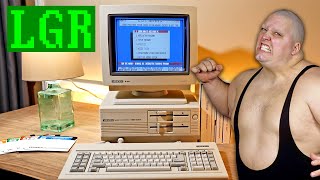
LGR Oddware - Tattooing CD-Rs with Yamaha DiscT-2
video description
Date: 2022-04-14
Related videos



Comments and reviews: 10
Andrew
I still say lightscribe was better. You could use just any CDR but you had to be good at knowing how many hundreds of MBs used how much of the disc. My rule was I always used the last 1/2 inch of the disc for labeling, and never put more than 600 MBs on a disc. If you got it wrong the light scribe process after burning & flipping over the disc would make the disc/file not readable by a drive. But if you got it right it was the best way to label discs. You needed discs with a solid colored label side and didn't etch the label away to mark the brand name etc. That would always screw things up. We always bought discs with writing different color as the bottom of the discs. Or have as few as possible - the edge.
reply
I still say lightscribe was better. You could use just any CDR but you had to be good at knowing how many hundreds of MBs used how much of the disc. My rule was I always used the last 1/2 inch of the disc for labeling, and never put more than 600 MBs on a disc. If you got it wrong the light scribe process after burning & flipping over the disc would make the disc/file not readable by a drive. But if you got it right it was the best way to label discs. You needed discs with a solid colored label side and didn't etch the label away to mark the brand name etc. That would always screw things up. We always bought discs with writing different color as the bottom of the discs. Or have as few as possible - the edge.
reply
bird
That restriction to CD-Rs and not allowing CD-RWs is probably because of the fact that CD-RWs have phase-changing alloys like AgInSbTe that can be written to and then 'erased' by heating them to a certain point. They behave differently from the materials used to make a CD-R of course; which is why CD-RWs have a minimum write speed and need certain temperatures to be written to. It's speculation but those differences would probably lead to a need for a different tattoo-inking process or a tattoo that can be erased, maybe? The former doesn't seem terribly hard to implement and the latter would actually be useful and something the system had over LightScribe so that's probably not it. I'm curious though.
reply
That restriction to CD-Rs and not allowing CD-RWs is probably because of the fact that CD-RWs have phase-changing alloys like AgInSbTe that can be written to and then 'erased' by heating them to a certain point. They behave differently from the materials used to make a CD-R of course; which is why CD-RWs have a minimum write speed and need certain temperatures to be written to. It's speculation but those differences would probably lead to a need for a different tattoo-inking process or a tattoo that can be erased, maybe? The former doesn't seem terribly hard to implement and the latter would actually be useful and something the system had over LightScribe so that's probably not it. I'm curious though.
reply
Fred
I think there might be some niche uses for the disc tattoo. One of them is security by deception; if you put a piece of paper inside a disc case or write in the case, its obvious people will see the password and use it to unlock the disc. However, if its tattooed on the disc, and its readable under just the right level of light, odds are nobody will look there for the password. Of course, good luck trying to tell someone how to find the password, chances are they'll forget and call you. They'll also call you if they can't read it or if its designed so poorly they have no clue where the password starts, whether a character is a letter or number or whether a letter is upper or lowercase.
reply
I think there might be some niche uses for the disc tattoo. One of them is security by deception; if you put a piece of paper inside a disc case or write in the case, its obvious people will see the password and use it to unlock the disc. However, if its tattooed on the disc, and its readable under just the right level of light, odds are nobody will look there for the password. Of course, good luck trying to tell someone how to find the password, chances are they'll forget and call you. They'll also call you if they can't read it or if its designed so poorly they have no clue where the password starts, whether a character is a letter or number or whether a letter is upper or lowercase.
reply
Onyx
I remember around the mid 2000s that I wasn't able to see how much data had been written to CDs anymore. It was around the same time that CD's started failing their data verifications about 75% through. This happened in 3 different drives, using 3 different manufacturers of disks at every burning speed. DVDs and CDRWs were always fine though, and you could clearly see how much of the disk was used as well. It's like they started using weaker burning lasers for CDRs when they started equipping them with DVD capabilities. I never could figure it out.
reply
I remember around the mid 2000s that I wasn't able to see how much data had been written to CDs anymore. It was around the same time that CD's started failing their data verifications about 75% through. This happened in 3 different drives, using 3 different manufacturers of disks at every burning speed. DVDs and CDRWs were always fine though, and you could clearly see how much of the disk was used as well. It's like they started using weaker burning lasers for CDRs when they started equipping them with DVD capabilities. I never could figure it out.
reply
Anton
Nice to see! I have the exact drive on SCSI. Still burn sometimes audio CDs or tattoos. This Yamaha F1 drive is perfect for smooth audio recording with the best quality ever. Its second most reasonable feature. It burns 80 minutes blank CD at 68 minutes max capacity. That means burned pits and graves are a bit longer and smoother at +15% on average. The sound is clearer everywhere and discs lasts longer. Plextor drives had same feature but Yamaha can do it live at 1x speed or much faster than Plextor for better dye compatibility.
reply
Nice to see! I have the exact drive on SCSI. Still burn sometimes audio CDs or tattoos. This Yamaha F1 drive is perfect for smooth audio recording with the best quality ever. Its second most reasonable feature. It burns 80 minutes blank CD at 68 minutes max capacity. That means burned pits and graves are a bit longer and smoother at +15% on average. The sound is clearer everywhere and discs lasts longer. Plextor drives had same feature but Yamaha can do it live at 1x speed or much faster than Plextor for better dye compatibility.
reply
greggv8
One thing this could be useful for is an authentication watermark. Burn a unique pattern onto the disc so if bootleg copies turn up it would be not too difficult to tell. Use the silver discs and people making copies aren't likely to notice the marking.
It would probably show up really well on the old CD-Rs with Cyanine dye and a gold or -gold- reflective layer. Those were dark green.
reply
One thing this could be useful for is an authentication watermark. Burn a unique pattern onto the disc so if bootleg copies turn up it would be not too difficult to tell. Use the silver discs and people making copies aren't likely to notice the marking.
It would probably show up really well on the old CD-Rs with Cyanine dye and a gold or -gold- reflective layer. Those were dark green.
reply
marc
bought the Yamaha F1 SCSI back then, but not for the T-2 but for being the best recording device with the least errors producing at that time and being able to copy on the fly with high speeds. it still works today (but I don't use it regularly anymore of course.
T-2 was for the trash bin as you couldn't use a multi session CD (as you stated.
reply
bought the Yamaha F1 SCSI back then, but not for the T-2 but for being the best recording device with the least errors producing at that time and being able to copy on the fly with high speeds. it still works today (but I don't use it regularly anymore of course.
T-2 was for the trash bin as you couldn't use a multi session CD (as you stated.
reply
Stupha
Future archeologists are going to be all, -Just imagine! This must have been STUNNING technology. It would have been absolutely breathtakingly beautiful at the time, before all the millennia of degradation took their sad toll, and now we're left with this sad, barely visible shit. Where are the snows of yesteryear? -
reply
Future archeologists are going to be all, -Just imagine! This must have been STUNNING technology. It would have been absolutely breathtakingly beautiful at the time, before all the millennia of degradation took their sad toll, and now we're left with this sad, barely visible shit. Where are the snows of yesteryear? -
reply
Valentin
It's believed a certain amount of NEC and Pioneer drives support DiscT-2 as well. I've grabbed one (ND-4551A) and an old version of Nero (6. 1. 1. 4, but there's no option in the misc section. Can anyone confirm any drive beyond CRW-F1 supports it? Or it requires a special version of Nero? If so, a link, please.
reply
It's believed a certain amount of NEC and Pioneer drives support DiscT-2 as well. I've grabbed one (ND-4551A) and an old version of Nero (6. 1. 1. 4, but there's no option in the misc section. Can anyone confirm any drive beyond CRW-F1 supports it? Or it requires a special version of Nero? If so, a link, please.
reply
Sion
I worked in a recording studio back then, I used Verbatim super-Azo discs, and used to put a little logo on people's CDs when they got their preview mixes, and they loved it. IT wasn't well known even back then, and always surprised people. Simple b/w designs showed up quite well on the Super Azo discs, too
reply
I worked in a recording studio back then, I used Verbatim super-Azo discs, and used to put a little logo on people's CDs when they got their preview mixes, and they loved it. IT wasn't well known even back then, and always surprised people. Simple b/w designs showed up quite well on the Super Azo discs, too
reply
Add a review, comment
Other channel videos