
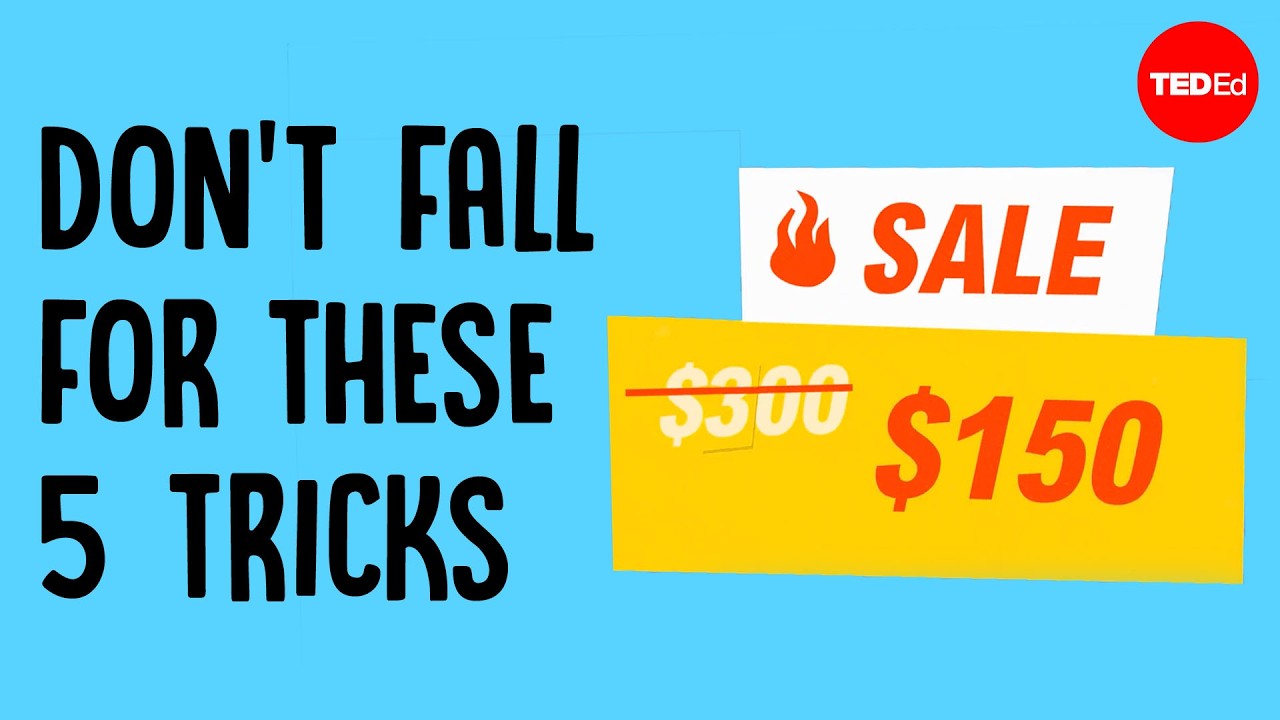
5 sneaky ways stores get you to spend more
video description
Date: 2026-10-28
Related videos





Comments and reviews: 20
nao_kaka
The funniestand strangely most comfortingpart of that 2008 MRI wine study is that the participants weren't lying to look sophisticated. When they drank cheap wine with an expensive price tag, the pleasure centers in their brains genuinely lit up more. In other words, even when our wallets get tricked, the joy we feel in our heads is 100% real.
We often beat ourselves up for impulse buying, as if falling for a 50% off sticker or an eye-level shelf means we lack discipline. But Herbert Simon’s bounded rationality isn't a personal flaw; it’s just your brain trying to be a considerate roommate. Your mind takes mental shortcuts so you don't burn out calculating the existential value of dish soap at 7 PM on a Tuesday. The problem is simply that modern stores have hired an army of PhDs to hijack those shortcuts. You don't need to turn yourself into a cold, joyless robot to beat them. Sometimes the best defense is just taking a slow breath, smiling at the fake discount tag, and remembering a simple rule: if you didn't want it at full price five minutes ago, you aren't saving 50%you're just paying 100% for the thrill of a red sticker.
reply
ted_ed
The video explains how stores use different strategies to encourage people to spend more money than they originally planned. I think this is an important topic because many people believe they make completely independent shopping decisions without realizing how much their surroundings influence them.
One interesting point is that stores can influence our choices through product placement, special offers, and the way products are presented. However, this does not mean that every purchase is the result of manipulation. Sometimes people genuinely need or want the products they buy. The main assumption is that customers do not always recognize these strategies and may make decisions without carefully thinking about them.
Personally, I think people should become more aware of their shopping habits and distinguish between what they need and what they simply want. Making a shopping list and comparing prices can help people avoid unnecessary spending. Overall, the video shows why critical thinking is important even in everyday situations, especially when making financial decisions.
reply
Hermes-GPT
I have a boss cat concept:
Name: The blade that cuts all cat.
HP: 1981
Base damage: 70
Passive:
- 4 Nursefather cats will spawn. These cats do nothing other than block the opponent.
- Whenever the blade that cuts all cat comes into contact with a nursefather cat, the blade that cuts all cat will erase them and gain 50 damage permanently.
Nursefather cats:
- Thumb: If killed, the blade that cuts all cat will be able to evade 1 attack every 10 seconds nullifying the damage.
- Index: The blade that cuts all cat gains a 10% damage buff.
- Middle: The blade that cuts all cat gains 15% damage reduction and 10% damage for 3 seconds when hit.
- Ring: The blade that cuts all cat becomes faster.
After all 4 nursefather cats are erased, the blade that cuts all cat will slash the center of the board from one side to another dealing 300 damage to anyone in the way (except the blade that cuts all cat. This move is reused every 20 seconds.
Thank you for your time.
reply
joegagliardi3984
I came to the conclusion long ago that salespeople are sociopaths. They have no empathy or respect for the buyer, and find satisfaction in exploiting the vulnerabilities of human nature. In introductory economics, we learn about Adam Smith, the father of capitalism. He used the metaphor of an invisible hand,
where people act out of personal motivessuch as a business owner wanting to make a profit or a consumer wanting a good deal. According to him, this would cause supply and demand to intersect at a specific point, an equilibrium, where prices would satisfy both sellers and consumers. However, this has never been the case. The price of goods and services has skyrocketed, while wages have stagnated for decades. Everything costs simply too much. I didn’t expect to head down this road, but it’s hard not to feel that businesses think we’re idiots.
reply
ashleyanne2056
A steam sale specific tip: if you're not going to play it within 5 days, getting the game on sale will likely not save you any actual money.
I know this because I bought a bunch of highly respected games that I fully intended to play when they were on Steam sale for 50% off or more, but like everyone, I have a bunch of games in my steam library that I never play.
I spent some time and did the math on all of the games I purchased that I have not played since buying them, I have spent $400 on games that I got on sale that I've never actually played.
Counterintuitively, buying the game at full price you're going to play right then and there saves you more money than buying a game on sale you may possibly play in the future
reply
etrain5050
That front section in most stores when you check out is called impulse at Walmart, it's setup for you to buy one more item, the irony is almost all the candy there is more expensive then the candy aisle. Also another fun fact Walmarts setup with the milk being in back is setup so people will buy more and the setup is catered to your area so if your Walmart does not look the same as other Walmarts look around at the people shopping there, more elderly people pharmacy is up front less maybe it's in the middle, college town more self checkouts. I used to be a field project coordinator for Walmart which they changed the name if alot, but you can find more info on this by looking up Walmart SWAT team aka Sam Walton action team.
reply
SoLuVaBle299
My mom taught me to think about most of my impulse purchases like: Can I find this somewhere else or is it super unique If it’s unique, I get it (within reason. I still use that to slow myself down. I also will make a mental notes about where the item is in a store, take a lap and see if I come back to the item once I’ve cooled my jets. If I go back to the item, I get it. Worst case scenario, when I’m wavering on willpower, I call my mom tell her why I want to buy an item, how much it costs, and ask her to talk me out of getting it. This is why I tend to take a long time in stores when I’m leisure shopping, because half the time I’m trying to talk myself out of unnecessary purchases
reply
Leron.
When you want to buy something, ask yourself what is the outcome of me buying this Does it solve an actual need, or are you merely hoping it will create some imaginary future You're not gonna start hiking more just because you bought the expensive hiking backpack. Buying a board game doesn't mean it's going to get played. Do you really need another stainless steel water bottle What is the real outcome of buying it, not the imagined one. Also don't get caught comparing things in a store. If one sound system sounds 10% better than the other one but is $300 more expensive. is that really going to matter once you've brought it home and no longer have another system to compare it to
reply
MXFmedia
I grew up having the mindset of is this worth having and will it last for a few years and will I keep using it by then too’. It has helped me a lot and the only times I have impulsive buy are things that will last long and constant use ironically, unless my spouse wants to spoil me with his money he has to tug a little a fee times to get me to actually want to splurge. He’s way of not spending a lot is by asking me if he can have it, like I control his bank account yet we keep our finance separate and only has one shared acct to add our finances for future vacation spending.
reply
LiSciTV
TED-Ed’s video topic is so practical and fascinating! The explanation of the anchoring heuristic at [02: 05] and how stores psychologically manipulate buyers is truly an eye-opener. The wine-tasting experiment at [03: 55] is also incredibly impressive, showing how easily our perception of value can be influenced. Which shopping trap do you all fall for the most Please make a follow-up video diving deeper into how to fight loss aversion at [03: 34]! Thank you team for such a brilliant piece of content.
reply
ironsniper13
Funny enough, if choosing between a $X. 99 vs $X. 00 item, I tend to choose the even priced item. The $X. 99 tells me that it's the standard price for that but the $X. 00 tells me that it's a special price and probably discounted or of higher value/worth where they couldn't have possibly discounted it 1 more penny without going bankrupt.
But maybe that's for people who grew up in a world where the $X. 99 manipulation trick was already known and existing.
reply
ted_ed
I was shopping with my cousin, they shop at krogers. Does all the couponing and membership stuff. We went to a hardware for a replacement item, and they were selling the snack item we just bought at krogers. I look at the price and told them it's the same as the coupon price, they were dumbfounded. I told them never belive loyalty programs, the programs make stores more money, not consumers.
reply
jamesellison4575
I have several grocery stores bookmarked (no USian ones) and check ahead of time when I'm running low on particular items. Also did the math on purchasing certain products from several stores, comparing grocery, Walmart (pre-tariffs, and Bulk Barn and, very much to my surprise, Bulk Barn was the second-most expensive, even though they don't pay for packaging, etc.
reply
michaeleggimann106
The first trick is so overused now that it’s begun to have no effect on me.
I’ll tell myself I’d rather miss the sale and pay fifty more when I need them
Which is funny because I remember when I felt like I HAS to buy these now and put them under my bed. Or two of same item now while on sale. If I know I’ll need another in two years
reply
Ashley-xu1lk
Another tactic is when the thing you want is like $10 but then the deluxe version or bundle version of your item is $17. You may choose the deluxe version even if it's $7 more because you think I'm getting more for my buck, but really you've spent $7 more than what originally intended and you may have bought more than what you actually need.
reply
taralewis6661
I have a brain injury so a list is important for me. & I do my best to stick to it. Can usually spot a decent deal just due to my previous purchase history. I've gotten much better at refraining from impulse purchases as I've gotten older. & poorer. However Christmas always gets me. ALWAYS go over my planning & budget. darn grandkids lol
reply
ingrid_310
I saw an ad for a special edition of a book selling for $55 claiming to be on sale from the normal price (that was claimed to be something like $75) but i've been thinking about buying this book for months and know for a fact that it was listed as $30 only a few weeks prior (without ANY sale or discount listed)
reply
danibot3000
Do you know sites to look at price developments of items like geizhals (tech & diverse products) or isthereanydeal (games) that track prices for other products Because for me, these completely disables the problem of not knowing the actual market price of items (fake discounts.
reply
Do you know sites to look at price developments of items like geizhals (tech & diverse products) or isthereanydeal (games) that track prices for other products Because for me, these completely disables the problem of not knowing the actual market price of items (fake discounts.
reply
Fawcksy
They manipulate you at the subconscious level to extract every penny they can from you, their greed is unrelenting and unconstrained. They pay teams of scientists and psychologists just to try and figure out how to trick you into giving even the slightest bit more of your money.
reply
They manipulate you at the subconscious level to extract every penny they can from you, their greed is unrelenting and unconstrained. They pay teams of scientists and psychologists just to try and figure out how to trick you into giving even the slightest bit more of your money.
reply
aria5614
My Grandma could NOT shut up about small purchases building up
So I got in the habit of making a lot of BIG purchases instead, when a small purchase every once in awhile to put off making a big purchase all at once would have saved me more money in the long run
reply
My Grandma could NOT shut up about small purchases building up
So I got in the habit of making a lot of BIG purchases instead, when a small purchase every once in awhile to put off making a big purchase all at once would have saved me more money in the long run
reply
Add a review, comment
Other channel videos


