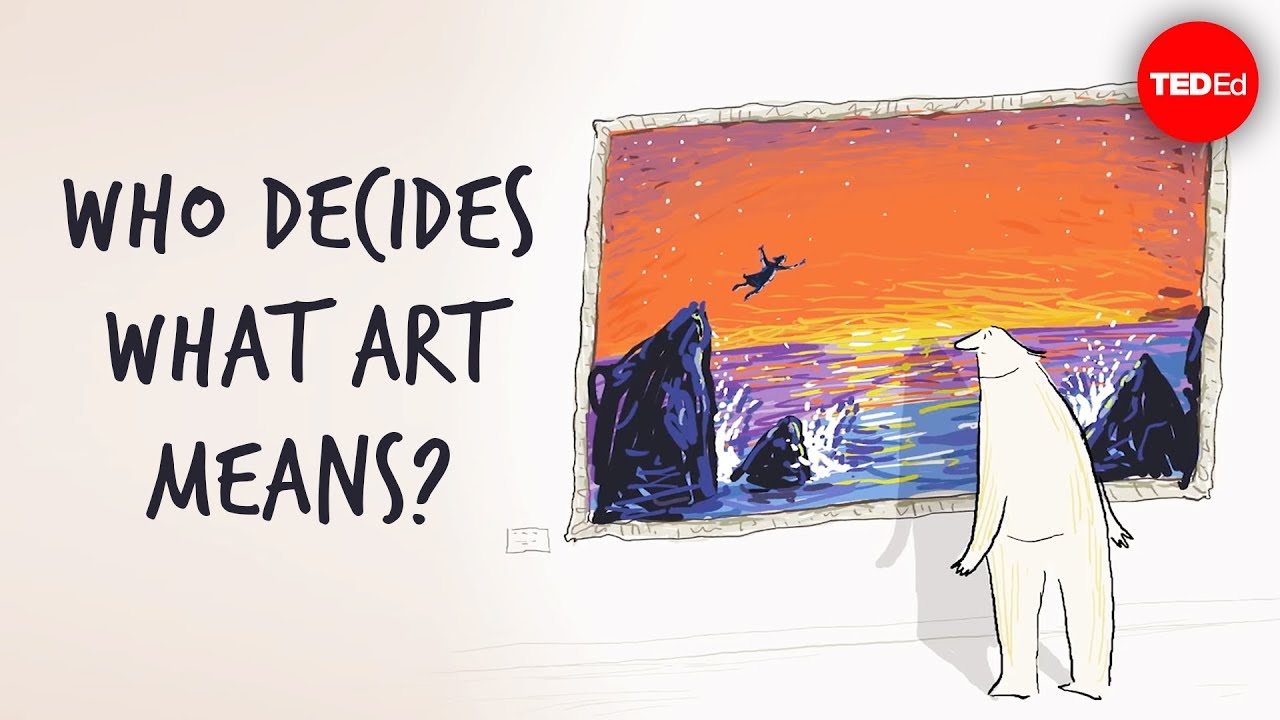
Who decides what art means? - Hayley Levitt
video description
Date: 2020-08-22
Related videos




Comments and reviews: 9
James
To my way of thinking, to say that the artist's intentions are the only possible interpretation of something is not only restrictive (and somewhat oblique because we simply can't know for certain, we're grasping for the impossible, it's also an oversimplified comfort. A childish indulgence of a kind. It gives an artwork stable meaning (I. e. it says that the artwork means. because the artist meant it to be this way. We get a pleasure from that approach. The approach is similar to the pleasure we get from Christian ideology about a god who can tell us what is right and what is wrong. It removes grey areas, ambiguities and spectrum which make us uncomfortable and makes things clear cut. We humans only feel safe in the realm of the graspable, the clearly defined. The artist is god approach imprints a complete meaning onto the artwork and onto the world around it. But of course, the real, human world isn't full of meaning. All meaning in life is constructed by humans to help us divide up our days, hours and minutes and to give us a purpose. I work because. I go jogging because. Ultimately though this is a kind of luxury. The world has no meaning in particular, there is no point to life. It's the same with art, to interpret it as having definitive meaning is to severely restrict its possibilities, its available meanings, it cuts the artwork off from the viewer in a certain way, we're not able to give it a meaning personal to ourselves because the meaning has supposedly already been defined by the author. Allowing art to mean something to each and every viewer brings the viewer into the creative process, involves us in the creation of the world of that art piece in the same way that life, having no meaning, must be given it by each and every one of us: only then can life and art properly mean something personal to every one of us. Only then is that meaning, that purpose, that point, personal. Only then is it yours. It puts in greater control.
reply
To my way of thinking, to say that the artist's intentions are the only possible interpretation of something is not only restrictive (and somewhat oblique because we simply can't know for certain, we're grasping for the impossible, it's also an oversimplified comfort. A childish indulgence of a kind. It gives an artwork stable meaning (I. e. it says that the artwork means. because the artist meant it to be this way. We get a pleasure from that approach. The approach is similar to the pleasure we get from Christian ideology about a god who can tell us what is right and what is wrong. It removes grey areas, ambiguities and spectrum which make us uncomfortable and makes things clear cut. We humans only feel safe in the realm of the graspable, the clearly defined. The artist is god approach imprints a complete meaning onto the artwork and onto the world around it. But of course, the real, human world isn't full of meaning. All meaning in life is constructed by humans to help us divide up our days, hours and minutes and to give us a purpose. I work because. I go jogging because. Ultimately though this is a kind of luxury. The world has no meaning in particular, there is no point to life. It's the same with art, to interpret it as having definitive meaning is to severely restrict its possibilities, its available meanings, it cuts the artwork off from the viewer in a certain way, we're not able to give it a meaning personal to ourselves because the meaning has supposedly already been defined by the author. Allowing art to mean something to each and every viewer brings the viewer into the creative process, involves us in the creation of the world of that art piece in the same way that life, having no meaning, must be given it by each and every one of us: only then can life and art properly mean something personal to every one of us. Only then is that meaning, that purpose, that point, personal. Only then is it yours. It puts in greater control.
reply
Sandro
Art is ultimately as valuable as the beholder declares it to be. The intention of the artist does matter, it helps you understand his mindset and gives you a rich perspective on his work. But we also know that Tommy Wiseau made The Room as a romantic drama, and failed spectacularly at it. His movie is now hailed as a surreal comedy. If we weren't allowed to reinterpret art, many great works would loose their value. Let art be whatever it means to you. But it's probably also a good idea not to overanalyse art, and seek meanings where there are none.
reply
Art is ultimately as valuable as the beholder declares it to be. The intention of the artist does matter, it helps you understand his mindset and gives you a rich perspective on his work. But we also know that Tommy Wiseau made The Room as a romantic drama, and failed spectacularly at it. His movie is now hailed as a surreal comedy. If we weren't allowed to reinterpret art, many great works would loose their value. Let art be whatever it means to you. But it's probably also a good idea not to overanalyse art, and seek meanings where there are none.
reply
Josef
I would say it is a false dichotomy. I would ponder both, and have two different methods of interpreting the painting. It isn't a line, not a spectrum. That is illusory, it isn't double-think to take both into account and acknowledge all of them as sensible interpretations. I adopt a linguist's view, that of a description of what people in fact believe and interpret, rather than prescriptions about how I should view it.
However, not everything is completely open to interpretation. A lot of things are though.
reply
I would say it is a false dichotomy. I would ponder both, and have two different methods of interpreting the painting. It isn't a line, not a spectrum. That is illusory, it isn't double-think to take both into account and acknowledge all of them as sensible interpretations. I adopt a linguist's view, that of a description of what people in fact believe and interpret, rather than prescriptions about how I should view it.
However, not everything is completely open to interpretation. A lot of things are though.
reply
education
I think an art's meaning changes over time for the viewer and the artist. Whenever I draw something, initially, it is meaningless, but over time, it develops a meaning to me when I look back on that drawing. Even so, as we grow older, we change, and with that change, we view things differently. For example, if you revisit games from your childhood, the graphics almost always seem worse than you remember because nowadays we are used to better graphics than what those times had to offer.
reply
I think an art's meaning changes over time for the viewer and the artist. Whenever I draw something, initially, it is meaningless, but over time, it develops a meaning to me when I look back on that drawing. Even so, as we grow older, we change, and with that change, we view things differently. For example, if you revisit games from your childhood, the graphics almost always seem worse than you remember because nowadays we are used to better graphics than what those times had to offer.
reply
Water
personally if same ask for fire for cigarette i don't give fire because first i dont have lighter with me and second event if have lighter because i dont want people to smock very close for my especially in close areas i hate cigarettes the are correct even the people the smock i understand have but is in the health and top of that i have breathe one and a half nostril it is more dangerous for my for meny other people it make seans to heate cigarette
reply
personally if same ask for fire for cigarette i don't give fire because first i dont have lighter with me and second event if have lighter because i dont want people to smock very close for my especially in close areas i hate cigarettes the are correct even the people the smock i understand have but is in the health and top of that i have breathe one and a half nostril it is more dangerous for my for meny other people it make seans to heate cigarette
reply
Wishvesh
Why you need an interpretation? What's the use? What are you actually here for? What's the purpose of yours looking at the painting?
You wanna know what the artist was thinking? Go for his interpretation. You wanna enjoy the painting? Sit back and relax, either just mindlessly watching it or thinking about what could mean what. Or if you want to get inspired, if you are here for that? Do that.
reply
Why you need an interpretation? What's the use? What are you actually here for? What's the purpose of yours looking at the painting?
You wanna know what the artist was thinking? Go for his interpretation. You wanna enjoy the painting? Sit back and relax, either just mindlessly watching it or thinking about what could mean what. Or if you want to get inspired, if you are here for that? Do that.
reply
Misael
In my opinion, the author's interpretation is THE interpretation, and the one that gives the piece meaning, because preceded it's creation, and not the other way around; however, any individual can have a singular interpretation of the piece of art, but this would be in a lower category than the author's.
reply
In my opinion, the author's interpretation is THE interpretation, and the one that gives the piece meaning, because preceded it's creation, and not the other way around; however, any individual can have a singular interpretation of the piece of art, but this would be in a lower category than the author's.
reply
Tais
I think that the artist meaning does change the feeling towards the painting for better or worse, so in all I believe artist should not put a meaning towards the painting but just let everyone have their moment of feeling with it
reply
I think that the artist meaning does change the feeling towards the painting for better or worse, so in all I believe artist should not put a meaning towards the painting but just let everyone have their moment of feeling with it
reply
Miikhiel
So then why are some pieces of art pennies to a dime whilst others are a small fortune? Who decides the actual price tag? Is it a person? A group of persons? What happens if one disagrees with its value, does it go down?
reply
So then why are some pieces of art pennies to a dime whilst others are a small fortune? Who decides the actual price tag? Is it a person? A group of persons? What happens if one disagrees with its value, does it go down?
reply
Add a review, comment
Other channel videos