Correct Arm Movement - Skills N' Talents
video description
Date: 2022-07-18
Related videos


Comments and reviews: 15
robohippy
Well, some many miles and laps later, I am still not convinced that either method has any advantage. I will stick with the slight outsweep coming from the shoulders being rotated when the recover hand enters the water, so your hands are pretty close to that center line rather than at 11 and 1 o'clock. I figure best angle for the arms to pull would be in the super man position, so that is why there is a slight outsweep. Not sure why this seems to be necessary in the fly though. As for the curve inwards, in watching countless freestyle videos, and people in my pool, it seems that some move the elbow outwards to get the arm bend, and some keep the elbow in closer to the body so the hand moves more in towards the body center line. I still don't see any advantage to either method. When I swim freestyle, I tend to move my elbow out more, but when swimming my over arm side stroke, I can't move my elbow away from my body since my elbow would be coming out of the water. The finish part of the arm pull remains identical.
reply
Well, some many miles and laps later, I am still not convinced that either method has any advantage. I will stick with the slight outsweep coming from the shoulders being rotated when the recover hand enters the water, so your hands are pretty close to that center line rather than at 11 and 1 o'clock. I figure best angle for the arms to pull would be in the super man position, so that is why there is a slight outsweep. Not sure why this seems to be necessary in the fly though. As for the curve inwards, in watching countless freestyle videos, and people in my pool, it seems that some move the elbow outwards to get the arm bend, and some keep the elbow in closer to the body so the hand moves more in towards the body center line. I still don't see any advantage to either method. When I swim freestyle, I tend to move my elbow out more, but when swimming my over arm side stroke, I can't move my elbow away from my body since my elbow would be coming out of the water. The finish part of the arm pull remains identical.
reply
Johnny
Do not do a full straight arm pull.
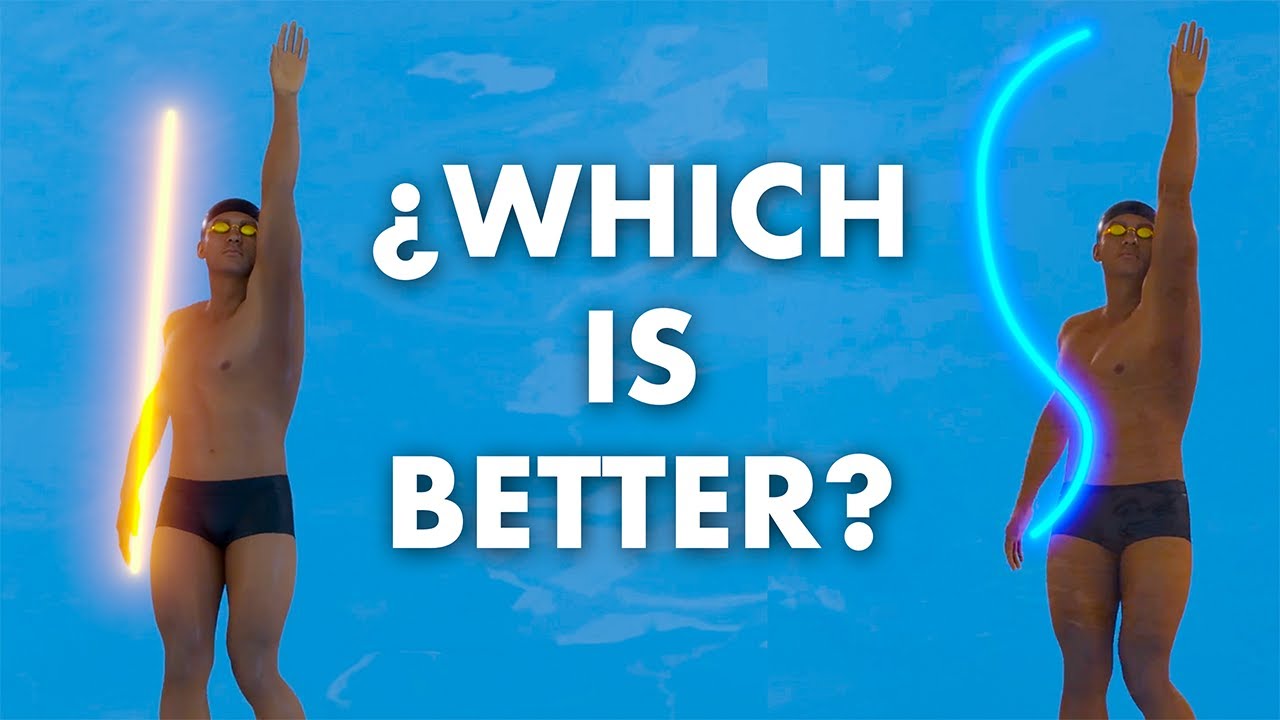
I swim my entire life, I am a sprinter, and always did the S pull, with no problems.
Around 2009 I made the mistake of trying to imitate some Olympic sprint swimmers who said were doing a full straight arm pull.
By 2010 I started feeling pain on my left shoulder. And it got to the point where it would be unbearable and I couldn't train anymore.
So in 2012 I had surgery on my shoulder.
The full straight arm pull puts A LOT of strain on the shoulders, you shouldn't do it. Even in the circumstance of it providing some apparent performance gain, it's not worth the risk of injury.
Just stick with the S pull and work on its technique a lot, to make it as efficient as possible.
reply
Do not do a full straight arm pull.
I swim my entire life, I am a sprinter, and always did the S pull, with no problems.
Around 2009 I made the mistake of trying to imitate some Olympic sprint swimmers who said were doing a full straight arm pull.
By 2010 I started feeling pain on my left shoulder. And it got to the point where it would be unbearable and I couldn't train anymore.
So in 2012 I had surgery on my shoulder.
The full straight arm pull puts A LOT of strain on the shoulders, you shouldn't do it. Even in the circumstance of it providing some apparent performance gain, it's not worth the risk of injury.
Just stick with the S pull and work on its technique a lot, to make it as efficient as possible.
reply
Giorgos
I swim alone in the pool. No coach, just yt videos and practice. I was dragging straight (that's what I thought at least, as from the comments and the video it seems that you can't really drag straight) one day a guy saw me, around 40, a former swimming athlete from Belarus and he told me to drag with my arm and forearm at 60o degrees angle and not drag straight. When I argued he told me Imagine you are holding a rope and you want to drag something that's attached to the rope, how would you drag it? Of course, it is better if you drag it with an S form than drag it straight. So I changed my style. It's not that I saw major differences. I still feel that I should drag straight though, it seems more simple to me.
reply
I swim alone in the pool. No coach, just yt videos and practice. I was dragging straight (that's what I thought at least, as from the comments and the video it seems that you can't really drag straight) one day a guy saw me, around 40, a former swimming athlete from Belarus and he told me to drag with my arm and forearm at 60o degrees angle and not drag straight. When I argued he told me Imagine you are holding a rope and you want to drag something that's attached to the rope, how would you drag it? Of course, it is better if you drag it with an S form than drag it straight. So I changed my style. It's not that I saw major differences. I still feel that I should drag straight though, it seems more simple to me.
reply
Lex
rowing with arms much wider than shoulders is very inefficient and this method can be completely ignored. The arm should enter the water just in front of the shoulder. If you try to do a perfectly straight stroke, then you will spend much more effort for this, paying attention to the wrong things at all. It is necessary to give the body the opportunity to get more speed with less effort and the hand itself will follow the desired trajectory. In physics there is such a thing as the principle of least interaction. Your body, if you give it freedom and do not load it with unnecessary rules. will behave exactly according to this law
reply
rowing with arms much wider than shoulders is very inefficient and this method can be completely ignored. The arm should enter the water just in front of the shoulder. If you try to do a perfectly straight stroke, then you will spend much more effort for this, paying attention to the wrong things at all. It is necessary to give the body the opportunity to get more speed with less effort and the hand itself will follow the desired trajectory. In physics there is such a thing as the principle of least interaction. Your body, if you give it freedom and do not load it with unnecessary rules. will behave exactly according to this law
reply
Dmitry
I noticed the movements of my hand under water when I was swimming with paddles. I noticed that the movement is different from what I do when I swim without shoulder blades: the palm goes closer to the body and closer to the midline. I tried to fix this and row the same way as I used to row without paddles - straight back. And this movement with the shoulder blades turned out to be uncomfortable, and besides, after that, my left shoulder hurt for 2 days. That's why I think the S-shaped movement is more natural, it's just that when you swim without paddles, you don't notice it.
reply
I noticed the movements of my hand under water when I was swimming with paddles. I noticed that the movement is different from what I do when I swim without shoulder blades: the palm goes closer to the body and closer to the midline. I tried to fix this and row the same way as I used to row without paddles - straight back. And this movement with the shoulder blades turned out to be uncomfortable, and besides, after that, my left shoulder hurt for 2 days. That's why I think the S-shaped movement is more natural, it's just that when you swim without paddles, you don't notice it.
reply
robohippy
Well, I learned in the late 50's. We were taught to enter the hand wide, at about a 45 degree angle down, and do a big ( or arc shape pull. Missed out on the S shape pull, but one lap pal was saying to do a couple of S's during the pull. I always figured that part of the inevitable S came as part of the rotation, and happened naturally. I see many swimmers doing a small wiggle/S pull in the middle of their arm pull. I know that is not efficient. Some thing else to work on in the pool today.
reply
Well, I learned in the late 50's. We were taught to enter the hand wide, at about a 45 degree angle down, and do a big ( or arc shape pull. Missed out on the S shape pull, but one lap pal was saying to do a couple of S's during the pull. I always figured that part of the inevitable S came as part of the rotation, and happened naturally. I see many swimmers doing a small wiggle/S pull in the middle of their arm pull. I know that is not efficient. Some thing else to work on in the pool today.
reply
zazugee
i good analogy for me during pool sessions, was to do same movements when i try to pull myself over the pool wall's edge using my arms
to push on wall you use your body weight and rely on the big muscles, that's the max force you can produce
if you use same muscles in water, you never get tired
if in fact since i did that, my underwater speed using frog kick became so fast, i could beat most people at the local pool by going underwater
reply
i good analogy for me during pool sessions, was to do same movements when i try to pull myself over the pool wall's edge using my arms
to push on wall you use your body weight and rely on the big muscles, that's the max force you can produce
if you use same muscles in water, you never get tired
if in fact since i did that, my underwater speed using frog kick became so fast, i could beat most people at the local pool by going underwater
reply
Kaelart
Ive always been trying to keep my arm straight despite having low mobility. After 4 days of my swimming lessons i felt pain in my shoulder and i assume its an inflamed rotator cuff based on my own research. I realized that at the end of the day, listening to your body is the most important. Whenever i overthink the technique too much, it makes it worse for myself.
Edit: spelling
reply
Ive always been trying to keep my arm straight despite having low mobility. After 4 days of my swimming lessons i felt pain in my shoulder and i assume its an inflamed rotator cuff based on my own research. I realized that at the end of the day, listening to your body is the most important. Whenever i overthink the technique too much, it makes it worse for myself.
Edit: spelling
reply
Peter
I am an amateur self thought swimmer and been pulling straight back since I started and when become stronger and better my shoulder quickly let me know that there's something im doing wrong. Watched few videos relating to swimmers shoulder and changed my pull-back technique to the one you are talking about and so far my sholder is perfectly fine.
reply
I am an amateur self thought swimmer and been pulling straight back since I started and when become stronger and better my shoulder quickly let me know that there's something im doing wrong. Watched few videos relating to swimmers shoulder and changed my pull-back technique to the one you are talking about and so far my sholder is perfectly fine.
reply
andrew
I learned in the 80s/90s I've been coaching since the early 2000s. I was taught the s pull but since then and exaggerated S causes too much drag. These days I advise using your hand to create force to go forwards. If you think you're pulling straight you're still doing a form of S pull but I feel teaching the s pull tends to make swimmers slower
reply
I learned in the 80s/90s I've been coaching since the early 2000s. I was taught the s pull but since then and exaggerated S causes too much drag. These days I advise using your hand to create force to go forwards. If you think you're pulling straight you're still doing a form of S pull but I feel teaching the s pull tends to make swimmers slower
reply
Chris
Agreed. Too straight is uncomfortable, hard to do, and not faster. Too much S is too easy and you're not pulling enough water, instead you're going around it, avoiding it. There is an appropriate S based on your shoulder flexibility (your catch, strength in your pull (pecs, lats, triceps, and how much you rotate your body/hips side to side.
reply
Agreed. Too straight is uncomfortable, hard to do, and not faster. Too much S is too easy and you're not pulling enough water, instead you're going around it, avoiding it. There is an appropriate S based on your shoulder flexibility (your catch, strength in your pull (pecs, lats, triceps, and how much you rotate your body/hips side to side.
reply
Pawel
The thing is when you are applying your technique right, then the S-Pull happens naturally without you thinking about it. Ultimately its not the S-Pull you should focus on, because that will make your technique worse. You should focus on the right-technique itself that will naturally move your arms into the S-Pull itself anyway.
reply
The thing is when you are applying your technique right, then the S-Pull happens naturally without you thinking about it. Ultimately its not the S-Pull you should focus on, because that will make your technique worse. You should focus on the right-technique itself that will naturally move your arms into the S-Pull itself anyway.
reply
Eduardo
Both are correct and simultaneous: from the body reference system point of view, the arm does the S shape naturally, because of the rotation of the body and the catch, subsequent high elbow position, etc. From the water or swimming pool reference system point of view, the hand moves in a quasi straight line.
reply
Both are correct and simultaneous: from the body reference system point of view, the arm does the S shape naturally, because of the rotation of the body and the catch, subsequent high elbow position, etc. From the water or swimming pool reference system point of view, the hand moves in a quasi straight line.
reply
Justin
Good video, my coach always tells to row my arms straight down but when I watch Olympians swim they do the swirly stuff. I can't really do the swirly movement long distance cause I notice my arms get tired fast when I do that but I think that's only me. Anyways great video I was always curious on this.
reply
Good video, my coach always tells to row my arms straight down but when I watch Olympians swim they do the swirly stuff. I can't really do the swirly movement long distance cause I notice my arms get tired fast when I do that but I think that's only me. Anyways great video I was always curious on this.
reply
Jo
Wonderful videos. Thanks for posting this and many others. I particularly enjoy your technical videos with lots of slow takes and your arrows and swooshes. I am learning a lot and getting awesome comments at the pool from applying what you teach, they say I am a super smooth swimmer thanks to you.
reply
Wonderful videos. Thanks for posting this and many others. I particularly enjoy your technical videos with lots of slow takes and your arrows and swooshes. I am learning a lot and getting awesome comments at the pool from applying what you teach, they say I am a super smooth swimmer thanks to you.
reply
Add a review, comment
Other channel videos



 8:57
8:57
 8:31
8:31