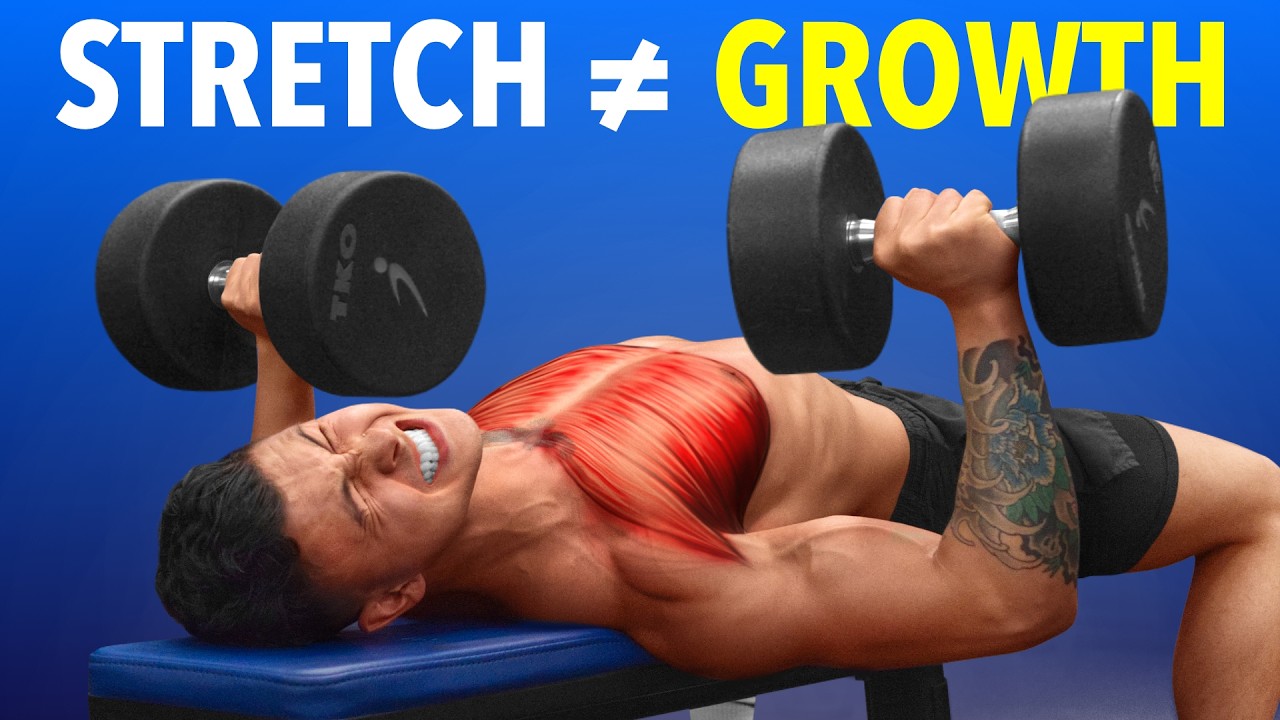
I Spent $40, 000 To Prove Them Wrong (My NEW Study)
video description
Date: 2025-12-12
Related videos



Comments and reviews: 20
kanishksingh6393
SUMMARY of the Study The Stretch Training Debate
What prompted the study
The fitness world has become obsessed with stretch-focused exercisesbelieving that placing a muscle under more stretch or challenging it in the stretched position = S-tier muscle growth.
Dozens of older studies supported this, especially for:
Biceps
Quads
Calves
Triceps (long head)
However, the creator found 3 big issues with existing research, so he spent $40, 000 to run a high-precision MRI study.
3 Major Problems With Previous Research
Only a few muscles were ever tested
Mostly biceps, quads, calves not chest, delts, glutes, etc.
Comparison of completely different exercises
e. g, preacher curl vs incline curl
Hard to tell whether the stretch caused growth or stabilization/joint angles did.
Ultrasound limitations
Ultrasound only measures one slice of a muscle, not the entire muscle volume.
MRI is far more accurate.
This New Study: What They Did
Tested pecs, glutes, side delts, rear deltsmuscles that were rarely tested before.
Used custom machines that could switch between:
Hardest at the stretch
Hardest at the squeeze
Same exercise, same ROMonly resistance profile changed.
Within-subject design (left vs right side of each person.
20 participants, 10 weeks of training.
Full 3D MRI analysis.
RESULTS
For ALL FOUR MUSCLES:
Chest SAME growth
Side delts SAME growth
Rear delts SAME growth
Glutes SAME growth
No advantage for stretch-focused resistance.
Even regional analysis (upper/lower sections) = no differences.
Conclusion:
Making an exercise harder in the stretch does NOT automatically give extra growth.
As long as you train through a full range of motion, stretch vs squeeze doesn’t matter.
Why Previous Studies Looked Different
There are 3 different stretch concepts, and only 1 was tested here:
1) Degree of stretch VERY IMPORTANT
Some muscles stretch much more because they cross two joints (bi-articulate muscles):
Hamstrings
Rectus femoris (quad)
Gastrocnemius (calf)
Long head of triceps
These do grow more when stretched deeply.
2) ROM depth VERY IMPORTANT
Going deeper more growth.
NOT disputed by the study.
3) Resistance profile (hardest at stretch vs squeeze) NOT IMPORTANT (for these muscles)
This is what the experiment tested.
So Does stretch training matter at all
Yes but not in the way people thought.
Stretch matters for:
Bi-articulate muscles (hams, quads, calves, long head triceps)
Exercises with deep ranges of motion
Ensuring you don’t cut reps short
Stretch DOES NOT matter for:
Making the exercise artificially hardest in the stretch
Optimized angles/profiles that change tension curves
Chest/delts/glutes (based on this study)
Practical Takeaways (This is what YOU should do)
1. Use Full Range of Motion on Every Exercise
Deep reps = more muscle growth than partial reps (top-half reps.
Example:
Deep squats
Deep RDL
Deep flies
Full stretch cable rows
Deep leg extensions (if knees tolerate)
2. Prioritize Stretch-Focused Exercises ONLY for Bi-Articulate Muscles
These muscles DO benefit from stretch-heavy movements:
Hamstrings
RDLs
Seated leg curls (better than lying leg curls)
Quads (Rectus femoris especially)
Deep leg extensions
Sissy squats
Split squats with forward torso
Calves
Calf raises with LONG bottom stretch
Seated calf raises for soleus
Standing for gastrocnemius
Triceps long head
Overhead extensions
Cross cable extensions with arm behind head
3. For Chest, Delts, Glutes choose exercises you enjoy & train hard
These muscles grew the SAME whether the exercise was:
hardest in stretch
hardest in squeeze
Meaning:
Choose the exercise that feels best and lets you push hard.
Examples:
Chest
Bench press
Dumbbell press
Cable fly
(All similar if ROM is good)
Delts
Dumbbell laterals
Cable laterals
Machine laterals
(All similar)
Glutes
Hip thrusts
Squats
Lunges
Cable kickbacks
(All similar)
4. Stretch vs Squeeze doesn’t matter INTENSITY matters
Your effort, proximity to failure, and technique matter far more.
5. Switching exercises sometimes causes growth simply due to novelty
If you’ve only done dumbbell laterals for years cable laterals feel fresh and stimulate growth.
Ultra-Condensed Takeaway
Full ROM hard training is king.
Stretch-bias matters for only a few muscles.
For chest, delts, glutes doesn’t matter if the hardest part is stretch or squeeze.
Most people obsessed with stretch are overthinking i
reply
SUMMARY of the Study The Stretch Training Debate
What prompted the study
The fitness world has become obsessed with stretch-focused exercisesbelieving that placing a muscle under more stretch or challenging it in the stretched position = S-tier muscle growth.
Dozens of older studies supported this, especially for:
Biceps
Quads
Calves
Triceps (long head)
However, the creator found 3 big issues with existing research, so he spent $40, 000 to run a high-precision MRI study.
3 Major Problems With Previous Research
Only a few muscles were ever tested
Mostly biceps, quads, calves not chest, delts, glutes, etc.
Comparison of completely different exercises
e. g, preacher curl vs incline curl
Hard to tell whether the stretch caused growth or stabilization/joint angles did.
Ultrasound limitations
Ultrasound only measures one slice of a muscle, not the entire muscle volume.
MRI is far more accurate.
This New Study: What They Did
Tested pecs, glutes, side delts, rear deltsmuscles that were rarely tested before.
Used custom machines that could switch between:
Hardest at the stretch
Hardest at the squeeze
Same exercise, same ROMonly resistance profile changed.
Within-subject design (left vs right side of each person.
20 participants, 10 weeks of training.
Full 3D MRI analysis.
RESULTS
For ALL FOUR MUSCLES:
Chest SAME growth
Side delts SAME growth
Rear delts SAME growth
Glutes SAME growth
No advantage for stretch-focused resistance.
Even regional analysis (upper/lower sections) = no differences.
Conclusion:
Making an exercise harder in the stretch does NOT automatically give extra growth.
As long as you train through a full range of motion, stretch vs squeeze doesn’t matter.
Why Previous Studies Looked Different
There are 3 different stretch concepts, and only 1 was tested here:
1) Degree of stretch VERY IMPORTANT
Some muscles stretch much more because they cross two joints (bi-articulate muscles):
Hamstrings
Rectus femoris (quad)
Gastrocnemius (calf)
Long head of triceps
These do grow more when stretched deeply.
2) ROM depth VERY IMPORTANT
Going deeper more growth.
NOT disputed by the study.
3) Resistance profile (hardest at stretch vs squeeze) NOT IMPORTANT (for these muscles)
This is what the experiment tested.
So Does stretch training matter at all
Yes but not in the way people thought.
Stretch matters for:
Bi-articulate muscles (hams, quads, calves, long head triceps)
Exercises with deep ranges of motion
Ensuring you don’t cut reps short
Stretch DOES NOT matter for:
Making the exercise artificially hardest in the stretch
Optimized angles/profiles that change tension curves
Chest/delts/glutes (based on this study)
Practical Takeaways (This is what YOU should do)
1. Use Full Range of Motion on Every Exercise
Deep reps = more muscle growth than partial reps (top-half reps.
Example:
Deep squats
Deep RDL
Deep flies
Full stretch cable rows
Deep leg extensions (if knees tolerate)
2. Prioritize Stretch-Focused Exercises ONLY for Bi-Articulate Muscles
These muscles DO benefit from stretch-heavy movements:
Hamstrings
RDLs
Seated leg curls (better than lying leg curls)
Quads (Rectus femoris especially)
Deep leg extensions
Sissy squats
Split squats with forward torso
Calves
Calf raises with LONG bottom stretch
Seated calf raises for soleus
Standing for gastrocnemius
Triceps long head
Overhead extensions
Cross cable extensions with arm behind head
3. For Chest, Delts, Glutes choose exercises you enjoy & train hard
These muscles grew the SAME whether the exercise was:
hardest in stretch
hardest in squeeze
Meaning:
Choose the exercise that feels best and lets you push hard.
Examples:
Chest
Bench press
Dumbbell press
Cable fly
(All similar if ROM is good)
Delts
Dumbbell laterals
Cable laterals
Machine laterals
(All similar)
Glutes
Hip thrusts
Squats
Lunges
Cable kickbacks
(All similar)
4. Stretch vs Squeeze doesn’t matter INTENSITY matters
Your effort, proximity to failure, and technique matter far more.
5. Switching exercises sometimes causes growth simply due to novelty
If you’ve only done dumbbell laterals for years cable laterals feel fresh and stimulate growth.
Ultra-Condensed Takeaway
Full ROM hard training is king.
Stretch-bias matters for only a few muscles.
For chest, delts, glutes doesn’t matter if the hardest part is stretch or squeeze.
Most people obsessed with stretch are overthinking i
reply
flymypg
I've been working with the same personal trainer 3x/week for 20 years, and we've been working out together for the past 15 years. We have very different bodies, with him looking like a chiseled Greek god, and me looking like, well, a late-middle-aged wannabe athlete.
Together, we've explored pretty much every modality for every muscle group. We've settled on a 4-week periodization cycle, with a week each of cardio intervals, then circuit training, then lifting, and a final week of recovery stretch stability. Together we've solidly proven the value of range of motion, as we both found substantial gains when we switched from primarily iron weights to adding a Tonal machine. For myself, the two most noticeable gains were the growth of my outer pecs (my pec wings) and my lats. As I do triathlon, I wanted as much strength as possible with minimal weight gain, and I didn't really care at all about muscle size or shape.
The next vital thing after range of motion has proven to be PERFECT FORM. We watch each other like hawks, particularly noting when we start to recruit secondaries and/or become slower or wobbly. This means we always stop a set early enough to leave one rep in the tank, to give us an extra margin of safety.
During the decades, I've been diagnosed with DDD (Degenerative Disc Disease, and I've already lost 2. 5 of height due to my evaporating discs, and I've been through several bouts of severe chronic back pain and multiple rounds of physical therapy. My trainer and I continuously rebuilt our SHARED training regimen to work around my limitations and prevent further damage while also continuing to improve strength to the greatest extent possible EVERYWHERE. The net result is I'm now 69, and I'm still occasionally setting lifting PRs! Including for deadlift and RDL!
I avoid most supplements, though 5g/day Creatine is an easy win, as is my morning caffeine. I also make most of my own meals from scratch, to keep nutrition as simple as possible and taste as good as possible. I like to joke that my diet exists only during the 20 minutes I spend shopping at Trader Joe's, after which I can eat as much as I want of everything I bring home, knowing it's all great for me. The only hard parts were when I kicked both bread and beer off my shopping list. Bread, because of all the stuff I'd also buy for sandwiches. Beer, because a six-pack was a single serving for me.
With this context, I really love your study, and the other studies you reference. As I'm an endurance (wannabe) athlete, my gym workouts must not get in the way of, or in any way limit, my swim/bike/run performance. Other than that, the sky's the limit!
reply
I've been working with the same personal trainer 3x/week for 20 years, and we've been working out together for the past 15 years. We have very different bodies, with him looking like a chiseled Greek god, and me looking like, well, a late-middle-aged wannabe athlete.
Together, we've explored pretty much every modality for every muscle group. We've settled on a 4-week periodization cycle, with a week each of cardio intervals, then circuit training, then lifting, and a final week of recovery stretch stability. Together we've solidly proven the value of range of motion, as we both found substantial gains when we switched from primarily iron weights to adding a Tonal machine. For myself, the two most noticeable gains were the growth of my outer pecs (my pec wings) and my lats. As I do triathlon, I wanted as much strength as possible with minimal weight gain, and I didn't really care at all about muscle size or shape.
The next vital thing after range of motion has proven to be PERFECT FORM. We watch each other like hawks, particularly noting when we start to recruit secondaries and/or become slower or wobbly. This means we always stop a set early enough to leave one rep in the tank, to give us an extra margin of safety.
During the decades, I've been diagnosed with DDD (Degenerative Disc Disease, and I've already lost 2. 5 of height due to my evaporating discs, and I've been through several bouts of severe chronic back pain and multiple rounds of physical therapy. My trainer and I continuously rebuilt our SHARED training regimen to work around my limitations and prevent further damage while also continuing to improve strength to the greatest extent possible EVERYWHERE. The net result is I'm now 69, and I'm still occasionally setting lifting PRs! Including for deadlift and RDL!
I avoid most supplements, though 5g/day Creatine is an easy win, as is my morning caffeine. I also make most of my own meals from scratch, to keep nutrition as simple as possible and taste as good as possible. I like to joke that my diet exists only during the 20 minutes I spend shopping at Trader Joe's, after which I can eat as much as I want of everything I bring home, knowing it's all great for me. The only hard parts were when I kicked both bread and beer off my shopping list. Bread, because of all the stuff I'd also buy for sandwiches. Beer, because a six-pack was a single serving for me.
With this context, I really love your study, and the other studies you reference. As I'm an endurance (wannabe) athlete, my gym workouts must not get in the way of, or in any way limit, my swim/bike/run performance. Other than that, the sky's the limit!
reply
mr. doudou-ki9kh
Hey,
What everyone seems to forget is that muscles have different leverages. Resistance profile DO matter, they are just different for every muscle. For example, the short and medial head have better leverage near full elbow extension, which means that a bench press that's harder at the top (either a hammer strength press or a banded bench press) will load the triceps more than the chest. Similarly, which really challenged my point of view, the long head of the triceps has the best leverage (over the chest and the lats) near the top of a pullover, so the top half of a dumbell pullover will be a goated pullover. If you want to know what muscles have the best leverage, here it is:
Shortened position (muscle that benefit from the squeeze or an ascending resistance profile
Glutes
Lats
Front delts
Calves (soleus)
Triceps (Short&Medial head)
Mid position (muscles that benefit a bell curve (hardest in the middle and easier at the bottom and top)
Hamstrings
Lenghtened position (muscles that benefit from the stretch or a descending resistance profile)
Biceps
Adductors
Calves (gastrocnemius)
Special mention:
the pecs have great leverage towards all of shoulder adduction (pec fly, chest press) and benefit from a descending resistance profile HOWEVER the upper pecs (which do shoulder flexion) have best leverage in the bottom part, after 45 degrees of shoulder flexion
the only muscle contributing to knee extension are the quads, so the leverages dont really matter (though it has great leverage towards full knee flexio, we'll see why this is important later, same thing for the rear delt and the traps
now: not all muscle that have best leverage in the lenghtened position benefit from strectch mediated hypertrophy (which we will abreviate to SMH for convenience. why because of sarcomeres. muscle that have few sarcomeres in the serie can generate enough passive tension for that muscle to experience SMH. the muscles that can LIKELY benefit from SMH are: the chest, the quads, the hamstrings, and the glutes.
why wouldn't i just strech every muscle because training a muscle at longer lenghts will release more calcium ions, which will then cause more fatigue
lmk if you have any questions, i'm fairly active here!
reply
Hey,
What everyone seems to forget is that muscles have different leverages. Resistance profile DO matter, they are just different for every muscle. For example, the short and medial head have better leverage near full elbow extension, which means that a bench press that's harder at the top (either a hammer strength press or a banded bench press) will load the triceps more than the chest. Similarly, which really challenged my point of view, the long head of the triceps has the best leverage (over the chest and the lats) near the top of a pullover, so the top half of a dumbell pullover will be a goated pullover. If you want to know what muscles have the best leverage, here it is:
Shortened position (muscle that benefit from the squeeze or an ascending resistance profile
Glutes
Lats
Front delts
Calves (soleus)
Triceps (Short&Medial head)
Mid position (muscles that benefit a bell curve (hardest in the middle and easier at the bottom and top)
Hamstrings
Lenghtened position (muscles that benefit from the stretch or a descending resistance profile)
Biceps
Adductors
Calves (gastrocnemius)
Special mention:
the pecs have great leverage towards all of shoulder adduction (pec fly, chest press) and benefit from a descending resistance profile HOWEVER the upper pecs (which do shoulder flexion) have best leverage in the bottom part, after 45 degrees of shoulder flexion
the only muscle contributing to knee extension are the quads, so the leverages dont really matter (though it has great leverage towards full knee flexio, we'll see why this is important later, same thing for the rear delt and the traps
now: not all muscle that have best leverage in the lenghtened position benefit from strectch mediated hypertrophy (which we will abreviate to SMH for convenience. why because of sarcomeres. muscle that have few sarcomeres in the serie can generate enough passive tension for that muscle to experience SMH. the muscles that can LIKELY benefit from SMH are: the chest, the quads, the hamstrings, and the glutes.
why wouldn't i just strech every muscle because training a muscle at longer lenghts will release more calcium ions, which will then cause more fatigue
lmk if you have any questions, i'm fairly active here!
reply
ungus
First of all, fantastic work. Challenging the in-vogue schools of thought is one of the best things that science can do. This is fantastic and reassuring information: Push yourself and ensure resistance through a large range of motion, and you'll see maximum results without overthinking (for most exercises.
But also, when I see fitness studies like these, as a nerd, I often wonder: Why are they so often constructed to gather single points of data Wouldn't it be more informative and accurate to real life to be targeting at least two dimensional data More specifically, in this study, why would you want to measure two opposing resistance profiles on a muscle mass gained scale, as opposed to gathering data on the on the exact resistance profile over distance/angle for each subject compared to the muscle volume gained over some slice of muscle Sure, the equipment and math is more complicated, but doesn't this increase in dimensionality result in higher fidelity results that allow for a deeper understanding of how resistance profiles affect muscle growth
If the answer to that question is that complicating the experiment this way just creates noise in the data, or that it would be prohibitively expensive, or that it's logistically complex, that's totally valid. I'm in mediocre shape at best and work as a software engineer, not a scientist. Asking purely out of curiosity, and looking to learn, not criticize.
reply
First of all, fantastic work. Challenging the in-vogue schools of thought is one of the best things that science can do. This is fantastic and reassuring information: Push yourself and ensure resistance through a large range of motion, and you'll see maximum results without overthinking (for most exercises.
But also, when I see fitness studies like these, as a nerd, I often wonder: Why are they so often constructed to gather single points of data Wouldn't it be more informative and accurate to real life to be targeting at least two dimensional data More specifically, in this study, why would you want to measure two opposing resistance profiles on a muscle mass gained scale, as opposed to gathering data on the on the exact resistance profile over distance/angle for each subject compared to the muscle volume gained over some slice of muscle Sure, the equipment and math is more complicated, but doesn't this increase in dimensionality result in higher fidelity results that allow for a deeper understanding of how resistance profiles affect muscle growth
If the answer to that question is that complicating the experiment this way just creates noise in the data, or that it would be prohibitively expensive, or that it's logistically complex, that's totally valid. I'm in mediocre shape at best and work as a software engineer, not a scientist. Asking purely out of curiosity, and looking to learn, not criticize.
reply
kirilucero6130
I love the effort that went into this study, but one thing I keep wondering is whether focusing only on hypertrophy misses part of the picture. Connective tissue tolerance (tendons, fascia, aponeuroses) and neuromuscular control are a big part of why lengthened-position work feels so effective for many trained athletes who’ve plateaued.
Training tissues in their most vulnerable, lengthened positions can increase end-range stability and tissue stiffness in a good way, giving the muscle better support at its attachments by improving collagen organization and load tolerance. That can potentially improve force output through the whole ROM. It’s almost like a loaded PNF stretch: you’re recruiting more fibers, challenging the fascia, and improving neural drive.
So even if hypertrophy isn’t drastically different on MRI, the functional adaptations might be. Totally just speculating, but the body is so complex that I can see why lengthened work still helps advanced lifters break plateaus. This study definitely got me thinking
reply
I love the effort that went into this study, but one thing I keep wondering is whether focusing only on hypertrophy misses part of the picture. Connective tissue tolerance (tendons, fascia, aponeuroses) and neuromuscular control are a big part of why lengthened-position work feels so effective for many trained athletes who’ve plateaued.
Training tissues in their most vulnerable, lengthened positions can increase end-range stability and tissue stiffness in a good way, giving the muscle better support at its attachments by improving collagen organization and load tolerance. That can potentially improve force output through the whole ROM. It’s almost like a loaded PNF stretch: you’re recruiting more fibers, challenging the fascia, and improving neural drive.
So even if hypertrophy isn’t drastically different on MRI, the functional adaptations might be. Totally just speculating, but the body is so complex that I can see why lengthened work still helps advanced lifters break plateaus. This study definitely got me thinking
reply
kirilucero6130
Another variable I keep thinking about is pelvic orientation and how much it affects quad recruitment. For me personally, the top of my quads (especially rectus femoris) barely activate unless I change the tilt of my pelvis. Anterior tilt lengthens the rectus femoris and suddenly I can feel it contributing way more, and the opposite happens with a tucked pelvis. Nordic quad work is the only thing that hits those fibers consistently for me.
Since rectus femoris is so sensitive to hip position as a biarticular muscle, even slight differences in pelvic orientation could change which fibers are being loaded during unilateral designs. So even if both sides are doing the same exercise, the actual mechanical stimulus might not be the same at all.
That makes me wonder how much individual asymmetries, hip posture, old injuries, and joint orientation might affect results in studies like this. The setup can look identical, but the internal mechanics may not be. Just something I’ve been thinking about!
reply
Another variable I keep thinking about is pelvic orientation and how much it affects quad recruitment. For me personally, the top of my quads (especially rectus femoris) barely activate unless I change the tilt of my pelvis. Anterior tilt lengthens the rectus femoris and suddenly I can feel it contributing way more, and the opposite happens with a tucked pelvis. Nordic quad work is the only thing that hits those fibers consistently for me.
Since rectus femoris is so sensitive to hip position as a biarticular muscle, even slight differences in pelvic orientation could change which fibers are being loaded during unilateral designs. So even if both sides are doing the same exercise, the actual mechanical stimulus might not be the same at all.
That makes me wonder how much individual asymmetries, hip posture, old injuries, and joint orientation might affect results in studies like this. The setup can look identical, but the internal mechanics may not be. Just something I’ve been thinking about!
reply
janjansen2091
I just view it from a biophysical standpoint:
I think muscle growth is higher in the stretched position because the pressure inside the muscle fibers becomes much greater when the muscle is lengthened. The force the muscle produces may be similar in both stretched and contracted positions, but in a stretched state the fibers are elongated and have a smaller effective cross-sectional area. Since pressure equals force divided by area, the same force acting on a smaller area creates much higher internal pressure. This is similar to stretching a rubber band: as it gets longer, it becomes thinner, and the tension concentrates on a smaller area until it eventually snaps. In muscles, this increased internal pressure may amplify mechanical stress on the fibers, stimulating greater growth.
But at the end of the day, more than 90% of people shouldn’t worry about these details there are a thousand other factors with far greater influence on muscle growth that they can focus on instead.
reply
I just view it from a biophysical standpoint:
I think muscle growth is higher in the stretched position because the pressure inside the muscle fibers becomes much greater when the muscle is lengthened. The force the muscle produces may be similar in both stretched and contracted positions, but in a stretched state the fibers are elongated and have a smaller effective cross-sectional area. Since pressure equals force divided by area, the same force acting on a smaller area creates much higher internal pressure. This is similar to stretching a rubber band: as it gets longer, it becomes thinner, and the tension concentrates on a smaller area until it eventually snaps. In muscles, this increased internal pressure may amplify mechanical stress on the fibers, stimulating greater growth.
But at the end of the day, more than 90% of people shouldn’t worry about these details there are a thousand other factors with far greater influence on muscle growth that they can focus on instead.
reply
thomast3640
One thing to note is that there should be multiple studies done by different researchers yielding similar results to confirm and solidify the claim. Often times talented and intelligent researchers forget this key point in research amidst their happiness and joy from having published their study. Many many smart people on media cite single studies (without mentioning how many studies are out there having yielded similar results) to the public and this relays the wrong message of how research studies should be interpreted -- that a single study is definitive truth -- it is not and it shouldn't be. (Not saying you did this since you did mention this in your vid)
Otherwise the research seemed to be well structured. Sample size is definitely small but I thought it was genius to split the participants' bodies in half. Though I did wonder if this would yield any discrepancy among the testing conditions. Great study nonetheless!
reply
One thing to note is that there should be multiple studies done by different researchers yielding similar results to confirm and solidify the claim. Often times talented and intelligent researchers forget this key point in research amidst their happiness and joy from having published their study. Many many smart people on media cite single studies (without mentioning how many studies are out there having yielded similar results) to the public and this relays the wrong message of how research studies should be interpreted -- that a single study is definitive truth -- it is not and it shouldn't be. (Not saying you did this since you did mention this in your vid)
Otherwise the research seemed to be well structured. Sample size is definitely small but I thought it was genius to split the participants' bodies in half. Though I did wonder if this would yield any discrepancy among the testing conditions. Great study nonetheless!
reply
SangaPommike
Really enjoyed the breakdown of the study! It’s impressive what you managed to get done on such a tight direct budget.
That said, anyone who’s worked in research knows that the true cost of a year-long study goes far beyond the $40k you put in / raised. MRI time alone is expensive, but so are staff hours, supervision, university facilities, insurance, recruitment, ethics admin, and the opportunity cost of having researchers tied up for months.
The MSc lead may not have been salaried, but the academic staff and institutional overhead absolutely were. If all of those were costed transparently, the real price tag would almost certainly be many times higher.
That doesn’t take anything away from the project. But I also think it's important to note that the figure quoted only reflects out-of-pocket costs, not the full cost of doing research at this scale.
reply
Really enjoyed the breakdown of the study! It’s impressive what you managed to get done on such a tight direct budget.
That said, anyone who’s worked in research knows that the true cost of a year-long study goes far beyond the $40k you put in / raised. MRI time alone is expensive, but so are staff hours, supervision, university facilities, insurance, recruitment, ethics admin, and the opportunity cost of having researchers tied up for months.
The MSc lead may not have been salaried, but the academic staff and institutional overhead absolutely were. If all of those were costed transparently, the real price tag would almost certainly be many times higher.
That doesn’t take anything away from the project. But I also think it's important to note that the figure quoted only reflects out-of-pocket costs, not the full cost of doing research at this scale.
reply
grudley
Isn't the biceps also biarticular
Also, something that I haven't seen about stretched ROM exercises, something I haven't seen people mention, but I suspect is true, is that stretched ROM can be protective of tendons. For example, if you do preacher curls all the way down, you both have to use a lighter weight, and you're strengthening your biceps and conditioning your biceps tendon in that stretched ROM, which I would expect to protect from biceps tears as long as you don't overdo them. Contrast this with preacher curls where you don't go all the way down, you're able to go heavier, and you're not conditioning your tendon, so when you get to the end of a set and start slipping into that end ROM, you're risking a biceps tear with that much heavier weight.
reply
Isn't the biceps also biarticular
Also, something that I haven't seen about stretched ROM exercises, something I haven't seen people mention, but I suspect is true, is that stretched ROM can be protective of tendons. For example, if you do preacher curls all the way down, you both have to use a lighter weight, and you're strengthening your biceps and conditioning your biceps tendon in that stretched ROM, which I would expect to protect from biceps tears as long as you don't overdo them. Contrast this with preacher curls where you don't go all the way down, you're able to go heavier, and you're not conditioning your tendon, so when you get to the end of a set and start slipping into that end ROM, you're risking a biceps tear with that much heavier weight.
reply
Dayystra
this is a great discovery if you ask me. Essentially, it proves most that what truly matters is working hard with proper ROM. People get lost in the complexity of the science based field, but at the end of the day, as Jeff mentioned, these are the small final pieces were moving around. for the most part, we know all the major things about lifting. don't get too worried or overwhelmed about how you train and all the little variables, cause what truly matters is how hard your training, and i think this complexity scares away new lifters time and time again, cause they join the gym and start consuming science based content and get overwhelmed. train hard and have a good lift.
reply
this is a great discovery if you ask me. Essentially, it proves most that what truly matters is working hard with proper ROM. People get lost in the complexity of the science based field, but at the end of the day, as Jeff mentioned, these are the small final pieces were moving around. for the most part, we know all the major things about lifting. don't get too worried or overwhelmed about how you train and all the little variables, cause what truly matters is how hard your training, and i think this complexity scares away new lifters time and time again, cause they join the gym and start consuming science based content and get overwhelmed. train hard and have a good lift.
reply
savedbygamer9293
Good job investing in a study to challenge the conventional wisdom. For any of you out there who listen to anything people like Jeff Nippard say- you’re responsible for your own failure. You should be smarter than that! Ofc, all of these little guys who look like nothing will say the same thing- you might be bigger and more jacked than me but I know the science. Makes me laugh - if they applied the science to themselves why in the hell do they look like donuts Wake up! Look at the physiques of guys from the 60’ through the 90’s before any of the science started emerging- those physiques SMOKE Jeff Nippard and all of these other clowns
reply
Good job investing in a study to challenge the conventional wisdom. For any of you out there who listen to anything people like Jeff Nippard say- you’re responsible for your own failure. You should be smarter than that! Ofc, all of these little guys who look like nothing will say the same thing- you might be bigger and more jacked than me but I know the science. Makes me laugh - if they applied the science to themselves why in the hell do they look like donuts Wake up! Look at the physiques of guys from the 60’ through the 90’s before any of the science started emerging- those physiques SMOKE Jeff Nippard and all of these other clowns
reply
DrAJ-vt9uq
I appreciate your hard work, and I hope that the research community will appreciate it. But I hope that you will not jump to a conclusion that: as long as you are doing hard work with full range of motion you will be nice, I think it is better to be harder and more time under pressure regardless of range of motion.
Because based on hamstring study, range of motion had zero effect and you need the dorsiflexion part(which has less range of motion, they interpreted it(wrongly) to claim that it is better because you do stretch part, but the reality may be: It is better to do exercises with more time in the hard part rather than range of motion.
reply
I appreciate your hard work, and I hope that the research community will appreciate it. But I hope that you will not jump to a conclusion that: as long as you are doing hard work with full range of motion you will be nice, I think it is better to be harder and more time under pressure regardless of range of motion.
Because based on hamstring study, range of motion had zero effect and you need the dorsiflexion part(which has less range of motion, they interpreted it(wrongly) to claim that it is better because you do stretch part, but the reality may be: It is better to do exercises with more time in the hard part rather than range of motion.
reply
g__l7217
There are even more things to take into consideration. Eg, when it comes to DB laterals vs cable laterals: many people get FAR more trap involvement with db laterals than with high cable laterals. If you don't want any extra sets for traps (like myself, cables are king.
Similarly, with db rear delt flies, I frequently don't feel much tension on the rear delts at the bottom of the movement and then at the top, where i do get more rear delt involvement, the weight quickly feels too hard and my other upper back muscles take over. not that its bad necessarily to hit those muscles, its just not what I'm trying to isolate
reply
There are even more things to take into consideration. Eg, when it comes to DB laterals vs cable laterals: many people get FAR more trap involvement with db laterals than with high cable laterals. If you don't want any extra sets for traps (like myself, cables are king.
Similarly, with db rear delt flies, I frequently don't feel much tension on the rear delts at the bottom of the movement and then at the top, where i do get more rear delt involvement, the weight quickly feels too hard and my other upper back muscles take over. not that its bad necessarily to hit those muscles, its just not what I'm trying to isolate
reply
unholyquail4560
My theory on why people get better results on the stretch exercises and this was the reason people were developing an extreme bias towards this being better - Form and effort. When learning a standard exercise that does not focus on stretch you can get away with poor form and get pretty far but not grow. Any exercise that focussed on the stretch and pure ROM solves that issues because you need to learn proper form before you can start loading it from there.
The superior thing about it is that it turns rookies and poor form user into more aware and precise lifters. Which we all know leads to better outcomes.
reply
My theory on why people get better results on the stretch exercises and this was the reason people were developing an extreme bias towards this being better - Form and effort. When learning a standard exercise that does not focus on stretch you can get away with poor form and get pretty far but not grow. Any exercise that focussed on the stretch and pure ROM solves that issues because you need to learn proper form before you can start loading it from there.
The superior thing about it is that it turns rookies and poor form user into more aware and precise lifters. Which we all know leads to better outcomes.
reply
19rich91
What people seem to be missing from this is it does’t change the importance of picking exercises that include the biggest stretch in them, it just means it’s not as important as first believed that you need to have the maximum tension in that position. So doing rear Delt flies that include a deep stretch would still be better than ones that don’t. The only exercise I could imagine it changing for me is instead of doing incline bicep curls on nearly a flat bench. You could have a steeper incline because that will allow a bigger range of motion with as much stretch but less tension in the stretch
reply
What people seem to be missing from this is it does’t change the importance of picking exercises that include the biggest stretch in them, it just means it’s not as important as first believed that you need to have the maximum tension in that position. So doing rear Delt flies that include a deep stretch would still be better than ones that don’t. The only exercise I could imagine it changing for me is instead of doing incline bicep curls on nearly a flat bench. You could have a steeper incline because that will allow a bigger range of motion with as much stretch but less tension in the stretch
reply
cragz9191
Great video. However, as you mentioned stretch is still important as you state getting the full range of motion and having at least a bit of tension in the stretch area helps gains. I believe this is what Jeff Nippard mentions when he talks about the stretch. For example, doing the rear delt fly on the peck deck side saddled one arm allows a wider range of motion. So most of Jeff's stuff was expressing the importance of the full range of motion.
If you only worked a partial range of motion, you will still get gains but surely you will be limiting your mobility.
reply
Great video. However, as you mentioned stretch is still important as you state getting the full range of motion and having at least a bit of tension in the stretch area helps gains. I believe this is what Jeff Nippard mentions when he talks about the stretch. For example, doing the rear delt fly on the peck deck side saddled one arm allows a wider range of motion. So most of Jeff's stuff was expressing the importance of the full range of motion.
If you only worked a partial range of motion, you will still get gains but surely you will be limiting your mobility.
reply
deceasedturtle
Great work on your study Jeremy. As a physio by trade, I can appreciate the blood, sweat, and tears you had to go through to make this dream come true.
Can't wait to read through your study and digest it.
I'm curious if you looked at perceived muscle tightness during the study and if there were any differences between groups/sides.
One issue which I come across, especially with athletes are tight muscles. In conjunction with stretching I would recommend players to train the target muscle in with the stretch.
Keen to hear your opinion on this
reply
Great work on your study Jeremy. As a physio by trade, I can appreciate the blood, sweat, and tears you had to go through to make this dream come true.
Can't wait to read through your study and digest it.
I'm curious if you looked at perceived muscle tightness during the study and if there were any differences between groups/sides.
One issue which I come across, especially with athletes are tight muscles. In conjunction with stretching I would recommend players to train the target muscle in with the stretch.
Keen to hear your opinion on this
reply
AnimeWrld
There’s a massive problem with training both halves of the same body. There is a cross-education effect where if you train only one side of the body the other will grow as well and it’s a method athletes use to preserve muscle mass when they can’t train one side of their body. This significantly skews results so the training evens out. That way you likely wouldn’t see as much of a growth difference even if one side is more optimal. A better study would’ve involved more candidates or did the study with the full body at different points in time.
reply
There’s a massive problem with training both halves of the same body. There is a cross-education effect where if you train only one side of the body the other will grow as well and it’s a method athletes use to preserve muscle mass when they can’t train one side of their body. This significantly skews results so the training evens out. That way you likely wouldn’t see as much of a growth difference even if one side is more optimal. A better study would’ve involved more candidates or did the study with the full body at different points in time.
reply
GnortsOmen
There is a missing factor; the study gives an indication that the more loaded portion of the range doesn't make a significant difference in growth; the issue is with the starting and ending range of motion. One group loaded the stretch more, though both groups had the same stretch under a load, to start the exercise. The only way for the study to be complete, is to have a reduced stretch and lengthened stretch group.
It is incomplete; obviously the groups would still be the alternate sides of each individual participant.
reply
There is a missing factor; the study gives an indication that the more loaded portion of the range doesn't make a significant difference in growth; the issue is with the starting and ending range of motion. One group loaded the stretch more, though both groups had the same stretch under a load, to start the exercise. The only way for the study to be complete, is to have a reduced stretch and lengthened stretch group.
It is incomplete; obviously the groups would still be the alternate sides of each individual participant.
reply
Add a review, comment
Other channel videos