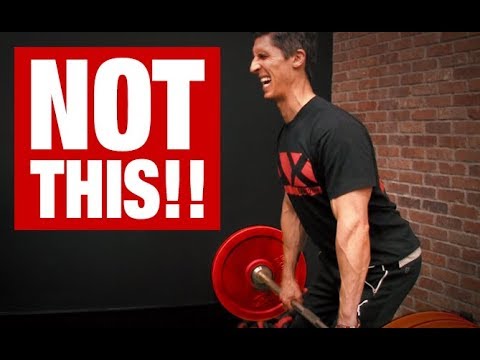
This Exercise CAUSES Hernias (IT'S VERY POPULAR)
video description
Date: 2022-04-22
Related videos


Comments and reviews: 10
Carl
I just had a second hernia surgery and the surgeon told me that, judging by how the tissue was, I'd had the hernia for 20 years! (I had the other side operated on 20 years ago) The exercise that originally brought symptoms for the second hernia was actually deadlift, followed by twisting as I moved off the wall from training wall handstand pushups. I'd say that, yes, one arm rows are the worst, but deadlifts aren't that good for hernias either! And for those of you going for surgery, I was up and walking unaided on the day of the surgery. But I expect it'll be another 6 months before I'm back to dragon flags and front levers again.
reply
I just had a second hernia surgery and the surgeon told me that, judging by how the tissue was, I'd had the hernia for 20 years! (I had the other side operated on 20 years ago) The exercise that originally brought symptoms for the second hernia was actually deadlift, followed by twisting as I moved off the wall from training wall handstand pushups. I'd say that, yes, one arm rows are the worst, but deadlifts aren't that good for hernias either! And for those of you going for surgery, I was up and walking unaided on the day of the surgery. But I expect it'll be another 6 months before I'm back to dragon flags and front levers again.
reply
actionsportster
When it comes to one-arm DB rows, why do you even have to straddle the bench? The exercise could be performed in the same position Jeff recommends in this video, but with your body either perpendicular to the bench, or turned 180 degrees so that your supporting arm is positioned on the end where your head would normally rest on the bench when performing a DB or BB bench press. This way you can still keep both feet on the floor and maintain equal weight distribution through the legs. and still allow the weight to be pulled up in a vertical plane instead of trying to pull the weight up around the bench itself.
reply
When it comes to one-arm DB rows, why do you even have to straddle the bench? The exercise could be performed in the same position Jeff recommends in this video, but with your body either perpendicular to the bench, or turned 180 degrees so that your supporting arm is positioned on the end where your head would normally rest on the bench when performing a DB or BB bench press. This way you can still keep both feet on the floor and maintain equal weight distribution through the legs. and still allow the weight to be pulled up in a vertical plane instead of trying to pull the weight up around the bench itself.
reply
MPTrader
Jeff, I do the following regularly. what do you think about it? I do a modified version of this exercise. I face the dumbbell rack and with my feet shoulder width or slightly narrower apart I place one hand on a dumbbell that is on the top rack and I have another dumbbell in the other hand. I then squat down enough to get a decent angle of my upper body (maintaining a neutral spine) and then perform the row movement. I realize that I am not very horizontal but I am able to still get a decent movement for the lats. I modified this due to low back problem where the traditional way to do this causes more stress.
reply
Jeff, I do the following regularly. what do you think about it? I do a modified version of this exercise. I face the dumbbell rack and with my feet shoulder width or slightly narrower apart I place one hand on a dumbbell that is on the top rack and I have another dumbbell in the other hand. I then squat down enough to get a decent angle of my upper body (maintaining a neutral spine) and then perform the row movement. I realize that I am not very horizontal but I am able to still get a decent movement for the lats. I modified this due to low back problem where the traditional way to do this causes more stress.
reply
Aaron
Having suffered through a herniated disk and spinal stenosis from a car accident I was always hesitant to do the DB row, but a buddy of mine who is a personal trainer taught me to straddle the bench as Jeff is showing here and I've been pulling heavier weight with no issues. Let's be honest, in life how many times are we going to find ourselves lifting any sort of weight with one knee planted somewhere, our other foot on the ground, reaching for an object? Yes, there are times when eccentric movement is needed, but does it make sense to train as if they're a common occurrence? Not really.
reply
Having suffered through a herniated disk and spinal stenosis from a car accident I was always hesitant to do the DB row, but a buddy of mine who is a personal trainer taught me to straddle the bench as Jeff is showing here and I've been pulling heavier weight with no issues. Let's be honest, in life how many times are we going to find ourselves lifting any sort of weight with one knee planted somewhere, our other foot on the ground, reaching for an object? Yes, there are times when eccentric movement is needed, but does it make sense to train as if they're a common occurrence? Not really.
reply
manakin5
I'm going to find out tomorrow for sure after my next doctor consult, but right now I'm pretty certain I just got an inguinal hernia over the past 2-3 weeks, and I can definitely say I'd been doing a fair number of these exact same standing one-arm rows. Man, I wished I'd known about this even just a month ago. Thanks for having this out there though. Lesson learned.
reply
I'm going to find out tomorrow for sure after my next doctor consult, but right now I'm pretty certain I just got an inguinal hernia over the past 2-3 weeks, and I can definitely say I'd been doing a fair number of these exact same standing one-arm rows. Man, I wished I'd known about this even just a month ago. Thanks for having this out there though. Lesson learned.
reply
allnighter2011
how could this be overlooked by so many for so long if its really a frequent cause of hernia. I mean every exercise video and trainer are doing it that way with one leg up the bench and one down. if straddling the bench is safer and as effective then why the hell isn't everyone doing it. i am curious to hear other point of views
reply
how could this be overlooked by so many for so long if its really a frequent cause of hernia. I mean every exercise video and trainer are doing it that way with one leg up the bench and one down. if straddling the bench is safer and as effective then why the hell isn't everyone doing it. i am curious to hear other point of views
reply
Sandeep
U cant cure inguinal hernia wd any technique. Surgery is the only option. Its been more than 48 hrs since my laproscopic surgery, i dnt feel any pain now. A little itching where the mesh has been placed. But i will be fine soon. People dont waste ur time wd wait n watch, it will only get big n make u depressed! get it fixed
reply
U cant cure inguinal hernia wd any technique. Surgery is the only option. Its been more than 48 hrs since my laproscopic surgery, i dnt feel any pain now. A little itching where the mesh has been placed. But i will be fine soon. People dont waste ur time wd wait n watch, it will only get big n make u depressed! get it fixed
reply
Wakingfromslumber
I do not perform my one arm dumbbell rows kneeling on a bench, I would imagine this puts significant strain on the pelvis area. I stand up in a lunge like position resting one hand on a bench, back upright chest pointing down. This position uses the lats far more effectively.
reply
I do not perform my one arm dumbbell rows kneeling on a bench, I would imagine this puts significant strain on the pelvis area. I stand up in a lunge like position resting one hand on a bench, back upright chest pointing down. This position uses the lats far more effectively.
reply
Daryn
I actually did the one arm dumbell row and is no joke could actually I feel the zipper line thank goodness I didn't have the herina because I know it I was feeling pain lucky I stop I checked to make sure no herina was in my Gorining thankfully
reply
I actually did the one arm dumbell row and is no joke could actually I feel the zipper line thank goodness I didn't have the herina because I know it I was feeling pain lucky I stop I checked to make sure no herina was in my Gorining thankfully
reply
Robyn
Single arm renegade rows gave me a groin strain. Talk about asymmetrical load! I can't even look at a pic of a renegade row without cringing now. I was 100% sure I had a hernia when I went to the doc, but apparently, no.
reply
Single arm renegade rows gave me a groin strain. Talk about asymmetrical load! I can't even look at a pic of a renegade row without cringing now. I was 100% sure I had a hernia when I went to the doc, but apparently, no.
reply
Add a review, comment
Other channel videos