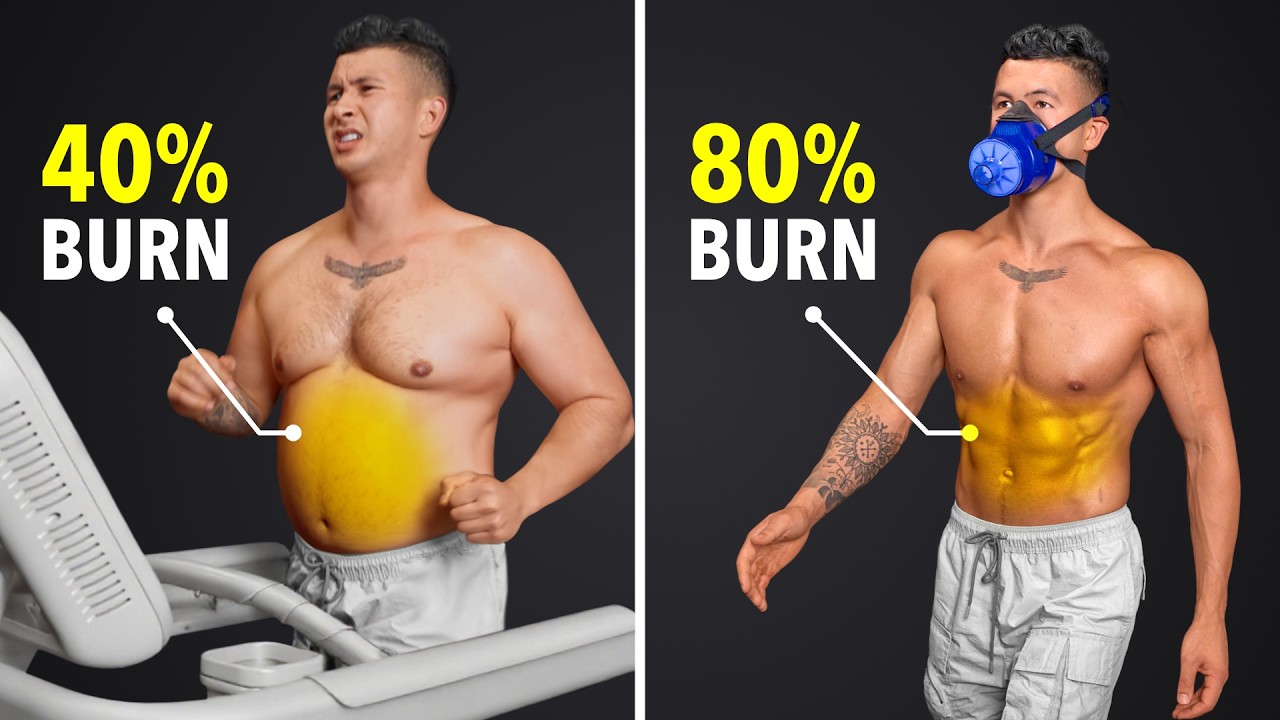
Busting Cardio Myths Everyone STILL Believes
video description
Date: 2025-12-23
Related videos


Comments and reviews: 20
baraahilal91
Here's a summary of the myths and findings:
Myth 1: Walking isn't hard enough to improve fitness (0: 20): The video demonstrates that even a simple walking routine can significantly improve VO2 max and heart efficiency, especially for previously sedentary individuals (19: 50-22: 25.
Myth 2: More sweat equals more fat burn (1: 39): Experiments show that sweating more in a hot environment does not lead to increased calorie or fat burn; sweat is primarily a cooling response (2: 51-3: 56.
Myth 3: You can eat back whatever calories you burn from exercise (4: 02): People tend to significantly overestimate the calories they burn during workouts and also compensate by reducing non-exercise activity, making it difficult to eat back calories without negating fat loss efforts (4: 56-6: 29.
Myth 4: Fitness trackers are completely useless for calorie tracking (6: 36): While not perfectly accurate, fitness trackers like the Apple Watch were found to have an average accuracy of 79%, varying by activity. They are suitable for rough data but not for precise diet decisions (6: 50-7: 03, 20: 17-20: 50.
Myth 5: You need 10, 000 steps a day for health benefits (7: 16): The 10, 000-step goal originated from marketing. Research indicates that most health benefits level off around 7, 000 steps per day, though more can still be beneficial (7: 51-8: 25.
Myth 6: The fat-burning zone is best for fat loss (9: 50): While Zone 2 cardio burns a higher percentage of fat during the workout, overall fat loss is determined by total calories burned, not the heart rate zone. Zone 2 is excellent for endurance and recovery (10: 50-11: 13.
Myth 7: Running is way more effective for fat loss than walking (11: 14): When covering the same distance, running burns more calories per minute, but the total calories burned between walking and running can be surprisingly similar. Consistency is key for fat loss (11: 30-13: 12.
Myth 8: Cardio has to last 20 minutes or longer to matter (13: 20): Exercise snacksvery short, high-effort bursts spread throughout the daycan significantly improve fitness and are a powerful workaround for those with limited time (13: 44-14: 38.
Myth 9: Cardio is the best exercise for fat loss (14: 45): Cardio burns more calories during the workout itself. However, for long-term fat loss and body composition, it's crucial to pair cardio with strength training, as strength training helps preserve muscle mass, ensuring more weight loss comes from fat (15: 29-16: 47.
Myth 10: Too much cardio kills muscle gains (16: 49): The video, with expert insight, explains that cardio does not inherently cause muscle loss. Problems arise only when recovery and nutrition are not managed properly, and in some cases, cardio can even aid muscle growth by improving blood flow and nutrient delivery (18: 03-19: 46.
The video concludes that there is no perfect type of cardio (23: 35. The most effective exercise is one that is challenging enough for the individual and can be consistently maintained long-term (23: 16-23: 39.
reply
Here's a summary of the myths and findings:
Myth 1: Walking isn't hard enough to improve fitness (0: 20): The video demonstrates that even a simple walking routine can significantly improve VO2 max and heart efficiency, especially for previously sedentary individuals (19: 50-22: 25.
Myth 2: More sweat equals more fat burn (1: 39): Experiments show that sweating more in a hot environment does not lead to increased calorie or fat burn; sweat is primarily a cooling response (2: 51-3: 56.
Myth 3: You can eat back whatever calories you burn from exercise (4: 02): People tend to significantly overestimate the calories they burn during workouts and also compensate by reducing non-exercise activity, making it difficult to eat back calories without negating fat loss efforts (4: 56-6: 29.
Myth 4: Fitness trackers are completely useless for calorie tracking (6: 36): While not perfectly accurate, fitness trackers like the Apple Watch were found to have an average accuracy of 79%, varying by activity. They are suitable for rough data but not for precise diet decisions (6: 50-7: 03, 20: 17-20: 50.
Myth 5: You need 10, 000 steps a day for health benefits (7: 16): The 10, 000-step goal originated from marketing. Research indicates that most health benefits level off around 7, 000 steps per day, though more can still be beneficial (7: 51-8: 25.
Myth 6: The fat-burning zone is best for fat loss (9: 50): While Zone 2 cardio burns a higher percentage of fat during the workout, overall fat loss is determined by total calories burned, not the heart rate zone. Zone 2 is excellent for endurance and recovery (10: 50-11: 13.
Myth 7: Running is way more effective for fat loss than walking (11: 14): When covering the same distance, running burns more calories per minute, but the total calories burned between walking and running can be surprisingly similar. Consistency is key for fat loss (11: 30-13: 12.
Myth 8: Cardio has to last 20 minutes or longer to matter (13: 20): Exercise snacksvery short, high-effort bursts spread throughout the daycan significantly improve fitness and are a powerful workaround for those with limited time (13: 44-14: 38.
Myth 9: Cardio is the best exercise for fat loss (14: 45): Cardio burns more calories during the workout itself. However, for long-term fat loss and body composition, it's crucial to pair cardio with strength training, as strength training helps preserve muscle mass, ensuring more weight loss comes from fat (15: 29-16: 47.
Myth 10: Too much cardio kills muscle gains (16: 49): The video, with expert insight, explains that cardio does not inherently cause muscle loss. Problems arise only when recovery and nutrition are not managed properly, and in some cases, cardio can even aid muscle growth by improving blood flow and nutrient delivery (18: 03-19: 46.
The video concludes that there is no perfect type of cardio (23: 35. The most effective exercise is one that is challenging enough for the individual and can be consistently maintained long-term (23: 16-23: 39.
reply
justsayin-0o
Every time I hear the words calories and burn in this context, it makes me cringe, because both are rooted in misconceptions and they keep coming up over and over again. Really appreciate the effort to test cardio myths with real data, but there’s a huge conceptual issue in a video that’s all about calories burned.
The metabolic cart doesn’t measure calories or fat loss directly. It measures gas exchange: oxygen uptake (VO) and carbon dioxide production (VCO. From these, equations like the Weir formula are used to estimate energy expenditure, and the respiratory exchange ratio (VCO/VO) is used to infer the relative contribution of fat and carbohydrate oxidation.
But even more importantly: in human metabolism there are no calories or energy substrates that get literally burned. Biochemically, carbohydrates and fats are gradually oxidized in pathways like glycolysis, betaoxidation and the TCA cycle to generate ATP, which is the actual energy currency used by cells. A calorie is just a unit we use to quantify energy transfer, not a physical thing inside the body.
Longterm changes in fat mass happen when the body’s regulatory systems settle into a new energy homeostasis integrating diet, activity, NEAT, hormones, etc. over days, weeks, and months. Excess body fat reflects a sustained period of netpositive energy balance; a stable body weight reflects a dynamic balance, not what the metabolic cart shows in a single workout.
For a video that aims to clear up myths about calories, it would be a big step forward to spell this out clearly:
The cart reports estimates of energy expenditure and substrate oxidation from VO/VCO.
Fat oxidation during a bout is not the same as longterm fat loss.
And calories are bookkeeping for energy, not real entities that the body burns.
reply
Every time I hear the words calories and burn in this context, it makes me cringe, because both are rooted in misconceptions and they keep coming up over and over again. Really appreciate the effort to test cardio myths with real data, but there’s a huge conceptual issue in a video that’s all about calories burned.
The metabolic cart doesn’t measure calories or fat loss directly. It measures gas exchange: oxygen uptake (VO) and carbon dioxide production (VCO. From these, equations like the Weir formula are used to estimate energy expenditure, and the respiratory exchange ratio (VCO/VO) is used to infer the relative contribution of fat and carbohydrate oxidation.
But even more importantly: in human metabolism there are no calories or energy substrates that get literally burned. Biochemically, carbohydrates and fats are gradually oxidized in pathways like glycolysis, betaoxidation and the TCA cycle to generate ATP, which is the actual energy currency used by cells. A calorie is just a unit we use to quantify energy transfer, not a physical thing inside the body.
Longterm changes in fat mass happen when the body’s regulatory systems settle into a new energy homeostasis integrating diet, activity, NEAT, hormones, etc. over days, weeks, and months. Excess body fat reflects a sustained period of netpositive energy balance; a stable body weight reflects a dynamic balance, not what the metabolic cart shows in a single workout.
For a video that aims to clear up myths about calories, it would be a big step forward to spell this out clearly:
The cart reports estimates of energy expenditure and substrate oxidation from VO/VCO.
Fat oxidation during a bout is not the same as longterm fat loss.
And calories are bookkeeping for energy, not real entities that the body burns.
reply
MDMSL65
The vast majority of your body fat is a function of your diet, not exercise. I'm over 55, 5’-5 tall, and recently lost almost 40 lbs in six months while maintaining most of my considerable muscle mass by using a 350-500 calorie per day deficit. Just stop eating calorie-dense, packaged foods and snacks (especially ones made from grains and flour, and only eat lean proteins, fresh or frozen non-starch vegetables, and low-sugar fruits - making sure everything you eat tastes good (so you can stick with your new diet, and be very consistent. Increase the size of your portions, as part of feeling full is based on volume, with low-calorie foods like broccoli, cauliflower, onions, lettuce, cucumbers, carrots, and Konjac/root-based pasta. It's challenging at first, but once you start seeing results, you will become increasingly motivated, and your taste preferences for healthier foods will naturally evolve, both physically and psychologically, like a child’s eventual preference for fruit over candy. Of course, calories by themselves are a crude measurement, because they are based on the energy released when nutrients are burned in a bomb calorimeter, a method that does not account for how the human body actually digests and metabolizes food. On the other hand, you can certainly get fat by chronically overeating anything, including heathy foods. Done it myself after major joint surgeries, of which I have had five. =P PS Naturally, you can speed up fat loss (and increase or at least maintain your muscularity) with exercise, preferably resistance training, as I’ve done since my mid-20s. Best of luck to all!
reply
The vast majority of your body fat is a function of your diet, not exercise. I'm over 55, 5’-5 tall, and recently lost almost 40 lbs in six months while maintaining most of my considerable muscle mass by using a 350-500 calorie per day deficit. Just stop eating calorie-dense, packaged foods and snacks (especially ones made from grains and flour, and only eat lean proteins, fresh or frozen non-starch vegetables, and low-sugar fruits - making sure everything you eat tastes good (so you can stick with your new diet, and be very consistent. Increase the size of your portions, as part of feeling full is based on volume, with low-calorie foods like broccoli, cauliflower, onions, lettuce, cucumbers, carrots, and Konjac/root-based pasta. It's challenging at first, but once you start seeing results, you will become increasingly motivated, and your taste preferences for healthier foods will naturally evolve, both physically and psychologically, like a child’s eventual preference for fruit over candy. Of course, calories by themselves are a crude measurement, because they are based on the energy released when nutrients are burned in a bomb calorimeter, a method that does not account for how the human body actually digests and metabolizes food. On the other hand, you can certainly get fat by chronically overeating anything, including heathy foods. Done it myself after major joint surgeries, of which I have had five. =P PS Naturally, you can speed up fat loss (and increase or at least maintain your muscularity) with exercise, preferably resistance training, as I’ve done since my mid-20s. Best of luck to all!
reply
ryptoll4801
I do all my intense workouts in the evening, and then force myself to cook and clean up my kitchen afterwards. So I don't think my NEAT goes down much from it, but even if so, it doesn't affect most of my day. That said I have about equal focus on intense cardio (I think around zone 3) and strength, doing both twice a week. Because I care equally much about my muscle mass and bone health as I do about my heart health and endurance. And so far I'm improving in both aspects. But obviously doing cardio and strength on different days isn't going to affect my recovery negatively. It might be different for someone who does strength/lifting more than 4 days a week.
I definitely burn more calories from my intense cardio (swimming) than I do from my walking. Swimming for an hour makes me burn around 700 calories, while walking for an hour is closer to 400 calories. I don't use a calorie tracker device, but found these numbers based on my total TDEE minus my BMR, plus comparing weeks I only walked vs weeks I both walked and swam. Of course that's still not without a margin of error, but probably fairly accurate. So yeah, it never made any sense to me, people who say walking burns just as much calories as doing hard exercise, when the time of the workout is accounted for. I always kinda thought people who say that are the ones who compare 1h of walking to 10-20 min of hard cardio, because they can't keep up a higher speed for as long as they walk.
reply
I do all my intense workouts in the evening, and then force myself to cook and clean up my kitchen afterwards. So I don't think my NEAT goes down much from it, but even if so, it doesn't affect most of my day. That said I have about equal focus on intense cardio (I think around zone 3) and strength, doing both twice a week. Because I care equally much about my muscle mass and bone health as I do about my heart health and endurance. And so far I'm improving in both aspects. But obviously doing cardio and strength on different days isn't going to affect my recovery negatively. It might be different for someone who does strength/lifting more than 4 days a week.
I definitely burn more calories from my intense cardio (swimming) than I do from my walking. Swimming for an hour makes me burn around 700 calories, while walking for an hour is closer to 400 calories. I don't use a calorie tracker device, but found these numbers based on my total TDEE minus my BMR, plus comparing weeks I only walked vs weeks I both walked and swam. Of course that's still not without a margin of error, but probably fairly accurate. So yeah, it never made any sense to me, people who say walking burns just as much calories as doing hard exercise, when the time of the workout is accounted for. I always kinda thought people who say that are the ones who compare 1h of walking to 10-20 min of hard cardio, because they can't keep up a higher speed for as long as they walk.
reply
groupups11
Ill say this again and again in every fitness video. Walk as much as you can. The only people I have seen that struggle to gain weight are walkers. 4 hours a day should be your target. I have done it myself. You never lose weight until you clock in atleast 3 hours of walking in your day to day life. It is boring but its worth it. Do not listen to songs, they fatigue you mentally. Walk with your thoughts. It becomes meditative. Walk, it will melt your fat off, nutrition partitioning becomes efficient, insulin sensitivity increases, your kidney filtration improves, your cortisol level goes down, scientifically proven to have ADDED skeletal musculature in 60 plus year old subjects and I can keep going on. WALK! just walk! If you have ailments like diabetis or anything do ADF style fasting. It improves insulin sensitivity, How to know if your insulin sensitivity is good When you eat carbs you should feel alert and active, if you felt drowsy and sleepy, your insulin handling is not as effective as it should be. Hope this helps. Just focus on walking, even if you are a bodybuilder who is bulking, focus on progressive overload, dont quit walking for size. Keep going, Keep walking.
reply
Ill say this again and again in every fitness video. Walk as much as you can. The only people I have seen that struggle to gain weight are walkers. 4 hours a day should be your target. I have done it myself. You never lose weight until you clock in atleast 3 hours of walking in your day to day life. It is boring but its worth it. Do not listen to songs, they fatigue you mentally. Walk with your thoughts. It becomes meditative. Walk, it will melt your fat off, nutrition partitioning becomes efficient, insulin sensitivity increases, your kidney filtration improves, your cortisol level goes down, scientifically proven to have ADDED skeletal musculature in 60 plus year old subjects and I can keep going on. WALK! just walk! If you have ailments like diabetis or anything do ADF style fasting. It improves insulin sensitivity, How to know if your insulin sensitivity is good When you eat carbs you should feel alert and active, if you felt drowsy and sleepy, your insulin handling is not as effective as it should be. Hope this helps. Just focus on walking, even if you are a bodybuilder who is bulking, focus on progressive overload, dont quit walking for size. Keep going, Keep walking.
reply
ChiliM4n
Something that is often missing in these scientific tests, but what I believe plays a significant role, is placebo.
So what you did is you take Person 1, have them do a fitness test and tell them to do X type of walking/workout for the next weeks, and then make them do the same fitness test again.
However most people push themselves to be better than last time, no matter the fitness level. So if Person 1 took the fitness test, then laid at home for 2 weeks and did the fitness test again, they would most probably still perform better. I had my fair share amount of bad fitness habit where I would go to the gym once and not go for a month again. But each time where I would measure my performance (like how long I can go on the stairmaster) I would do a little bit better than last time. It's the psychology of I'm not more or less fit than last time. But if I managed 20 minutes last time, I surely can get at least 20 minutes again this time. Military taught me we can go for way longer than we think we can. Doing a fitness check the first time will make you stop way before you actually need to stop.
reply
Something that is often missing in these scientific tests, but what I believe plays a significant role, is placebo.
So what you did is you take Person 1, have them do a fitness test and tell them to do X type of walking/workout for the next weeks, and then make them do the same fitness test again.
However most people push themselves to be better than last time, no matter the fitness level. So if Person 1 took the fitness test, then laid at home for 2 weeks and did the fitness test again, they would most probably still perform better. I had my fair share amount of bad fitness habit where I would go to the gym once and not go for a month again. But each time where I would measure my performance (like how long I can go on the stairmaster) I would do a little bit better than last time. It's the psychology of I'm not more or less fit than last time. But if I managed 20 minutes last time, I surely can get at least 20 minutes again this time. Military taught me we can go for way longer than we think we can. Doing a fitness check the first time will make you stop way before you actually need to stop.
reply
HarithBK
we try to make things so complex work is work and takes the same energy to do doesn't matter if it is slow or fast. similarly pushing our max for shorts bursts still pushes us to our max do that in short bursts often will let us push further.
then our bodies work in a use it or lose mentality so we need to do strength training to maintain muscle mass while cardio churns calories like mad. if you goal is weight loss after the initial burst of strength it is fine to tell people that standing still in the weights used is normal as long as the person is losing weight as well.
as i have gotten older in my jojo of weight i have found i get to pick one lose weight or gain strength. sure i gain in both still but at a much reduced rate.
reply
we try to make things so complex work is work and takes the same energy to do doesn't matter if it is slow or fast. similarly pushing our max for shorts bursts still pushes us to our max do that in short bursts often will let us push further.
then our bodies work in a use it or lose mentality so we need to do strength training to maintain muscle mass while cardio churns calories like mad. if you goal is weight loss after the initial burst of strength it is fine to tell people that standing still in the weights used is normal as long as the person is losing weight as well.
as i have gotten older in my jojo of weight i have found i get to pick one lose weight or gain strength. sure i gain in both still but at a much reduced rate.
reply
patriq-x4s
This is so much BS, VO2Mac don't tell shit. Do you really think the fastes cyclist will have the same VO2Max if he/she running Of course not. VO2Max Don't set any value of the lung or heart, instead when you train you have the SKILL that matters, if you use VO2Max and train ex left side of the body and then compare it to the untrained right you get a different result, its all about in cell level in the peripheries
NOT specific Heart and lungs. If you take the best athlete in running, he/she won't have a chance against an athlete in cycling.
reply
This is so much BS, VO2Mac don't tell shit. Do you really think the fastes cyclist will have the same VO2Max if he/she running Of course not. VO2Max Don't set any value of the lung or heart, instead when you train you have the SKILL that matters, if you use VO2Max and train ex left side of the body and then compare it to the untrained right you get a different result, its all about in cell level in the peripheries
NOT specific Heart and lungs. If you take the best athlete in running, he/she won't have a chance against an athlete in cycling.
reply
ken54525
Could you explain why 34. 0 to 34. 9 is not within standard deviation and you're saying it was an improvement It makes it sound like you are just giving the guy positive encouragement and not actually sound. The lady on the bike had 25% in heat and 22% without and you said the percentages (3%) were similar. So I feel like you're skewing the numbers based on the narrative you're pushing. It would be nice to have footnotes or something to explain why you are saying numbers are the same when they are not exactly the same.
reply
Could you explain why 34. 0 to 34. 9 is not within standard deviation and you're saying it was an improvement It makes it sound like you are just giving the guy positive encouragement and not actually sound. The lady on the bike had 25% in heat and 22% without and you said the percentages (3%) were similar. So I feel like you're skewing the numbers based on the narrative you're pushing. It would be nice to have footnotes or something to explain why you are saying numbers are the same when they are not exactly the same.
reply
kventinho
The walking vs jogging part (emphasis on jogging because full on running probably is a bit too harsh to beginners/overweight people) is eye-opening. It means that it is easier to build a healthy lifestyle habit by just brisk walking in the park, say for 1 hour if you have time to spare or you are not in the mood to run, and switch it up to interval running or jogging for 20-25 minutes if you have a busy day. Both would work to contribute to your daily cardiovascular health improvement caloric burn!
reply
The walking vs jogging part (emphasis on jogging because full on running probably is a bit too harsh to beginners/overweight people) is eye-opening. It means that it is easier to build a healthy lifestyle habit by just brisk walking in the park, say for 1 hour if you have time to spare or you are not in the mood to run, and switch it up to interval running or jogging for 20-25 minutes if you have a busy day. Both would work to contribute to your daily cardiovascular health improvement caloric burn!
reply
kenblueline
Go Andy! You will feel better in every way. I’m 57 years old and lived an alcohol driven lifestyle for 35 years. I quit all sugar and alcohol and started exercising. I found that body weight exercises are way more challenging than they look and than I remember. You will get fit and feel great, stick with it. And btw, I’m on day 97, lost a bunch of fat and dropped an American pant size (2. If my old, atrophied butt can do it, so can you! Best to ya!
reply
Go Andy! You will feel better in every way. I’m 57 years old and lived an alcohol driven lifestyle for 35 years. I quit all sugar and alcohol and started exercising. I found that body weight exercises are way more challenging than they look and than I remember. You will get fit and feel great, stick with it. And btw, I’m on day 97, lost a bunch of fat and dropped an American pant size (2. If my old, atrophied butt can do it, so can you! Best to ya!
reply
Plasmafox
21: 15 I HAVE to call out the thing here that no weird breathalyzer is going to be able to measure: confidence. Compare this to his first attempt and he has gained BELIEF in his physical ability to do this. He isn't slumped, miserable or desperate even at the end because he accomplished what Mark Wildman calls Learning to Succeed. A 3. 5% increase pales in comparison to a 3-5 _decade_ commitment to better health, and that's the real goal.
reply
21: 15 I HAVE to call out the thing here that no weird breathalyzer is going to be able to measure: confidence. Compare this to his first attempt and he has gained BELIEF in his physical ability to do this. He isn't slumped, miserable or desperate even at the end because he accomplished what Mark Wildman calls Learning to Succeed. A 3. 5% increase pales in comparison to a 3-5 _decade_ commitment to better health, and that's the real goal.
reply
CrazyGaming-ig6qq
Um, that Alysha test with the low/high temperature the result was that she burned more than 10% less calories (121 ves 135) but more than 10% more fat (25% vs 22%) during the high temperature session. Seems to me this indicates a significant problem with your testing environment and measuring. I would hardly call a more than 10% jump from 22% to 25% largely similar especially not given the accompanying lower caloric burn!
reply
Um, that Alysha test with the low/high temperature the result was that she burned more than 10% less calories (121 ves 135) but more than 10% more fat (25% vs 22%) during the high temperature session. Seems to me this indicates a significant problem with your testing environment and measuring. I would hardly call a more than 10% jump from 22% to 25% largely similar especially not given the accompanying lower caloric burn!
reply
ivanivanovski1
Getting to 70% of your max is actually exercising, so you are basically doing intervals. If you are in good enough shape you might need to jog or speed walk to get to 70%. I think this was mostly intended for older or people that are completely untrained.
Also how do you do a 30 seconds all out sprint on the stairs, isn't that too long for an all out sprint. I can honestly do only 10 seconds all out sprint, maybe 15.
reply
Getting to 70% of your max is actually exercising, so you are basically doing intervals. If you are in good enough shape you might need to jog or speed walk to get to 70%. I think this was mostly intended for older or people that are completely untrained.
Also how do you do a 30 seconds all out sprint on the stairs, isn't that too long for an all out sprint. I can honestly do only 10 seconds all out sprint, maybe 15.
reply
ryanyeethegifted
I don't believe in myth, and I don't need science to tell what should I do. I do long run, sprint easy run and cycling also I do lifting almost 5 days per week. Eat moderate and focus on protein. I don't really count much on calories just do t eat shxt. I believe quality food equal better recovery. Result I fit. I will run 20min for 200 calories burned, rather than just walk for and hours just to burned 200 calories.
reply
I don't believe in myth, and I don't need science to tell what should I do. I do long run, sprint easy run and cycling also I do lifting almost 5 days per week. Eat moderate and focus on protein. I don't really count much on calories just do t eat shxt. I believe quality food equal better recovery. Result I fit. I will run 20min for 200 calories burned, rather than just walk for and hours just to burned 200 calories.
reply
JuliaCantley
As a women in peri-meno pause, I am lifting weights and walking every day. I could track my calories, but I find it exhausting in this part of my life. but no matter what I do, I'm finding a hard time getting rid of this belly. I know that estrogen lowering later in life causes belly fat, so I'm not sure what to do anymore. Not to mention having POTS is so hard with my already high resting heart rate.
reply
As a women in peri-meno pause, I am lifting weights and walking every day. I could track my calories, but I find it exhausting in this part of my life. but no matter what I do, I'm finding a hard time getting rid of this belly. I know that estrogen lowering later in life causes belly fat, so I'm not sure what to do anymore. Not to mention having POTS is so hard with my already high resting heart rate.
reply
xorsyst1
Any advice on what strength training I can add to my routine when I don't have time to go to a gym or space for much equipment at home I'm a runner looking to go from half marathon to marathon distance this year so I don't have a lot of time for non-cardio, but I'm trying to fit other stuff in to support the transition where possible. Also I'm a little overweight so wouldn't mind some fat loss in there too.
reply
Any advice on what strength training I can add to my routine when I don't have time to go to a gym or space for much equipment at home I'm a runner looking to go from half marathon to marathon distance this year so I don't have a lot of time for non-cardio, but I'm trying to fit other stuff in to support the transition where possible. Also I'm a little overweight so wouldn't mind some fat loss in there too.
reply
nnnnavr
Brandon's results were very interesting. He didn't see much growth in his VO2Max because walking was such an easy task for him at his VO2Max level, where he never pushed his heart rate up; he should be running at a higher intensity instead. Goes to show that progressive overload works on every exercise/training, including cardio for your heart and lungs, not just weight training for your muscles.
reply
Brandon's results were very interesting. He didn't see much growth in his VO2Max because walking was such an easy task for him at his VO2Max level, where he never pushed his heart rate up; he should be running at a higher intensity instead. Goes to show that progressive overload works on every exercise/training, including cardio for your heart and lungs, not just weight training for your muscles.
reply
TheRealPat316
Please don't use AI apps to track the amount of calories in food. Not because I have something against AI, I don't. But those apps (even if it's your app) are known to be inaccurate. The most precise way is to weigh the food (normaly you should have the amount of calories per gram for packaged foods, for other foods like fruits and vegetables, you can find that info by Googling it.
reply
Please don't use AI apps to track the amount of calories in food. Not because I have something against AI, I don't. But those apps (even if it's your app) are known to be inaccurate. The most precise way is to weigh the food (normaly you should have the amount of calories per gram for packaged foods, for other foods like fruits and vegetables, you can find that info by Googling it.
reply
thelorddarkam3563
If you are actually hitting the gym, even if you keep the same body fat with the food compensating your cardio like the dude said here, you would grow some muscle over time it would make your gym efforts eventually defeat the fat cuz muscle consume energy too, unless you keep eating more and more like a endless pit so no way anyone can help you maybe a psychologist
reply
If you are actually hitting the gym, even if you keep the same body fat with the food compensating your cardio like the dude said here, you would grow some muscle over time it would make your gym efforts eventually defeat the fat cuz muscle consume energy too, unless you keep eating more and more like a endless pit so no way anyone can help you maybe a psychologist
reply
Add a review, comment
Other channel videos