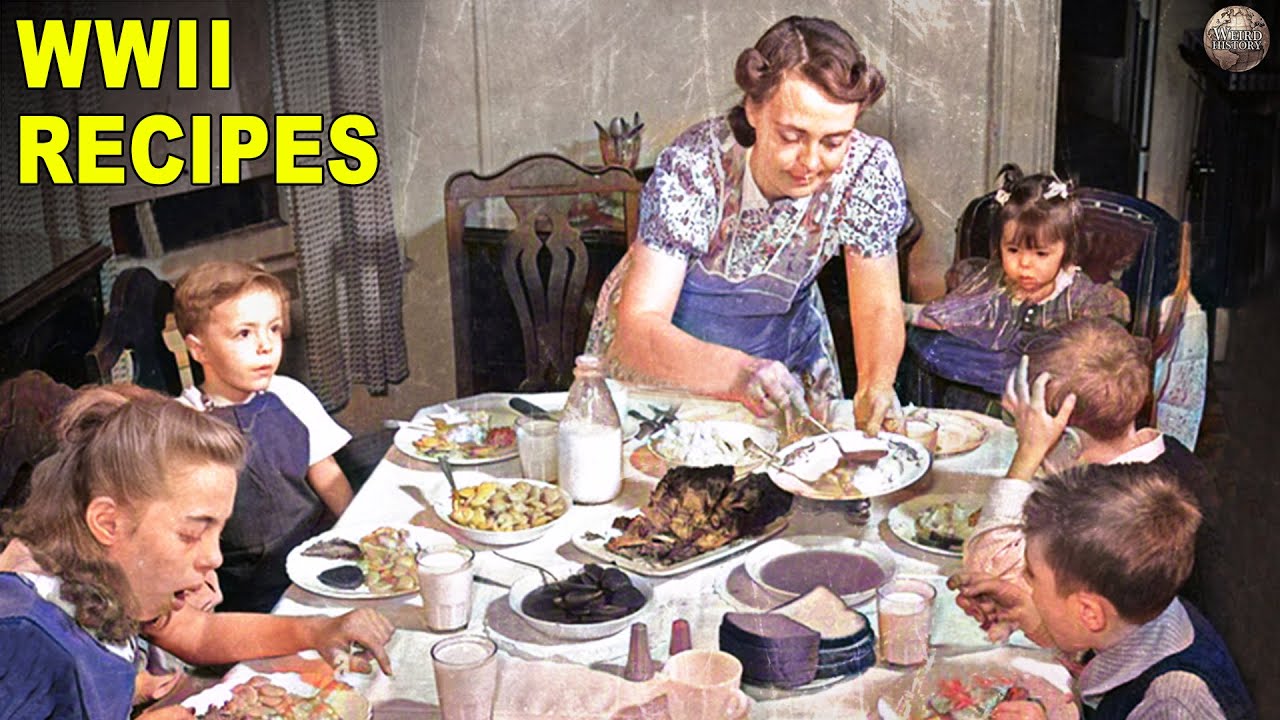
Here's What People Ate To Survive During WWII
video description
Date: 2022-12-29
Related videos





Comments and reviews: 20
pgandy1
The meat or lack of it, is what I remember mostly. There was spam and bologna, fried or otherwise. I had dislike for both and stopped with the spam after the war but ate bologna sandwiches from my brown lunch bag at school which stopped by high school. 20-30 years after the war I bought a can of spam out of nostalgia. It wasnt as bad as I remembered, but that one can was enough. We had fish from time to time as we lived on the coast. It was always flounder. I didnt like it nor the bones I had to contend with. And then there was hamburger in every conceivable manner, when available and no telling what was ground up in it. We were lucky as there was a lady in the next block that raised chickens that was a supply of eggs and meat. When in the need, we would walk around the corner, buy the chicken and she would place its head on a stump and gave a whack with a hatchet. I think at any other time there would have been a conflict with the zoning laws, but at that time who carried? Vegetables always seemed available, onions, string beans, potatoes, and beets. Mom had a thing she called Spanish Omelet that she served us kids frequently, I think mostly because it was easy to prepare. This was a can of Campbells Vegetable Soup, water, and sliced green olives. I liked those olives. Campbells Tomato Soup made with milk was also a favourite. Butter was non-existent, and I learned to eat bread substituting salt. It seems that peanut butter and jelly sandwiches were readily available. I remember the ration books and those tokens, and my mom or grandma saying that she couldnt buy whatever it was that day.
reply
The meat or lack of it, is what I remember mostly. There was spam and bologna, fried or otherwise. I had dislike for both and stopped with the spam after the war but ate bologna sandwiches from my brown lunch bag at school which stopped by high school. 20-30 years after the war I bought a can of spam out of nostalgia. It wasnt as bad as I remembered, but that one can was enough. We had fish from time to time as we lived on the coast. It was always flounder. I didnt like it nor the bones I had to contend with. And then there was hamburger in every conceivable manner, when available and no telling what was ground up in it. We were lucky as there was a lady in the next block that raised chickens that was a supply of eggs and meat. When in the need, we would walk around the corner, buy the chicken and she would place its head on a stump and gave a whack with a hatchet. I think at any other time there would have been a conflict with the zoning laws, but at that time who carried? Vegetables always seemed available, onions, string beans, potatoes, and beets. Mom had a thing she called Spanish Omelet that she served us kids frequently, I think mostly because it was easy to prepare. This was a can of Campbells Vegetable Soup, water, and sliced green olives. I liked those olives. Campbells Tomato Soup made with milk was also a favourite. Butter was non-existent, and I learned to eat bread substituting salt. It seems that peanut butter and jelly sandwiches were readily available. I remember the ration books and those tokens, and my mom or grandma saying that she couldnt buy whatever it was that day.
reply
Sheila
WE, in England, grew our own vegetables and dad dug up our lawn and flower beds. We were lucky because a high class prostitute had bought a house in our close of 24 semi-detached houses. in PrestwichManchester. Her clients were American Officers, stationed in Heaton Park. Manchester, with the British Air Force There were 10 small children living in the Close and Mrs. B. kept us supplied with oranges. She used to make us Ice-cream out of dried milk and eggs She had a fridge! --I don't know where the eggs came from either. My Gran used to make a cake without eggs using vinegar to make the cake rise. . It tasted OK, but after the War she went back to making a chocolate cake with the weight of 2 eggs in flour sugar and fat, and a tbsp of drinking chocolate. Once she even got 2 bunches of bananas. I did not know what they were. After the war her husband and sons came back from being soldiers and they moved to Edgeware because they were Jewish and she gave up her trade She was very kind to ujs children, Her door steps and window sills. were done with lovely red paint and she had very white, lace curtains. Her house was very, very clean. I just bought a small book called A 1940s childhood. Worth buying.
reply
WE, in England, grew our own vegetables and dad dug up our lawn and flower beds. We were lucky because a high class prostitute had bought a house in our close of 24 semi-detached houses. in PrestwichManchester. Her clients were American Officers, stationed in Heaton Park. Manchester, with the British Air Force There were 10 small children living in the Close and Mrs. B. kept us supplied with oranges. She used to make us Ice-cream out of dried milk and eggs She had a fridge! --I don't know where the eggs came from either. My Gran used to make a cake without eggs using vinegar to make the cake rise. . It tasted OK, but after the War she went back to making a chocolate cake with the weight of 2 eggs in flour sugar and fat, and a tbsp of drinking chocolate. Once she even got 2 bunches of bananas. I did not know what they were. After the war her husband and sons came back from being soldiers and they moved to Edgeware because they were Jewish and she gave up her trade She was very kind to ujs children, Her door steps and window sills. were done with lovely red paint and she had very white, lace curtains. Her house was very, very clean. I just bought a small book called A 1940s childhood. Worth buying.
reply
musicalme27
I'm a Baby Boomer, so I missed the WW2 era. However, veganism was a popular thing in the 70's onward. I grew up and lived for a long time in N. Y. C. which has a large Jewish population. Vegetarian restaurants were quite popular, and vegetarian chopped liver was featured on the menus. How I LOVED it! Even some supermarkets carried it (frozen, in plastic containers. You could find it in some delis. Now, I live in Houston; I doubt it could be found here. Probably, one would have to look high and low for a market that carries it, or one would have to make it oneself. Such bittersweet memories. As a young married couple, living in Brooklyn, N. Y. we could find vegetable chopped liver in the kosher food stores. Now, I'm a widow, and my son moved me to Houston so I can live close to him and his family. I would love to go back in time to recapture the happy times.
reply
I'm a Baby Boomer, so I missed the WW2 era. However, veganism was a popular thing in the 70's onward. I grew up and lived for a long time in N. Y. C. which has a large Jewish population. Vegetarian restaurants were quite popular, and vegetarian chopped liver was featured on the menus. How I LOVED it! Even some supermarkets carried it (frozen, in plastic containers. You could find it in some delis. Now, I live in Houston; I doubt it could be found here. Probably, one would have to look high and low for a market that carries it, or one would have to make it oneself. Such bittersweet memories. As a young married couple, living in Brooklyn, N. Y. we could find vegetable chopped liver in the kosher food stores. Now, I'm a widow, and my son moved me to Houston so I can live close to him and his family. I would love to go back in time to recapture the happy times.
reply
weird_history
Hoarder was a dirty word during the war. My grandmother used to tell me about having to use food coupons, and having to save up things like sugar for Thanksgiving and Christmas treats. She and Grandpa raised chickens and rabbits, so had eggs and meat, and a cow for milk. They would also buy a piglet and fatten him up for pork. They also had a huge garden every summer, and my grandmother would can food for the winter: tomatoes, green beans, corn, tomato juice, potatoes (which are harder) and various pickled and preserved vegetables, including onions. When she didn't have enough left to can another run, she's make vegetable soup and can that. They survived very well during both the Depression and the war, frequently fed other people, and did it without hoarding.
reply
Hoarder was a dirty word during the war. My grandmother used to tell me about having to use food coupons, and having to save up things like sugar for Thanksgiving and Christmas treats. She and Grandpa raised chickens and rabbits, so had eggs and meat, and a cow for milk. They would also buy a piglet and fatten him up for pork. They also had a huge garden every summer, and my grandmother would can food for the winter: tomatoes, green beans, corn, tomato juice, potatoes (which are harder) and various pickled and preserved vegetables, including onions. When she didn't have enough left to can another run, she's make vegetable soup and can that. They survived very well during both the Depression and the war, frequently fed other people, and did it without hoarding.
reply
Paul
My parents both were Depression Era kids. Dad was also a World War 2 Navy veteran. They had hard times, all through till probably the 1950s. One thing they both said, that even if they didn't have much money. They ate well. Dad's family, were dairy farmers, and mom's parents lived not too far away, in a small coal mining town, in what they called a, patch. Both of my parents sides, had gardens, raised chickens and rabbits, etc. Hunted, fished, and canned vegetables and fruits. My parents continued to have gardens, fruit trees, berry patches and so on, till the early 1980s. Mom could sew just about anything, fix things, dad and her built our house, and it's still there. They tried to make us as self sufficient, as possible. Hopefully, they did?
reply
My parents both were Depression Era kids. Dad was also a World War 2 Navy veteran. They had hard times, all through till probably the 1950s. One thing they both said, that even if they didn't have much money. They ate well. Dad's family, were dairy farmers, and mom's parents lived not too far away, in a small coal mining town, in what they called a, patch. Both of my parents sides, had gardens, raised chickens and rabbits, etc. Hunted, fished, and canned vegetables and fruits. My parents continued to have gardens, fruit trees, berry patches and so on, till the early 1980s. Mom could sew just about anything, fix things, dad and her built our house, and it's still there. They tried to make us as self sufficient, as possible. Hopefully, they did?
reply
ManyaP
It doesnt hurt to at least learn some of the principles of being economic in the kitchen when cooking. We saw how hard it was and still is to get certain ingredients during lockdown or how expensive it has become to get basics like eggs. I had ordered powdered milks and eggs in February of 2020 not realizing how hard it was going to be to get some of these items fresh over the following months. Learning how to cook meals using inexpensive ingredients such as beans, rice and flour is important for all of us. Even making six figures, I learned from my mom (she was a teenager at the end of WWII) how to conserve and shop at dollar stores. Very little goes to waste in my home and I cook as much as possible.
reply
It doesnt hurt to at least learn some of the principles of being economic in the kitchen when cooking. We saw how hard it was and still is to get certain ingredients during lockdown or how expensive it has become to get basics like eggs. I had ordered powdered milks and eggs in February of 2020 not realizing how hard it was going to be to get some of these items fresh over the following months. Learning how to cook meals using inexpensive ingredients such as beans, rice and flour is important for all of us. Even making six figures, I learned from my mom (she was a teenager at the end of WWII) how to conserve and shop at dollar stores. Very little goes to waste in my home and I cook as much as possible.
reply
Christine
To ''survive''? The people in the UK had a FRACTION of what is shown here and far less products too. The women would queue only to find that the paltry amount of whatever was being sold had all gone. Sweets were never seen. My mother never had sweets and they were always hungry. Added to that air raids were frequent. She spent most of her schooldays in a shelter, praying while bombs rained down, shaking the ground. The poor children didn't even know if they would have a home ( and Mother) to return to and would walk home, a couple of miles to meagre rations, passing bombed out buildings. it was a much different war for Britain.
reply
To ''survive''? The people in the UK had a FRACTION of what is shown here and far less products too. The women would queue only to find that the paltry amount of whatever was being sold had all gone. Sweets were never seen. My mother never had sweets and they were always hungry. Added to that air raids were frequent. She spent most of her schooldays in a shelter, praying while bombs rained down, shaking the ground. The poor children didn't even know if they would have a home ( and Mother) to return to and would walk home, a couple of miles to meagre rations, passing bombed out buildings. it was a much different war for Britain.
reply
Major
As the eighth son, tenth child, in a family of thirteen, I was happy to eat whatever was put on the table. No one had allergies, couldn't eat this or that, must have gluten free, low salt, low fat, sugar free. Years later, a family friend told me my dear old ma would chop up old, broken leather shoe laces (which were made from cowhide) and add them to the soup. Once in a while my dear old pa would turn up with a pig (who knows or cares where it came from. After a few weeks of 'fattening', it was killed, shared with a few others and eaten. My dear old nan (died at 101) said the only thing thrown away was the teeth.
reply
As the eighth son, tenth child, in a family of thirteen, I was happy to eat whatever was put on the table. No one had allergies, couldn't eat this or that, must have gluten free, low salt, low fat, sugar free. Years later, a family friend told me my dear old ma would chop up old, broken leather shoe laces (which were made from cowhide) and add them to the soup. Once in a while my dear old pa would turn up with a pig (who knows or cares where it came from. After a few weeks of 'fattening', it was killed, shared with a few others and eaten. My dear old nan (died at 101) said the only thing thrown away was the teeth.
reply
Sherry
My grandparents lived threw the depression & WWII but luckily were on a farm they made potato pancakes I love them - also German dishes like hot lettuce a soupy stuff you put over mashed potatoes- it had a vinegar added to it & actual lettuce topped with sliced hard boiled eggs & crumbles of bacon I love that too haven't had it in many decades - but nowadays when I cook I think how hard it was for. y grandmother (mom mom) to make everything from scratch the hard way no convenience- & I can barely do it with modern day convenience
reply
My grandparents lived threw the depression & WWII but luckily were on a farm they made potato pancakes I love them - also German dishes like hot lettuce a soupy stuff you put over mashed potatoes- it had a vinegar added to it & actual lettuce topped with sliced hard boiled eggs & crumbles of bacon I love that too haven't had it in many decades - but nowadays when I cook I think how hard it was for. y grandmother (mom mom) to make everything from scratch the hard way no convenience- & I can barely do it with modern day convenience
reply
freakyflow
As we are Metis. We had Rainbow trout And other fish. Homeground potatos, Corn Serviceberries Blueberries Raspberries, Moose, Deer, rabbit And beaver And a long list of plants Honey. And in those days Trade was better than money And ration cards. 2 lbs of moose for 1 lbs of pork 1. 5 lbs of beef 1/2 of a chicken or 2 eggs. Out of that you also had Leather And furs to trade And that week of trading back and forth your lots you had flour and eggs and sugar etc And smoked meats to last you over the winter
reply
As we are Metis. We had Rainbow trout And other fish. Homeground potatos, Corn Serviceberries Blueberries Raspberries, Moose, Deer, rabbit And beaver And a long list of plants Honey. And in those days Trade was better than money And ration cards. 2 lbs of moose for 1 lbs of pork 1. 5 lbs of beef 1/2 of a chicken or 2 eggs. Out of that you also had Leather And furs to trade And that week of trading back and forth your lots you had flour and eggs and sugar etc And smoked meats to last you over the winter
reply
Betty
Beef tongue can be rubbery but isn't tough. It is a consistent texture throughout. After boiling with onions and herbs we would cool it and then slice into thin slices and it would retain it's shape. With any other meat you run the risk of it breaking into pieces. But this was more like the firmness of cold cuts. We were too poor growing up to be able to buy extravagant things like a chub of bologna so this was our version of lunch meat for our sandwiches when we got tired of jam and butter sandwiches.
reply
Beef tongue can be rubbery but isn't tough. It is a consistent texture throughout. After boiling with onions and herbs we would cool it and then slice into thin slices and it would retain it's shape. With any other meat you run the risk of it breaking into pieces. But this was more like the firmness of cold cuts. We were too poor growing up to be able to buy extravagant things like a chub of bologna so this was our version of lunch meat for our sandwiches when we got tired of jam and butter sandwiches.
reply
craig
I grew up on bubble and squeak. On Sundays we had the traditional roast. Any left over potatoes, cabbage was kept for lunch on Monday. My mother would fry them together in lard sometimes adding a chopped onion. The lard made them form a delicious crust. With the price of oil gone through the roof I have gone back to using lard. It makes the best roast potatoes, chips and pastry. If you like your roast potatoes crispy on the outside and light and fluffy on the inside, use lard.
reply
I grew up on bubble and squeak. On Sundays we had the traditional roast. Any left over potatoes, cabbage was kept for lunch on Monday. My mother would fry them together in lard sometimes adding a chopped onion. The lard made them form a delicious crust. With the price of oil gone through the roof I have gone back to using lard. It makes the best roast potatoes, chips and pastry. If you like your roast potatoes crispy on the outside and light and fluffy on the inside, use lard.
reply
Anibal
I was brought up in a Farm. we eat what the land produced. when I came to Britain in the middle of the 80s I couldn't understand why they eat so much fried food. and everything was and stil is wrapped in breadcrumbs, specially fish. and I was going to street markets and fresh vegetables they were everywhere, but only being bought by some much older generation. because young people they rather have burgers or take aways. I wonder Why. too last to cook
reply
I was brought up in a Farm. we eat what the land produced. when I came to Britain in the middle of the 80s I couldn't understand why they eat so much fried food. and everything was and stil is wrapped in breadcrumbs, specially fish. and I was going to street markets and fresh vegetables they were everywhere, but only being bought by some much older generation. because young people they rather have burgers or take aways. I wonder Why. too last to cook
reply
Collette
My mother was born 1924. This brings her back to me and all the stories of her own experiences during WW2. One was that when she and friends were going out to dance, they would take turns drawing a black line down the back of each other's legs to look like they were wearing silk stockings because all silk in USA was used for parachutes.
Thankyou, I really enjoyed this, and am sharing with my daughter.
reply
My mother was born 1924. This brings her back to me and all the stories of her own experiences during WW2. One was that when she and friends were going out to dance, they would take turns drawing a black line down the back of each other's legs to look like they were wearing silk stockings because all silk in USA was used for parachutes.
Thankyou, I really enjoyed this, and am sharing with my daughter.
reply
Orwellian
And that's why war is bad. Soldiers hoard all the food and aren't doing anything to produce more food or things that civilians need, instead they destroy everything that the civilians of the other side need. It's much better to make peace and cooperate with each other to create more wealth together. And when there's peace we don't need soldiers, so they can also get normal/productive jobs.
reply
And that's why war is bad. Soldiers hoard all the food and aren't doing anything to produce more food or things that civilians need, instead they destroy everything that the civilians of the other side need. It's much better to make peace and cooperate with each other to create more wealth together. And when there's peace we don't need soldiers, so they can also get normal/productive jobs.
reply
Lynn
We're headed that way again. Have you noticed the food shortages and out of control inflation. all while those dependent on the government are getting raises to cope. It's wealth redistribution. While the middle class pays more for every day items, the dependents get raises. The food shortages are getting worse. Soon the socialists will be rationing.
reply
We're headed that way again. Have you noticed the food shortages and out of control inflation. all while those dependent on the government are getting raises to cope. It's wealth redistribution. While the middle class pays more for every day items, the dependents get raises. The food shortages are getting worse. Soon the socialists will be rationing.
reply
Abby
They just changed the name of sawdust but it's still in a lot of things as cellulose.
My mother's family subsisted on mainly potatoes and cabbage when they could get them. They were very poor and I heard that my one aunt got a meal from a neighbour one time and threw up because she wasn't used to having food.
reply
They just changed the name of sawdust but it's still in a lot of things as cellulose.
My mother's family subsisted on mainly potatoes and cabbage when they could get them. They were very poor and I heard that my one aunt got a meal from a neighbour one time and threw up because she wasn't used to having food.
reply
Ruth
My mom was born during depression, lived in a tent and slept in a pallet. She remembers eating a lit of chocolate pudding.
Mom had 8 children so she used many of the foods here in video to feed us. Many casseroles.
We had a farm do we ended up eating a lit of fresh veggies snd fruit
reply
My mom was born during depression, lived in a tent and slept in a pallet. She remembers eating a lit of chocolate pudding.
Mom had 8 children so she used many of the foods here in video to feed us. Many casseroles.
We had a farm do we ended up eating a lit of fresh veggies snd fruit
reply
pandorazbox
Nope, during thr Last years of ww2 you gave a little help plus you made britain pay for the privilage of your
Arms assistance. Do not even go there. You have nothing to be proud of. ps korea vietnam. iraq Afganistan. bully Boys one and all.
Pah
reply
Nope, during thr Last years of ww2 you gave a little help plus you made britain pay for the privilage of your
Arms assistance. Do not even go there. You have nothing to be proud of. ps korea vietnam. iraq Afganistan. bully Boys one and all.
Pah
reply
DRAKKENFIRE22
I hate Grape Nuts cereal! If you eat it immediately, its hard and gritty. If you try to let it sit for a minute, it becomes mushy. I was glad when my grandmother went back to serving plain old Corn Flakes for breakfast. Frosted Flakes was a luxury!
reply
I hate Grape Nuts cereal! If you eat it immediately, its hard and gritty. If you try to let it sit for a minute, it becomes mushy. I was glad when my grandmother went back to serving plain old Corn Flakes for breakfast. Frosted Flakes was a luxury!
reply
Add a review, comment
Other channel videos