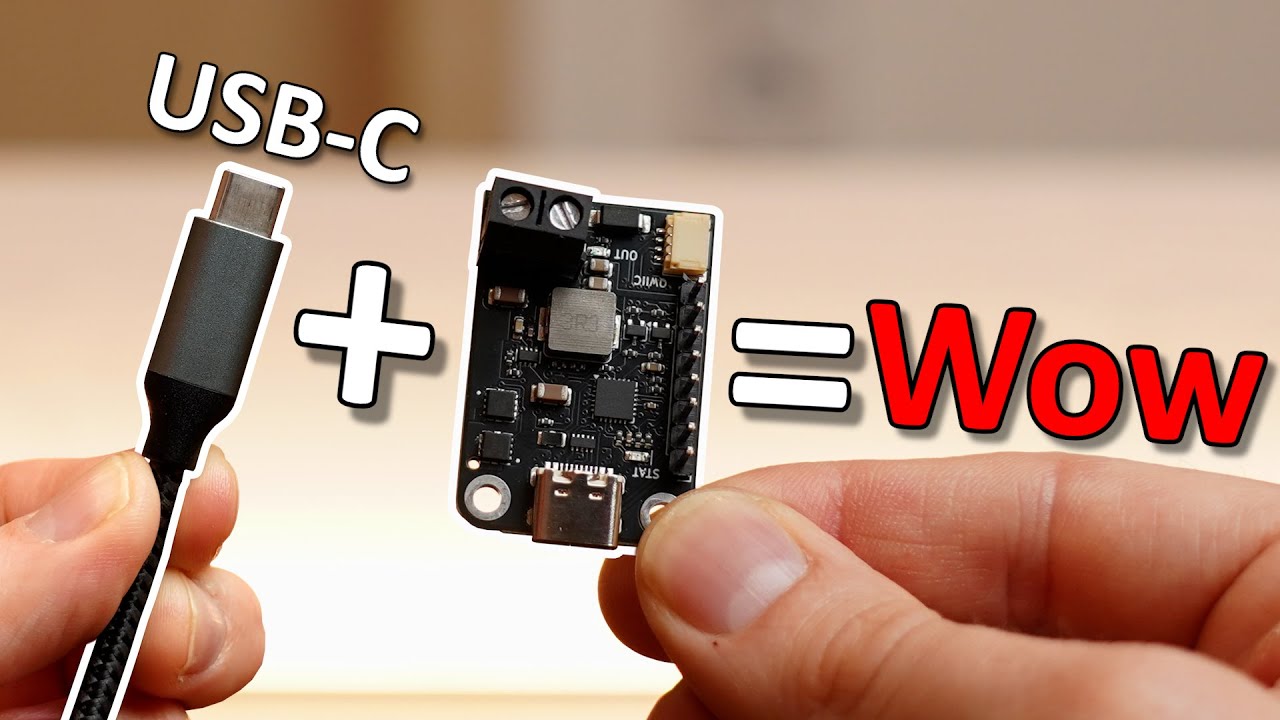
USB-C Just got Even Better! (PPS)
video description
Date: 2025-03-24
Related videos


• TED-Ed



Comments and reviews: 20
ccshello1
I've tested an inexpensive USB-C PD/PPS trigger from the popular e-commerce place. It's full manual mode of operation with 2 colored push buttons (Green and Red) Unfortunately, I have to report that its PPS mode isn't really feasible. First, it won't retain previous PPS setting after power is removed. Second, you have to press crazy amount of button pushes to reach high enough output value due to fine adj increments.
Note: different PPS power supply units have different response time, it's impossible to mechanically press a fixed amount of pushes to arrive the same voltage. Some units simply ignore up voltage commands. To be honest, IMHO this direction probably is only good for a full PPS-sink side uP controlled, voltage monitored system. With all that, I'd go back to a traditional power supply instead of relying on a client-server communication method, unless it's for smart phone charging.
reply
I've tested an inexpensive USB-C PD/PPS trigger from the popular e-commerce place. It's full manual mode of operation with 2 colored push buttons (Green and Red) Unfortunately, I have to report that its PPS mode isn't really feasible. First, it won't retain previous PPS setting after power is removed. Second, you have to press crazy amount of button pushes to reach high enough output value due to fine adj increments.
Note: different PPS power supply units have different response time, it's impossible to mechanically press a fixed amount of pushes to arrive the same voltage. Some units simply ignore up voltage commands. To be honest, IMHO this direction probably is only good for a full PPS-sink side uP controlled, voltage monitored system. With all that, I'd go back to a traditional power supply instead of relying on a client-server communication method, unless it's for smart phone charging.
reply
MikeHarris1984
The opening ad that you did for the PCBs JLC PCB, who I have used for years and absolutely love! They are a fraction price of PCB way and have amazing quality results And every time I order a batch of like 50 boards, from the time I order in USA, Arizona, to the day that they are delivered on my doorstep, is usually 5 days or less. Only once did it go longer up to 10 days and that was due to a special configuration I had or needed with part of it. But otherwise they are extremely fast! Anyways what I was talking about was your lines sounded like the Marines code at first what they say in full metal jacket, when They say this is my rifle, there are many like it but this one is mine whenever you started saying this is my PCB, there are many like them lol
reply
The opening ad that you did for the PCBs JLC PCB, who I have used for years and absolutely love! They are a fraction price of PCB way and have amazing quality results And every time I order a batch of like 50 boards, from the time I order in USA, Arizona, to the day that they are delivered on my doorstep, is usually 5 days or less. Only once did it go longer up to 10 days and that was due to a special configuration I had or needed with part of it. But otherwise they are extremely fast! Anyways what I was talking about was your lines sounded like the Marines code at first what they say in full metal jacket, when They say this is my rifle, there are many like it but this one is mine whenever you started saying this is my PCB, there are many like them lol
reply
FrankConforti
This is all and good until it burns up. Case in point I bought some cheap strobe lights for my drone that charges its batteries via a USB charger. Not thinking much about this, I plugged one in to a reliable PPS charger only to have it BURN UP the device and USB cable. Up until now I thought it was safe to just plug it in to charge. Now, I have to consider FIRE as one of the outcomes if I’m not paying attention. I understand that this isn’t the fault of the standard but shows the dark side of cheap’ poorly designed gadgets can result in actual damage (this just happened yesterday. A dumb old school USB charger has its advantages.
reply
This is all and good until it burns up. Case in point I bought some cheap strobe lights for my drone that charges its batteries via a USB charger. Not thinking much about this, I plugged one in to a reliable PPS charger only to have it BURN UP the device and USB cable. Up until now I thought it was safe to just plug it in to charge. Now, I have to consider FIRE as one of the outcomes if I’m not paying attention. I understand that this isn’t the fault of the standard but shows the dark side of cheap’ poorly designed gadgets can result in actual damage (this just happened yesterday. A dumb old school USB charger has its advantages.
reply
greatscott
Slowly doing more and more research into a solution for my problem with too many consoles!
Looking at making a custom USBC supply for my console setup, since there is not a product on the market to meet my demands.
Need to power 8x GameCubes (Modded with USBC ports supporting PD) (12V 3. 25A, and 4x Wii’s (USBC port supporting PD) (12V 3. 75A.
All these systems to be powered and connected to the custom power unit by USB-C to USB-C Cable. 12 ports on one unit
Any tips on how I’d go about source together components and a Wall outlet PSU
reply
Slowly doing more and more research into a solution for my problem with too many consoles!
Looking at making a custom USBC supply for my console setup, since there is not a product on the market to meet my demands.
Need to power 8x GameCubes (Modded with USBC ports supporting PD) (12V 3. 25A, and 4x Wii’s (USBC port supporting PD) (12V 3. 75A.
All these systems to be powered and connected to the custom power unit by USB-C to USB-C Cable. 12 ports on one unit
Any tips on how I’d go about source together components and a Wall outlet PSU
reply
piano40s
All very impressive but there is another side, 80% of faults on phones/computers and other devises are due to USB connections the more you plug/unplug them the weaker they get and will fail, they work fine if left plugged in, they are made out of the cheapest alloys the manufacturer can source, pay a $1000 for the latest phone it will fail in time for a USB port that costs a few penny's to make, the solution make them stronger which won't be easy as they are so small and nearly impossible to replace without the right tools.
reply
All very impressive but there is another side, 80% of faults on phones/computers and other devises are due to USB connections the more you plug/unplug them the weaker they get and will fail, they work fine if left plugged in, they are made out of the cheapest alloys the manufacturer can source, pay a $1000 for the latest phone it will fail in time for a USB port that costs a few penny's to make, the solution make them stronger which won't be easy as they are so small and nearly impossible to replace without the right tools.
reply
DistinctGamer_
I have a genuine question. I’m an Electrical and Computer engineer by major and absolutely loved tinkering with circuitry and such in college and still mess with arduinos and raspberry pi’s today. What job did you have/do you currently have I went down the power world (horrible, it’s very trivial and not challenging in the slightest) so I’m interested in pursuing a more challenging and interesting career. What would that job title be PCB designer Circuit designer I have no clue.
Love the videos, thank you!
reply
I have a genuine question. I’m an Electrical and Computer engineer by major and absolutely loved tinkering with circuitry and such in college and still mess with arduinos and raspberry pi’s today. What job did you have/do you currently have I went down the power world (horrible, it’s very trivial and not challenging in the slightest) so I’m interested in pursuing a more challenging and interesting career. What would that job title be PCB designer Circuit designer I have no clue.
Love the videos, thank you!
reply
greatscott
Delta Electronics makes a 240W (48V) EPR supply, you can find it on Mouser (although currently only for commercial customers.
ADP 240KB
Using one of those cheapo EPR triggers, I have managed to set it to 48V, and that works great as expected: )
My next project is to make a fast charger for Bosch Procore batteries, so I can charge the 12Ah packs at 1C. Or for charging eBike battery packs.
Using a simple buck DCDC you can also make an adapter to charge power hungry laptops, for example 170W 20V
reply
Delta Electronics makes a 240W (48V) EPR supply, you can find it on Mouser (although currently only for commercial customers.
ADP 240KB
Using one of those cheapo EPR triggers, I have managed to set it to 48V, and that works great as expected: )
My next project is to make a fast charger for Bosch Procore batteries, so I can charge the 12Ah packs at 1C. Or for charging eBike battery packs.
Using a simple buck DCDC you can also make an adapter to charge power hungry laptops, for example 170W 20V
reply
siberx4
Dang, thanks for running these tests. I was under the impression that PPS would limit via both constant current & voltage so that a device could simply set its parameters and wire the input straight up to the battery, but sounds like that's not the case if the current limit isn't actually implemented/enforced in the charger itself.
You definitely need an active monitoring loop to keep track of the current yourself and adjust the incoming voltage accordingly!
reply
Dang, thanks for running these tests. I was under the impression that PPS would limit via both constant current & voltage so that a device could simply set its parameters and wire the input straight up to the battery, but sounds like that's not the case if the current limit isn't actually implemented/enforced in the charger itself.
You definitely need an active monitoring loop to keep track of the current yourself and adjust the incoming voltage accordingly!
reply
pastek957
I didn't know about that, great!
That said, I would first and foremost refer to what the supply explicitly says on the label/product sheet. The fact that its chip claims to be able to follow PPS can very well be a default/remnant from debugging etc.
And when you're working out of specs like this, you better check extensively the supply as you'll very likely fry your board (as shown here with the current limit not working & overshooting the voltage)
reply
I didn't know about that, great!
That said, I would first and foremost refer to what the supply explicitly says on the label/product sheet. The fact that its chip claims to be able to follow PPS can very well be a default/remnant from debugging etc.
And when you're working out of specs like this, you better check extensively the supply as you'll very likely fry your board (as shown here with the current limit not working & overshooting the voltage)
reply
alastairleith8612
don’t know why this appeared in my feed but so happens a few years ago after reading about the issues around charging LithIon cells/batteries i was thinking to ask an electrical engineer to help me create a clever charging device for use with all devices which use lithium ion batteries to increase battery longevity.
sounds like it is all done now and i can buy off the shelf. thanks so much for this video. very interesting.
reply
don’t know why this appeared in my feed but so happens a few years ago after reading about the issues around charging LithIon cells/batteries i was thinking to ask an electrical engineer to help me create a clever charging device for use with all devices which use lithium ion batteries to increase battery longevity.
sounds like it is all done now and i can buy off the shelf. thanks so much for this video. very interesting.
reply
MalcolmCrabbe
Do these devices pass through USB communications as well - There are several projects such as using an Arduino for motor control via an application on a PC would benefit from this. One lead in, USB pass through to the Uno, and 12v up to 3A to a motor shield to control steppers or DC motors, all through a single USB C cable. Would save having to use a 12v 3A power brick for the motorshield.
reply
Do these devices pass through USB communications as well - There are several projects such as using an Arduino for motor control via an application on a PC would benefit from this. One lead in, USB pass through to the Uno, and 12v up to 3A to a motor shield to control steppers or DC motors, all through a single USB C cable. Would save having to use a 12v 3A power brick for the motorshield.
reply
greatscott
But [how] does this work across USB hubs, splitters, adaptors, etc I'd expect most of those are too dumb to support anything other than the minimal fixed voltage, and some might even be dangerous in that when one side of a split requests higher voltage all the other sides would unexpectedly get fed that higher voltage as well and be fried. Are there protections against that
reply
But [how] does this work across USB hubs, splitters, adaptors, etc I'd expect most of those are too dumb to support anything other than the minimal fixed voltage, and some might even be dangerous in that when one side of a split requests higher voltage all the other sides would unexpectedly get fed that higher voltage as well and be fried. Are there protections against that
reply
Lucavon
Now all I need is a way to configure the module to give me a specific voltage, but without an external microcontroller. I have a project where I need 16. 8V to replace a built-in battery, and while I could also put in a microcontroller, it feels a bit like a waste to use a whole microcontroller just to configure the PPS when it gets connected to power. So close!
reply
Now all I need is a way to configure the module to give me a specific voltage, but without an external microcontroller. I have a project where I need 16. 8V to replace a built-in battery, and while I could also put in a microcontroller, it feels a bit like a waste to use a whole microcontroller just to configure the PPS when it gets connected to power. So close!
reply
danbaker2619
Awesome boards, but when it comes to the crunch, I can get ten or more lesser boards that do a similar job for the price of one of these boards you rightfully advertise as the best board for the job. Worse still I live in Australia, and we have no market demand like Europe and America so we end up paying two or three times the price that you guys do: (
reply
Awesome boards, but when it comes to the crunch, I can get ten or more lesser boards that do a similar job for the price of one of these boards you rightfully advertise as the best board for the job. Worse still I live in Australia, and we have no market demand like Europe and America so we end up paying two or three times the price that you guys do: (
reply
inconnu_connue
That's exactly what does my phone but with a bit more power, I have a high end Xiaomi phone that can charge at a max if 120W but I can't charged it passed 30W due to protocol because Xiaomi has a proprietary charging protocol that allow 1) the 120W charging 2) has a AVS feature because it goes from 18 to 16V all without interrupt charge
reply
That's exactly what does my phone but with a bit more power, I have a high end Xiaomi phone that can charge at a max if 120W but I can't charged it passed 30W due to protocol because Xiaomi has a proprietary charging protocol that allow 1) the 120W charging 2) has a AVS feature because it goes from 18 to 16V all without interrupt charge
reply
MMuraseofSandvich
Caveat: Make absolutely sure that your USB type C cable and power source actually supports this! There are many, many cables out there that do not. Fortunately things are not like the time Benson Leung fried his laptop because a cable was out of spec, but it's always a good idea to know what your devices and cables are capable of.
reply
Caveat: Make absolutely sure that your USB type C cable and power source actually supports this! There are many, many cables out there that do not. Fortunately things are not like the time Benson Leung fried his laptop because a cable was out of spec, but it's always a good idea to know what your devices and cables are capable of.
reply
Christian-NaitSirC
I have a question. In your opinion the power in AVS that is given could be used as phantom power to feed microphones or audio DI that ask for 48V I mean if the technology involved will push noise in the system making the mic or the other audio instruments not good or if the output is clean from rf or other emf noises. Thanks
reply
I have a question. In your opinion the power in AVS that is given could be used as phantom power to feed microphones or audio DI that ask for 48V I mean if the technology involved will push noise in the system making the mic or the other audio instruments not good or if the output is clean from rf or other emf noises. Thanks
reply
reyzafany1992
Does that mean I can charge my old Acer laptop as effectively as with the original 19V3. 42A charger I'm interested in replacing my laptop's bulky power brick with a 65W Power Delivery charger using a Type-C to DC jack converter, but I'm concerned that the PD charger's voltage for 65W output is 20V3. 25A instead of 19V3. 42A.
reply
Does that mean I can charge my old Acer laptop as effectively as with the original 19V3. 42A charger I'm interested in replacing my laptop's bulky power brick with a 65W Power Delivery charger using a Type-C to DC jack converter, but I'm concerned that the PD charger's voltage for 65W output is 20V3. 25A instead of 19V3. 42A.
reply
someguy2741
I think it is dangerous to select amperage greater than the powerbank or wall supply. The maximum amperage often requires heatsinks to do it safely. The power bank may not have the ability to get rid of the heat. That could lead to overheating components in the power supply or power bank and that could be dangerous.
reply
I think it is dangerous to select amperage greater than the powerbank or wall supply. The maximum amperage often requires heatsinks to do it safely. The power bank may not have the ability to get rid of the heat. That could lead to overheating components in the power supply or power bank and that could be dangerous.
reply
greatscott
Is there a high-quality simple device/kit for the opposite functionality I have USB-C-powered lamps that under max load use 12 V/3 A (Estimated amperage. I’d like to power multiple units with an already existing very efficient 12 V DC power supply (a Titanium-rated PC power supply.
Thanks for any advice!
reply
Is there a high-quality simple device/kit for the opposite functionality I have USB-C-powered lamps that under max load use 12 V/3 A (Estimated amperage. I’d like to power multiple units with an already existing very efficient 12 V DC power supply (a Titanium-rated PC power supply.
Thanks for any advice!
reply
Add a review, comment
Other channel videos