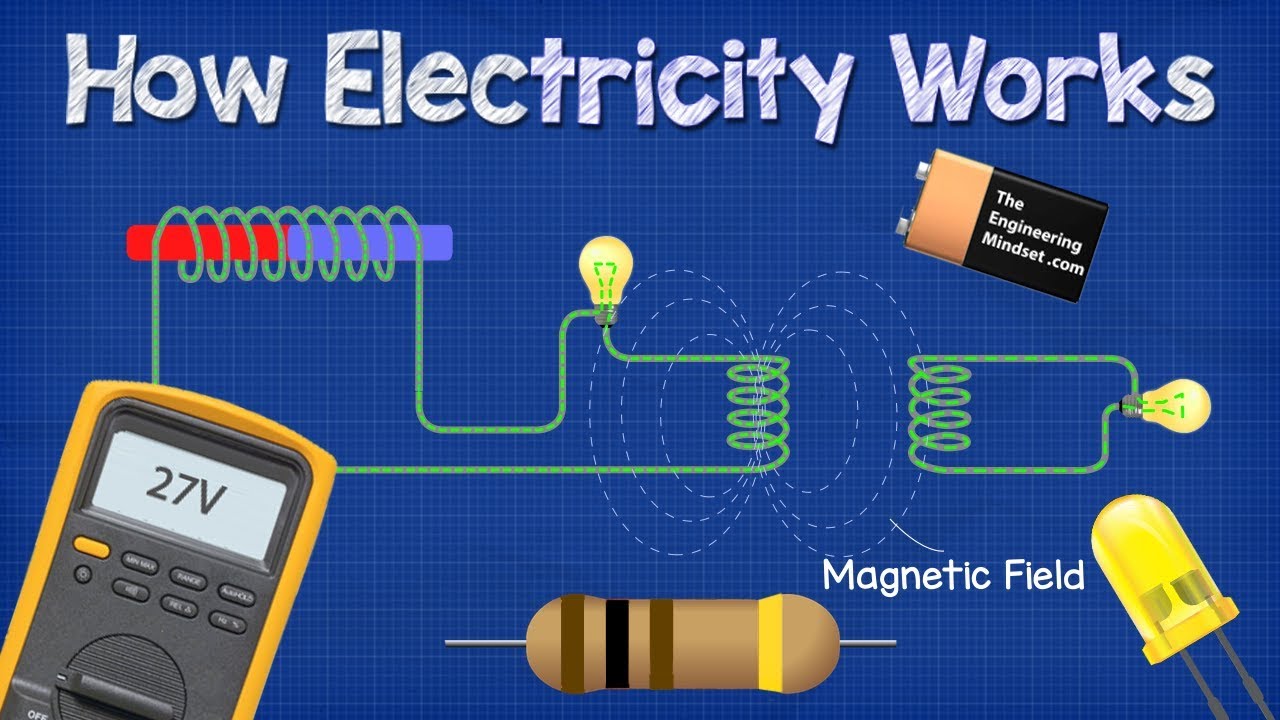
How ELECTRICITY works - working principle
video description
Date: 2023-11-17
Related videos





Comments and reviews: 24
education
If electricity can be induced by an electromagnet with a direct source, in a direct current generator, why should the coils of each ( armture or rotor & stator ) be connected to a direct current source? Why don't they just connect the winding of the moving part with a D. C, which produces a magnetic flux, and move the crankshaft by any means that induces electricity on the Winding of the stator part, and thus it can be exploited( i. e. direct current is supplied to the rotor coils rather than the stator coils )
reply
If electricity can be induced by an electromagnet with a direct source, in a direct current generator, why should the coils of each ( armture or rotor & stator ) be connected to a direct current source? Why don't they just connect the winding of the moving part with a D. C, which produces a magnetic flux, and move the crankshaft by any means that induces electricity on the Winding of the stator part, and thus it can be exploited( i. e. direct current is supplied to the rotor coils rather than the stator coils )
reply
Dj
all energy is fields, we live in a magnetic field, your body has a magnetic field, you can only generate electricity from a magnetic field, take away your electron idea and go back through everything you know and apply only fields, and you will notice it all still works the same way except its much easier to understand, and then you will notice how much nonsense has been added to compensate for the electron rubbish.
reply
all energy is fields, we live in a magnetic field, your body has a magnetic field, you can only generate electricity from a magnetic field, take away your electron idea and go back through everything you know and apply only fields, and you will notice it all still works the same way except its much easier to understand, and then you will notice how much nonsense has been added to compensate for the electron rubbish.
reply
Popandu
Another great video thank-you. I have a question regardsing AC; in principle, I understand that it changes direction. But, how does it actually do this? what actually makes that happen and why? secondly, given that it does go back and forth, I struggle to visualize how electrons actually flow across a distance from say A to B. Why don't they 'get stuck' between A and B because they are going back and forth?
reply
Another great video thank-you. I have a question regardsing AC; in principle, I understand that it changes direction. But, how does it actually do this? what actually makes that happen and why? secondly, given that it does go back and forth, I struggle to visualize how electrons actually flow across a distance from say A to B. Why don't they 'get stuck' between A and B because they are going back and forth?
reply
Chibacha21
I have found a mistake in this video that is crucial to electromagnetism. In 3: 59, the video states that 1 Amp (short for Ampere, a unit of current) = 1 Coulomb (unit of charge, not current. The correct equation would be 1 As (Ampere-second, how many Amperes flow through in 1 second) = 1 Coulomb. Please fix this as it's a mistake that seems to be overlooked, yet it is one that needs to be removed.
reply
I have found a mistake in this video that is crucial to electromagnetism. In 3: 59, the video states that 1 Amp (short for Ampere, a unit of current) = 1 Coulomb (unit of charge, not current. The correct equation would be 1 As (Ampere-second, how many Amperes flow through in 1 second) = 1 Coulomb. Please fix this as it's a mistake that seems to be overlooked, yet it is one that needs to be removed.
reply
DragonGod
I loved learning growing up, but when i got to highscho had so many stuff going on and just rushed it i did the bare min to get by due to personal reasons with family and finace, but now im tryna get something for thatll ill be proud of and thats a bachelors in eletrical and mechanical ik itll be hard but ive never been afraid of work. Im not doin it for anyone but me this time.
reply
I loved learning growing up, but when i got to highscho had so many stuff going on and just rushed it i did the bare min to get by due to personal reasons with family and finace, but now im tryna get something for thatll ill be proud of and thats a bachelors in eletrical and mechanical ik itll be hard but ive never been afraid of work. Im not doin it for anyone but me this time.
reply
AR
Great video! I love the topic of electricity, especially when it comes to outdoor camping and family time. Have you heard of the Segway Portable PowerStation Cube Series? It's a versatile powerhouse that can keep your devices and appliances running for extended periods. The waterproof design and fast recharging capabilities make it a great choice for outdoor enthusiasts. Check it out!
reply
Great video! I love the topic of electricity, especially when it comes to outdoor camping and family time. Have you heard of the Segway Portable PowerStation Cube Series? It's a versatile powerhouse that can keep your devices and appliances running for extended periods. The waterproof design and fast recharging capabilities make it a great choice for outdoor enthusiasts. Check it out!
reply
MAINESS
I used to tell my late Papa that I will be an engineer one day others say you are a girl can you not follow another career you know what engineering is a talent i am able to fix phones, speakers and touch light iam 19years old iam hoping soon to go to university never give up on your career you are strong the way you are.
reply
I used to tell my late Papa that I will be an engineer one day others say you are a girl can you not follow another career you know what engineering is a talent i am able to fix phones, speakers and touch light iam 19years old iam hoping soon to go to university never give up on your career you are strong the way you are.
reply
Josh
I think a lot of physicists would have a problem with calling electron orbitals flight paths. but I suppose in engineering, you have to think of things in terms of how they act, and electrons sure do act almost exactly like they're on flight paths
reply
I think a lot of physicists would have a problem with calling electron orbitals flight paths. but I suppose in engineering, you have to think of things in terms of how they act, and electrons sure do act almost exactly like they're on flight paths
reply
basics
I watched this about 6 times very hard for me to grasp but its super interesting I start school tomorrow for electrical tech hopefully I do good good luck for everyone starting school. I end school in 10 months Ill let you know how I do
reply
I watched this about 6 times very hard for me to grasp but its super interesting I start school tomorrow for electrical tech hopefully I do good good luck for everyone starting school. I end school in 10 months Ill let you know how I do
reply
SAI
at 4: 27 i think you have made a small mistake coloumb is a measure of electric charge it isnt the number of electrons flowing in a sec it is the charge carried by 6. 241018 electrons flowing in a second. coloumb=amperesseconds
reply
at 4: 27 i think you have made a small mistake coloumb is a measure of electric charge it isnt the number of electrons flowing in a sec it is the charge carried by 6. 241018 electrons flowing in a second. coloumb=amperesseconds
reply
Doug
Question: I have a well pump - 4. 8amps 220v - located 200 ft from house - Can I use 12/2 wire for that distance?
Everything I've found uses 20amps 110v which limits the run to 100 ft. Thanks in advance.
reply
Question: I have a well pump - 4. 8amps 220v - located 200 ft from house - Can I use 12/2 wire for that distance?
Everything I've found uses 20amps 110v which limits the run to 100 ft. Thanks in advance.
reply
duong
Oh my godddd, Im on the path of self learning, despite Ive already figured these out myself, the way you did is just perfecttttt and exactly like the perfect example Id need when I learn it. thank you
reply
Oh my godddd, Im on the path of self learning, despite Ive already figured these out myself, the way you did is just perfecttttt and exactly like the perfect example Id need when I learn it. thank you
reply
David
You have a mistake in the graphics at 4: 34. The definition of Coulomb should not include per second according to what you are saying since Coulomb is just a set amount of electrons.
reply
You have a mistake in the graphics at 4: 34. The definition of Coulomb should not include per second according to what you are saying since Coulomb is just a set amount of electrons.
reply
Brayan
When I was in school. Things I would say I don't need math once I get out of school. I don't need to know about atoms and the Periodic table. 10 years forward. Here I am.
reply
When I was in school. Things I would say I don't need math once I get out of school. I don't need to know about atoms and the Periodic table. 10 years forward. Here I am.
reply
Sharan
Bro, I'm a mechanical engineer and i learnt and UNDERSTOOD more stuff in 5 minutes than 1 semister in my engineering course, hats off to you my friend
reply
Bro, I'm a mechanical engineer and i learnt and UNDERSTOOD more stuff in 5 minutes than 1 semister in my engineering course, hats off to you my friend
reply
Unknown
Im going to try to get my degree in electrical engineering once i get in the military. I have a lot more to understand. I dont get this at all
reply
Im going to try to get my degree in electrical engineering once i get in the military. I have a lot more to understand. I dont get this at all
reply
nikos
I remember when I was young I was struggling to undestand these things. By this video I undenstood a lot about how electricity works. Good job!
reply
I remember when I was young I was struggling to undestand these things. By this video I undenstood a lot about how electricity works. Good job!
reply
nells
You can totally just take things slow and learn things at your own pace with lots of guidance too. There is no BEST way.
reply
You can totally just take things slow and learn things at your own pace with lots of guidance too. There is no BEST way.
reply
dragonlock12345
Electrons do NOT orbit the nucleus like planets. This has been throughly debunked. Video needs to be updated.
reply
Electrons do NOT orbit the nucleus like planets. This has been throughly debunked. Video needs to be updated.
reply
zEscOOt
I never really understood what Voltage and current meant but your example with water made it super easy to understand
reply
I never really understood what Voltage and current meant but your example with water made it super easy to understand
reply
Hem990
Thank you very much your videos and tutorials are great, finally after 37 years of age learn whats atom and electrons
reply
Thank you very much your videos and tutorials are great, finally after 37 years of age learn whats atom and electrons
reply
KrewFam
First lesson of it says
(Neutron) (Proton, then the second lesson says
(Proton) (Neotron, which is correct?
reply
First lesson of it says
(Neutron) (Proton, then the second lesson says
(Proton) (Neotron, which is correct?
reply
Momo
This is the part where I confirmed that I am a visual learner. Whoever invented animation, I owe you my life.
reply
This is the part where I confirmed that I am a visual learner. Whoever invented animation, I owe you my life.
reply
Saadi
Very useful reference for electronics basics, I'm watching it along with my kids,
Thank you very much
reply
Very useful reference for electronics basics, I'm watching it along with my kids,
Thank you very much
reply
Add a review, comment
Other channel videos