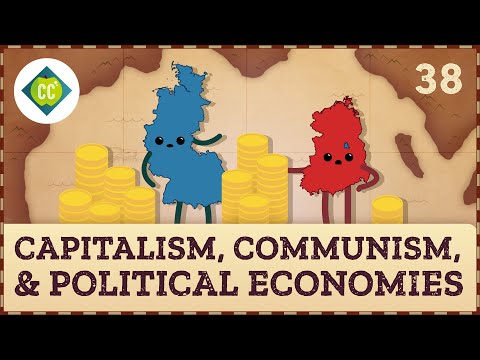
Capitalism, Communism, & Political Economies: Crash Course Geography #38
video description
Date: 2022-04-04
Related videos





Comments and reviews: 10
crash_course
Please don't conflate markets and Capitalism. Markets existed in almost all societies, from the Empires of antiquity to the Kingdoms of the middle ages to Slave markets, it's not linked to Capitalism. Capitalism is the privatisation of means of production. It means someone owning the machines worked by others, and trying to maximize the profits (the part of YOUR labor that the Capitalist puts in his own pockets after paying what's necessary to keep the business going.
But thank you to recognize that Stalinian control of the economy is a far ideal from what Marx suggested (he had surprisingly little prescriptions from his economical analysis of Capitalism, and it was mostly others, like Lenin, who fleshed out what the logical next steps were based on the situation at the time, but the structures necessary to centralize the revolution defence against the White Army, and other Capitalists also made it prone to be co-opted by the bureaucratic elite supported by Stalin, and later by Mao, and copy-pasted in most -communist- states afterward.
Yet, planned economies were almost doomed to develop this bureacucracy, supporting the government above the people, because of an anti-democratic structure (as opposed to the -all powers to the Soviets- slogan of Lenin, and the fact that technologically, it was harder to coordinate production. Now, Amazon, Walmart and others showed us very well that a planned economy could work. In -The People's Republic of Walmart-, the argument is layed out that these companies already manage more employees and money than entire countries, leveraging A. I. and automation to even guess what the demand will be. The only difference is that it's a whole machine geared toward the maximisation of profit for shareholders and the people on top. The tech exist, but it could be managed by all of us, directly.
Also, going over East and West Germany and Bulgaria, you omitted the economic consequences faced by the people in those countries AFTER becoming Capitalists. Their life-standard went down dramatically, their national industries and services became privatized (going to the corrupt elite already in place, leading to incredible levels of inequality, and a reduction in life-standard. Same in most Socialist countries that either had a CIA backed coup against them to bring in Neo-Liberal dictatorships (read -The Jakarta method-, and -The Shock Doctrine-.
reply
Lardah
I'd like to watch a series explaining where the true value of money comes from.
Especially in relation to the -need- of having poor countries and people.
Why can't this world be a truly enjoyable world without having the need for poverty on behalf of most people.
As I see it we have to increase the amount of money, since the global population grows and it does not seem to stop any time soon.
We humans have to delay, stop and fix the climate crisis as soon as possible, but it's too expensive to do so. Which just made me loose confidence in humanity.
I'd like to truly understand where this worth of money comes from to figure out how we could either adjust the system or create a completely new one, where the suffering on this planet is minimized.
As I see it, we humans could make our world a true paradise/utopia, but we don't because of inconvenience, expensiveness and greed.
The inconvenience could easily circumnavigated by changing the made up worth of money and limiting the amount of money everyone can have in total could soothe the greed.
reply
education
little fact check. at 9: 12: I would not call the economics of the German Reunification -smooth-. State owned East-German Companies (estimated at 380 Billion $) were sold to mostly West-German private Investors. for -80 Billion $ (yes negativ. Many Factories were sold under value and huge amounts of subsidies were given out. Many factories were then just closed and the workers were laid off) It's a contoversial topic (sometimes) event today but in some cases the economic damage in eastern germany has been compared to the damages of WW2. The former GDR jumped from virtually no unemployment to 15%, later 18% (in some regions even higher) and many important or high salary positions (for example Judges, University Professors etc) were filled with people from western Germany for decades. If you call this episode -capitalism, communism and. - this example of system change is to important to just -smooth- over.
reply
insuna
I'd like to add one correction to this video:
East Germany wasn't -helped- by the capitalist West Germany when they united, instead East Germany was completely gutted economically. All the factories and companies they had that were working at least somewhat well were bought out by West-German capitalists and sold for scrap mostly. That is one of the reason why East Germans still largely resent West Germans, why they still consistently have a much lower average salary and part of why they vote for far-right parties.
reply
Michael
Yes, plantation owners didn't make the bananas. They also didn't refine and ship them. They payed people wages to do all those things. Wages they could pay them because they had state violence (power as you like to keep calling it) to maintain their control over the lands and markets that deny the local people the ability to do so themselves due to the inequality in economic power because of the forced engagement (or they starve) in exchange of fiat currency that benefits the dominant political powers.
reply
TheGFeather
Dear Crash Course,
I humbly state that I, and I'm sure many others, now deeply desire a sticker of Thought Bubble Bill & Ted suitable for laptops, violin cases and general locations where we can all be encouraged to Be Excellent To Each Other. I'm hoping that if it was okay to use them in the video, it's okay to make merch. Please tell me this can happen. Perhaps as a P4A perk? My violin case really needs one.
Sincerely,
The Dude in the Comments
reply
David
This is a pretty good intro, considering most people who will watch this will be kids in school. If you are a kid in school, I hope you know that if you want to know more, there is an abundance of resources available to you.
reply
This is a pretty good intro, considering most people who will watch this will be kids in school. If you are a kid in school, I hope you know that if you want to know more, there is an abundance of resources available to you.
reply
Pfhorrest
I was expecting to hate this video for what I presumed would be a capitalist bias, but bravo on a surprisingly balanced (if still imperfect) gloss of the two.
reply
I was expecting to hate this video for what I presumed would be a capitalist bias, but bravo on a surprisingly balanced (if still imperfect) gloss of the two.
reply
Snowcold
Norway is a social democracy, not a democratic socialist country.
If the means of production are not owned by their workers, then it isn't socialism.
reply
Norway is a social democracy, not a democratic socialist country.
If the means of production are not owned by their workers, then it isn't socialism.
reply
ANother
All I seem to see are comments just preparing for the worst, not debating, not even showing outrage, just predicting a storm that's not coming.
reply
All I seem to see are comments just preparing for the worst, not debating, not even showing outrage, just predicting a storm that's not coming.
reply
Add a review, comment
Other channel videos