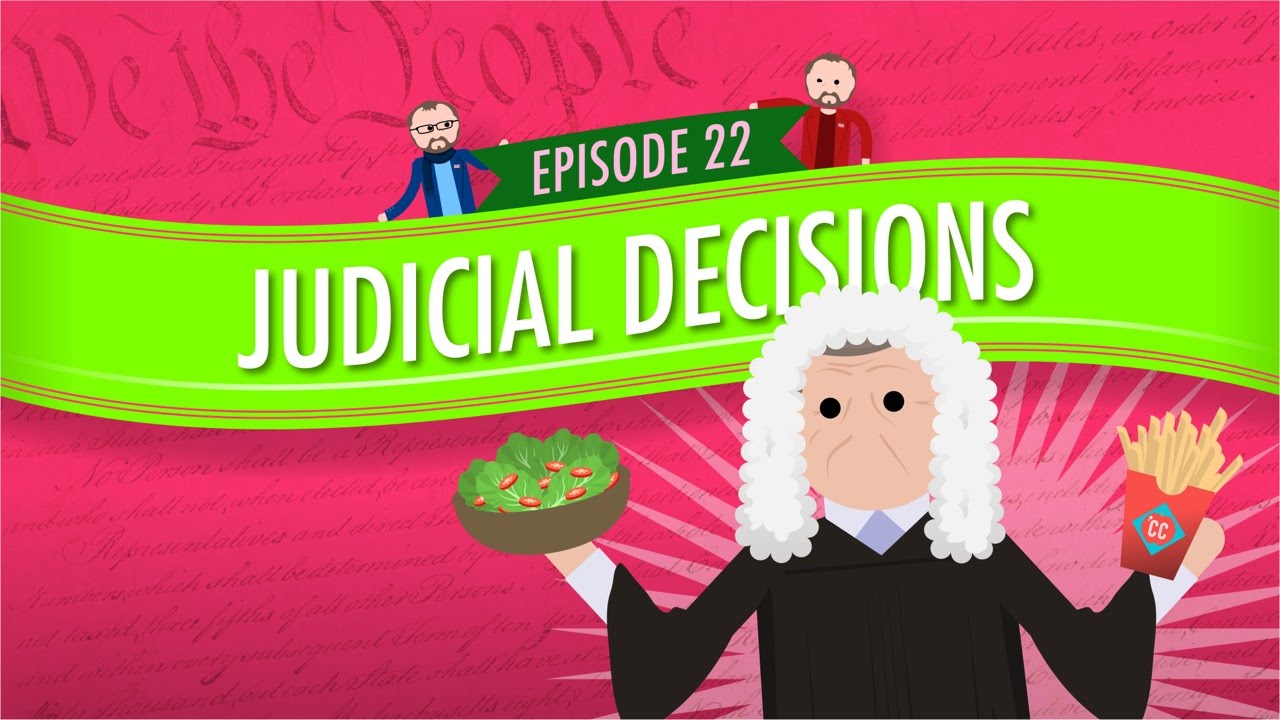
Judicial Decisions: Crash Course Government and Politics #22
video description
Date: 2022-04-04
Related videos




Comments and reviews: 9
Aviel
I'm going to have to strongly dispute the Thought Bubble segment on judicial activism and restraint.
First, it is difficult to come up with satisfactory definitions for the terms -activism- and -restraint- in this context; in fact, there's a good argument to be made that it might not be possible at all. The Thought Bubble segment didn't seem to appreciate this ambiguity. For example, what if the court's precedent clearly mandates striking down a law? If the court strikes down the law, is that activist because they overruled Congress or a state legislature, or is it restrained because they adhered closely to precedent? For an even more convoluted example, look at the debate between Chief Justice Roberts and Justice Scalia in NFIB v. Sebelius, 567 U. S. ___ (2012. Roberts believed that he was acting in a more restrained fashion by construing the Affordable Care Act to be Constitutional, and striking down only those parts that he couldn't find any way to uphold. Scalia thought that Roberts was being activist, because through such a strained construction of the law, Roberts was effectively rewriting it.
Second, even to the degree that we can understand how -activism- is different from -restraint-, its association with specifically liberal or specifically conservative justices is really non-existent. One can probably argue that the Warren court was an activist and a liberal court, but this hardly creates a general association between activism and liberalism. During the Lochner era, activism was strongly associated with conservatism, as the Supreme Court would aggressively use the due process clause to strike down economic regulation. Nowadays, the correlation continues to remain unclear; as was pointed out, conservatives are arguably activist for overturning Congressional legislation in Citizens United v. FEC, 558 U. S. 310 (2010, especially when they'd recently upheld that legislation in McConnell v. FEC, 540 U. S. 93 (2003. And liberal justices are arguably restrained for sticking to the precedent of the Warren court in cases like Herring v. United States, 555 U. S. 135 (2009, and Friedrichs v. California Teacher's Association ___ U. S. ___ (2016. Given the absence of correlation, it's not clear to me why a heuristic association was even suggested.
Third, it hardly makes historical sense to group the Burger and Warren courts together as alike in judicial philosophy. Though, especially during the early years of the Burger court, many of the liberal justices from the Warren court (like Brennan, Marshall, and Douglas) successfully upheld and extended some of the decisions of the Warren court, the Burger court very quickly started moving in the opposite direction. Decisions like Stone v. Powell, 428 U. S. 465 (1976) and Milliken v. Bradley, 418 U. S. 717 (1974, from early on in the Burger court, overturned or limited precedents from the Warren court, and that trend only continued as time went on.
I recognize that a video educating people on the way that federal courts make decisions is going to have to touch on concepts like judicial activism and judicial restraint, as many people will view the behaviour of courts through those lenses. But to ascribe those terms to specific decisions or justices, and to do so with such generality, misleads more than it educates.
reply
I'm going to have to strongly dispute the Thought Bubble segment on judicial activism and restraint.
First, it is difficult to come up with satisfactory definitions for the terms -activism- and -restraint- in this context; in fact, there's a good argument to be made that it might not be possible at all. The Thought Bubble segment didn't seem to appreciate this ambiguity. For example, what if the court's precedent clearly mandates striking down a law? If the court strikes down the law, is that activist because they overruled Congress or a state legislature, or is it restrained because they adhered closely to precedent? For an even more convoluted example, look at the debate between Chief Justice Roberts and Justice Scalia in NFIB v. Sebelius, 567 U. S. ___ (2012. Roberts believed that he was acting in a more restrained fashion by construing the Affordable Care Act to be Constitutional, and striking down only those parts that he couldn't find any way to uphold. Scalia thought that Roberts was being activist, because through such a strained construction of the law, Roberts was effectively rewriting it.
Second, even to the degree that we can understand how -activism- is different from -restraint-, its association with specifically liberal or specifically conservative justices is really non-existent. One can probably argue that the Warren court was an activist and a liberal court, but this hardly creates a general association between activism and liberalism. During the Lochner era, activism was strongly associated with conservatism, as the Supreme Court would aggressively use the due process clause to strike down economic regulation. Nowadays, the correlation continues to remain unclear; as was pointed out, conservatives are arguably activist for overturning Congressional legislation in Citizens United v. FEC, 558 U. S. 310 (2010, especially when they'd recently upheld that legislation in McConnell v. FEC, 540 U. S. 93 (2003. And liberal justices are arguably restrained for sticking to the precedent of the Warren court in cases like Herring v. United States, 555 U. S. 135 (2009, and Friedrichs v. California Teacher's Association ___ U. S. ___ (2016. Given the absence of correlation, it's not clear to me why a heuristic association was even suggested.
Third, it hardly makes historical sense to group the Burger and Warren courts together as alike in judicial philosophy. Though, especially during the early years of the Burger court, many of the liberal justices from the Warren court (like Brennan, Marshall, and Douglas) successfully upheld and extended some of the decisions of the Warren court, the Burger court very quickly started moving in the opposite direction. Decisions like Stone v. Powell, 428 U. S. 465 (1976) and Milliken v. Bradley, 418 U. S. 717 (1974, from early on in the Burger court, overturned or limited precedents from the Warren court, and that trend only continued as time went on.
I recognize that a video educating people on the way that federal courts make decisions is going to have to touch on concepts like judicial activism and judicial restraint, as many people will view the behaviour of courts through those lenses. But to ascribe those terms to specific decisions or justices, and to do so with such generality, misleads more than it educates.
reply
Sigal
I'm not an attorney & don't give legal advice. In fact, there is no such thing as legal advice as the Supreme Court revises the law weekly to ensure higher litigation costs. One of my mistakes was not checking my Register of Action weekly or daily. The Register of Action reveals all activities related to the case, with the exclusion of the judge's lunch with the other attorney & their future plans.
Bonnie Shields entered general representation and became an Attorney of Record on my case without my knowledge. Going to the File Retrieval window at the courthouse and asking for a free Register of Action with Minute Orders would have revealed that timely. Perhaps I could have gotten a civil protection order by asking for a timely dismissal.
I replaced her with Robert Wolf who claimed that he has to scan his pleadings and mail them to me weeks and months too late - when in reality he was e-filing. He also didn't tell me that Bonnie Shields was fired and that I could go pro-se as I wanted instead of hiring him to replace Shields. Robert Wolf wrote an illegal contract, giving him absolute power. I could only get him dismissed from my case upon appeal. He tried to get my husband back into the marital home by claiming that there is damage to the home. Although I got affidavits from neighbors testifying to the opposite I couldn't communicate with the courts because I had an Attorney of Record on file. The only filing I could do myself was a Request to Accept Attorney's Withdrawal. But the attorneys wanted to transfer the case from Magistrate Moss to Judge Angela Arkin, who agreed to a bribe scheme. The other party said they wanted Robert Wolf on the case and Arkin agreed.
The Register of Action should be available to all parties automatically and electronically. But the judicial branch is independent and does its best to keep its practices away from the public eye. Pro-se parties should be able to file pleadings with the clerk electronically. But destroying forests is the least of what these sociopaths-to-the-extreme are doing in order to make money faster.
reply
I'm not an attorney & don't give legal advice. In fact, there is no such thing as legal advice as the Supreme Court revises the law weekly to ensure higher litigation costs. One of my mistakes was not checking my Register of Action weekly or daily. The Register of Action reveals all activities related to the case, with the exclusion of the judge's lunch with the other attorney & their future plans.
Bonnie Shields entered general representation and became an Attorney of Record on my case without my knowledge. Going to the File Retrieval window at the courthouse and asking for a free Register of Action with Minute Orders would have revealed that timely. Perhaps I could have gotten a civil protection order by asking for a timely dismissal.
I replaced her with Robert Wolf who claimed that he has to scan his pleadings and mail them to me weeks and months too late - when in reality he was e-filing. He also didn't tell me that Bonnie Shields was fired and that I could go pro-se as I wanted instead of hiring him to replace Shields. Robert Wolf wrote an illegal contract, giving him absolute power. I could only get him dismissed from my case upon appeal. He tried to get my husband back into the marital home by claiming that there is damage to the home. Although I got affidavits from neighbors testifying to the opposite I couldn't communicate with the courts because I had an Attorney of Record on file. The only filing I could do myself was a Request to Accept Attorney's Withdrawal. But the attorneys wanted to transfer the case from Magistrate Moss to Judge Angela Arkin, who agreed to a bribe scheme. The other party said they wanted Robert Wolf on the case and Arkin agreed.
The Register of Action should be available to all parties automatically and electronically. But the judicial branch is independent and does its best to keep its practices away from the public eye. Pro-se parties should be able to file pleadings with the clerk electronically. But destroying forests is the least of what these sociopaths-to-the-extreme are doing in order to make money faster.
reply
ShooterMacs
The main highlights of this videoJustices could be influenced by the constitution, because, unless the case involves the constitution directly, congress can respond to a decision overturning a law by passing a new law. President makes the call on who gets to be a justice, with the help of the senate. The president is not much of a factor, because they can only serve a maximum of 8 yearsJustices decisions will be implemented by the executive branchJustices can turn out to be more conservative or liberal. Judicial activismThe idea that the court should act as an instrument of policy, making it much more like the other two branches of government. Often accused of making law from the benchEager to overturn congressional legislation to further policy goalsThe --high tide-- occurred during the 50s and the 70-s. Earl warren, and warren burgerJudicial restraintThe idea that judges should pay close attention the the precedent when they make their decisions and that any changes that they make to the law should be incremental. During the 1980s and the early 2000-s, the court was known for its judicial restraint. Conservative justices practice judicial restraint, but, that is not always the case. Originalism The idea that any new law should be interpreted in light of the constitution as it was written in 1787. One of the core tenets of judicial restraint is that courts are not supposed to overturn the decisions of a democratically elected congress in order to make policy, unless congress has passed laws that are clearly unconstitutional.
Judicial philosophy refers to activism and restraintPolitical ideology refers to liberalism or conservatism.
reply
The main highlights of this videoJustices could be influenced by the constitution, because, unless the case involves the constitution directly, congress can respond to a decision overturning a law by passing a new law. President makes the call on who gets to be a justice, with the help of the senate. The president is not much of a factor, because they can only serve a maximum of 8 yearsJustices decisions will be implemented by the executive branchJustices can turn out to be more conservative or liberal. Judicial activismThe idea that the court should act as an instrument of policy, making it much more like the other two branches of government. Often accused of making law from the benchEager to overturn congressional legislation to further policy goalsThe --high tide-- occurred during the 50s and the 70-s. Earl warren, and warren burgerJudicial restraintThe idea that judges should pay close attention the the precedent when they make their decisions and that any changes that they make to the law should be incremental. During the 1980s and the early 2000-s, the court was known for its judicial restraint. Conservative justices practice judicial restraint, but, that is not always the case. Originalism The idea that any new law should be interpreted in light of the constitution as it was written in 1787. One of the core tenets of judicial restraint is that courts are not supposed to overturn the decisions of a democratically elected congress in order to make policy, unless congress has passed laws that are clearly unconstitutional.
Judicial philosophy refers to activism and restraintPolitical ideology refers to liberalism or conservatism.
reply
jhonathan
this is dumb. power wasn't created by the constitution, power is a natural phenomenon. the constitution just tries to regulate it. the powers the court have is based on political phenomenon, and if it has grown so powerful is because the people, including Congress, has given them so much power by trusting the court with so many aspects of American life
reply
this is dumb. power wasn't created by the constitution, power is a natural phenomenon. the constitution just tries to regulate it. the powers the court have is based on political phenomenon, and if it has grown so powerful is because the people, including Congress, has given them so much power by trusting the court with so many aspects of American life
reply
Fabrizzio
I just don't understand if the judicial branch is supposed to be a check and balance for executive and legislative branch, then why is it the president chooses the justices and congress confirms them, doesn't that take away the check and balance purpose?
reply
I just don't understand if the judicial branch is supposed to be a check and balance for executive and legislative branch, then why is it the president chooses the justices and congress confirms them, doesn't that take away the check and balance purpose?
reply
Alex
I just got the script for this episode as one of the project for awesome perks. I loved rewatching it and following along with the script. Thank you!
reply
I just got the script for this episode as one of the project for awesome perks. I loved rewatching it and following along with the script. Thank you!
reply
Stella
1: 23 That's such an accurate picture of Trump, I can't believe Thought Bubble predicted our next president over a year before the elections
reply
1: 23 That's such an accurate picture of Trump, I can't believe Thought Bubble predicted our next president over a year before the elections
reply
Ergzay
Lot's of misinformation in this video, including the final worst line -all decisions are highly political- which is a bald faced lie.
reply
Lot's of misinformation in this video, including the final worst line -all decisions are highly political- which is a bald faced lie.
reply
Tommy
This guy is quick to elaborate shortcomings in affordable care act and then have zero comments about citizens united? hmmm
reply
This guy is quick to elaborate shortcomings in affordable care act and then have zero comments about citizens united? hmmm
reply
Add a review, comment
Other channel videos