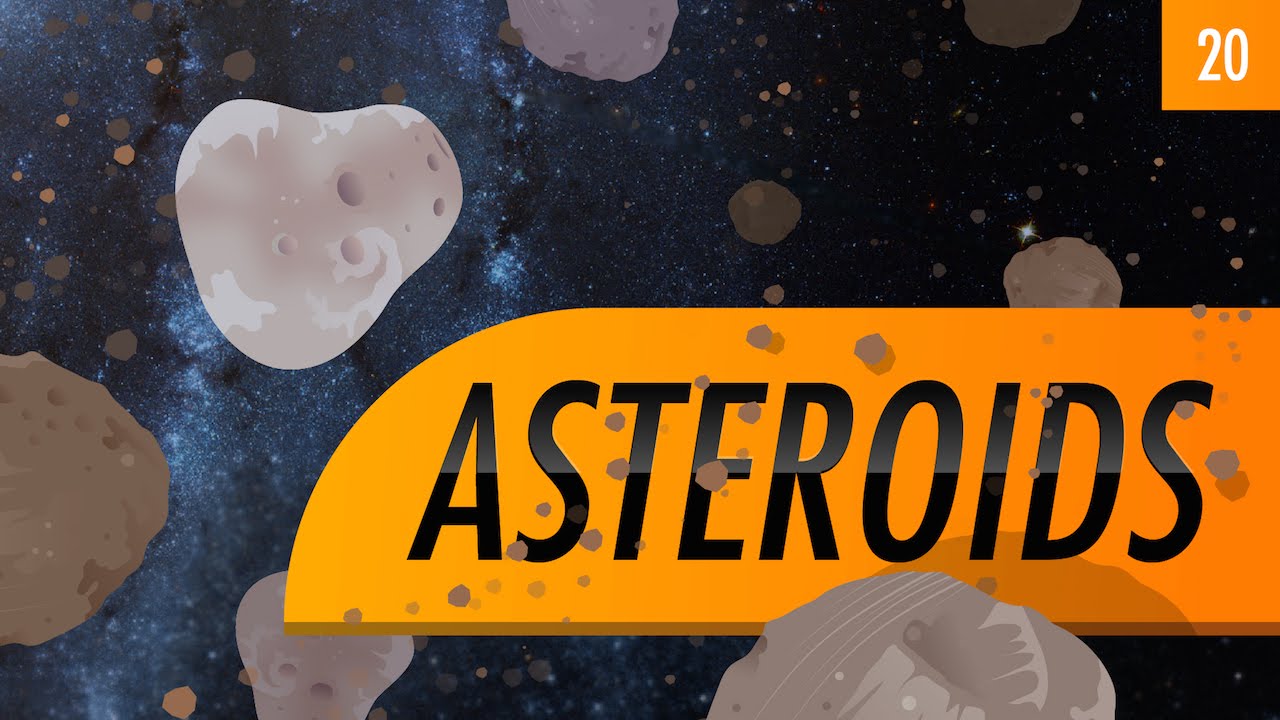
Asteroids: Crash Course Astronomy #20
video description
Date: 2022-04-04
Related videos




Comments and reviews: 5
Follower
The big gap between Mars and Jupiter can be easily explained. Long time ago there was another planet in our solar system between Mars and Jupiter. The name of that planet was Phaeton or Mallona, Mallona means broken planet. Mallona was destroyed in a nuclear war, only the four moons of Mallona survived. You will know everything about Mallona (and more) if you read the books of Jakob Lorber (1800 - 1864) and Leopold Engel (1858 - 1931.
reply
The big gap between Mars and Jupiter can be easily explained. Long time ago there was another planet in our solar system between Mars and Jupiter. The name of that planet was Phaeton or Mallona, Mallona means broken planet. Mallona was destroyed in a nuclear war, only the four moons of Mallona survived. You will know everything about Mallona (and more) if you read the books of Jakob Lorber (1800 - 1864) and Leopold Engel (1858 - 1931.
reply
wylderyde
Whether it's a real thing or not, Bode's Law does a largely good job of describing where you find the orbits of the planets and many of the major dwarf planets, with the notable exception of Neptune. I kinda wonder if Neptune originally formed in the asteroid belt and was later flung out by Jupiter to near the Kuiper Belt, thus leaving the gap that's been taken up by Ceres and messing up the orbit of Pluto. Just a random hypothesis.
reply
Whether it's a real thing or not, Bode's Law does a largely good job of describing where you find the orbits of the planets and many of the major dwarf planets, with the notable exception of Neptune. I kinda wonder if Neptune originally formed in the asteroid belt and was later flung out by Jupiter to near the Kuiper Belt, thus leaving the gap that's been taken up by Ceres and messing up the orbit of Pluto. Just a random hypothesis.
reply
oof
If there-s so many astroids and Ceres is kind of a spherical object, then how come Ceres cant gobble all the other asteroids and make itself a planet? Even if they are far away from each other
reply
If there-s so many astroids and Ceres is kind of a spherical object, then how come Ceres cant gobble all the other asteroids and make itself a planet? Even if they are far away from each other
reply
Vector
I consider any object smaller than and not including Ceres to bean asteroid, and I also believe that significant moons such as our own and Ganymede should be classified as planets.
reply
I consider any object smaller than and not including Ceres to bean asteroid, and I also believe that significant moons such as our own and Ganymede should be classified as planets.
reply
Alessandro
Just a minor bug: the correct astronomer's name was Giuseppe, with an -e-, not Giuseppi with an -i-.
Otherwise it's all pretty interesting and engaging, as always!
reply
Just a minor bug: the correct astronomer's name was Giuseppe, with an -e-, not Giuseppi with an -i-.
Otherwise it's all pretty interesting and engaging, as always!
reply
Add a review, comment
Other channel videos