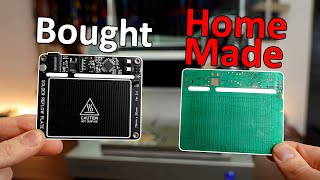
Forget Thermal Paste! This Cooling Trick Is Much Better
video description
Date: 2026-10-28
Related videos


Comments and reviews: 20
DrivingVertigo
I would replace all thermal pads with Upsiren thermal putty, then use a 0. 7 - 1mm copper shim, sandwiched with thermal paste, on the SOC to ensure a strong mounting pressure. If you are afraid of copper shorting something out you can use aluminum nitride ceramic instead, which is common for transistors that need thermal transfer to a heatsink, but also needs to be insulated electrically. Snark's Lab showed promising results with thermal ceramics as a shim, surpassing all thermal pads. Or you can just use conformal coating on top of your capacitors and not worry about shorting anything ever. If your mounts do not have springs to constantly apply mounting pressure, PTM 7950 can create a gap cause it thins out when melting. So the sandwiching of ptm 7950 ends up doubling your gaps, and with a. 3mm copper shim you were going to have gaps no matter what, hence your poor performance results. Upgrade to at least 0. 7mm shim, then retighten your screws after thermal cycling will likely help your results.
reply
PaulMassey-f8s
I dont know Wurth for their electronic products electronics is a small hobby thing for me, however I am very familar with lots of their products on the mechanics side of things. All sorts of locking compounds, cleaning products and if available in the workshop their timeserts are the best available thread repares with a very wide range of materials to suit expansion needs. However one thing they are not cheap and pretty sure neither are theese heat transfer materials. They are probably to some sort of ISO spec relevant to big manufactuers. Only shows my ignorance. But Wurth to me are bit like 3M. Its industry standard stuff it comes at a price
reply
DarkGT
It is possible that there is external sensor and your graphite layer is simply fooling the sensor by not allowing it to get hot by the real heat output.
I think it is worth it to try a premium paste instead of those solid layers, the idea for those pads comes from the laptop makers, because as in your device, they can't produce anything within a spec. The paste has to be thicker layer, but it should work. Also not a good idea to touch those pads with your fingers, you transfer dirt and oils, which could act as insulators.
reply
greatscott
Over the past many many many moons a few sun and a weekend or three. I have done similar operations. Though not on my game systems. But on any different systems I have been involved in the development of (Xbox, 360, xone. and other systems. I have quite a library of thermal data. But I have nothing like that of a college and friend that is the Thermo Queen. She can quote facts that I don't even know. She is one of those whom when she speaks about Thermal Management. Even CEO's listen.
Peace
reply
greatscott
I thought that was just the memory! I thought the cpu and gpu are one or both of the smaller chips What are the smaller chips
I've been thinking about the same thing. I wish I had an odin 3 but I do have and odin 2 portal. I'm not sure how good the thermal solution on the portal is but I've seen others that could definitely be improved. Most devices with the older snapdragon 865 have pretty mediocre cooling solutions. One I saw was just a flat piece of metal with fins on one end.
reply
qq_ulti
The ptm was probs the best. You could double stack it and use the pads on the outside and the PTM on the inside. PTM is not a pad it's more of a paste. To make the PTM work well though its like a paste so that copper shim would need to be soldered to the heated sink with a near perfect space gap. The problem is, you can't use ptm as a pad you need to use it as a paste cause that's in a sense, what it is. The only way to do it other than this would be to use a custom-made cooler.
reply
person880
Try isopropyl alcohol between tests so that you can make sure all surfaces are clean. Then, try a 0. 5 - 0. 7mm thick copper plate with thermal paste between the plate and the heatsink, with the thinnest TGF sheet you have between the plate and the chip.
This way, you get very good thermal conductivity between the heatsink and the plate, and then you only need a very small amount of TGF. The logic is that the copper plate will conduct better than a thick piece of TGF.
reply
Totumfacky
I really would appreciate help with decision what to put on the Threadripper 2920x under the Cooler Master 360 water block. I'm currently using Thermal Grizzly Duronaut. But I'm not sure if I put proper amount of that paste. It was hard to apply, because it's non greasy so it stays on a spatula and it's hard to spread on the CPU (moving spatula just moves the Thermal Grizzly, does not spread it. Because of that I'm afraid I put too much (I think a half of a 6g syringe)
reply
kazriko
I have a Retroid Pocket Nova. By far the best thing you can do with these is to underclock the processor. Because the ram is stacked, there's really no way to get heat out quickly, so the best thing to do is generate less heat to keep the chip cooler. I use ArmadaOS on mine in particular, and it by default does a medium-sized underclock on the processor. I don't play anything as heavy as The Witcher, but the heaviest game I do play tends to be under 60c.
reply
OneAmongBillions
I could not afford the amount of thermal paste needed to mount a 9 x 12 (108 square inch) Curtis motor controller to an aluminum chassis. Learned that I could simply use cosmetic grade zinc oxide powder (only $15 for 16 oz) with a silicone-based dielectric grease (60% - 40%. Was able to apply the necessary very thin coat. So, for a 108 square area, the material cost was only about $0. 50! I know, CPUs/GPUs are a different situation.
reply
lulul
I'll try this on my minipc too between the fan and the vapor chamber heatsink, just like you did. I hope it improves the temps a bit. It makes sense whan you think about it since most people try, like you did, to improve the transfer between the cpu and the heatsink, but the heatsink fan side gets overlooked, but that's probably the main bottleneck that would benefit most from some optimization in real life use. It's a briliant idea, good job!
reply
GeneralNickles
you could totally use the phase change material. just stack it until it's thick enough, and make sure to pack some of it down in the little grooves on both sides. when it semi-liquifies as it gets hot, it will essentially become one cohesive mass. if you really wanted to, you could even remove the RF shielding and put some kind of conformal coating on the surrounding PCB to make sure all of the PCM stays where it's supposed to be.
reply
mechadrake
going pad to metal to pad then to metal greatly hinders thermal transfer, this is why stock stuff I opened never has any shims or something. I dont remember how it is called, but I have read that in some kind of paper about cooling materials before. this is why it did not work properly. I think this needed special heatsink that reaches in better for thin thermal pad testing. out of scope for most home players
reply
taiiat0
oh thank god this wasn't just another overblown PCM Video on YT: )
this makes sense in hindsight, cool. the Graphite is able to simulate a thicker Heatsink assembly even though the Manufacturer didn't design one that thick!
even better if the Manufacturer didn't encase the heat generating things in Plastic and could have the rear housing act as a Heatspreader in addition to the cute sized Heatsink. :P
reply
razzix2
I feel like kryonaut and a copper shim would have done way better. Copper shims are super easy to sand to the required thickness. There is an efficiency penalty for two layers of thermal paste so it's important to be conservative and not over paste. But nowhere near the penalty of using a pad. I use double pasted shims all the time and get light-years better performance than every pad I've worked with.
reply
sinisterprime6017
This has give me some great ideas to use on my laptop, for years I have been trying hard to strike a balance between performance and longevity usually hitting 95c on the CPU but barely 65 to 70 on the gpu with throttling hurting framerate with micro stutters i have been looking and heatpipes and everything, this looks like the perfect thing to try before i modify my heatpipes. Thank you sir
reply
sammy_dee
Using any thermal capacitor material within the thermal pad or thermal paste is the biggest mistake one can make when trying to improve the thermal conductivity. you want the heat move fast from one side to another, copper also has great thermal conductivity but it also act as a great thermal capacitor and that's why you are getting lower score with copper sandwiched between two PCM pads.
reply
hpux735
I think your benchmark performance topped-out the same with the TGS because you hit the limit of the chip's raw processing power, and were no longer thermally throttling. But, because you got lower temperatures in the game, to me, implies that you were still able to improve the thermal performance somewhat with it.
I kinda want to try the TGS on the heat spreader of my laptop now
reply
zci-o9i
The copper shim with the Phase Change Material should have been the best performer for sure. Something wasn't done right. Maybe the shim wasn't flat enough, or too thin. Also PCM requires multiple heat cycles for maximum performance. Maybe the chip itself isn't flat. Thick thermal pads have bad conductivity. Ultimately this was a product design flaw to have such a gap.
reply
RaymondSwanson-u9y
Higher and higher frequencies. Great and greater frame rates. Incredible amounts of heat generated. Modern gaming PC's are running into the same problems of tube based computers. Kilowatt power demands and excessive heat generation requiring more and more cooling drawing more and more power generating more and more heat. You're about to hit the wall.
reply
Add a review, comment
Other channel videos