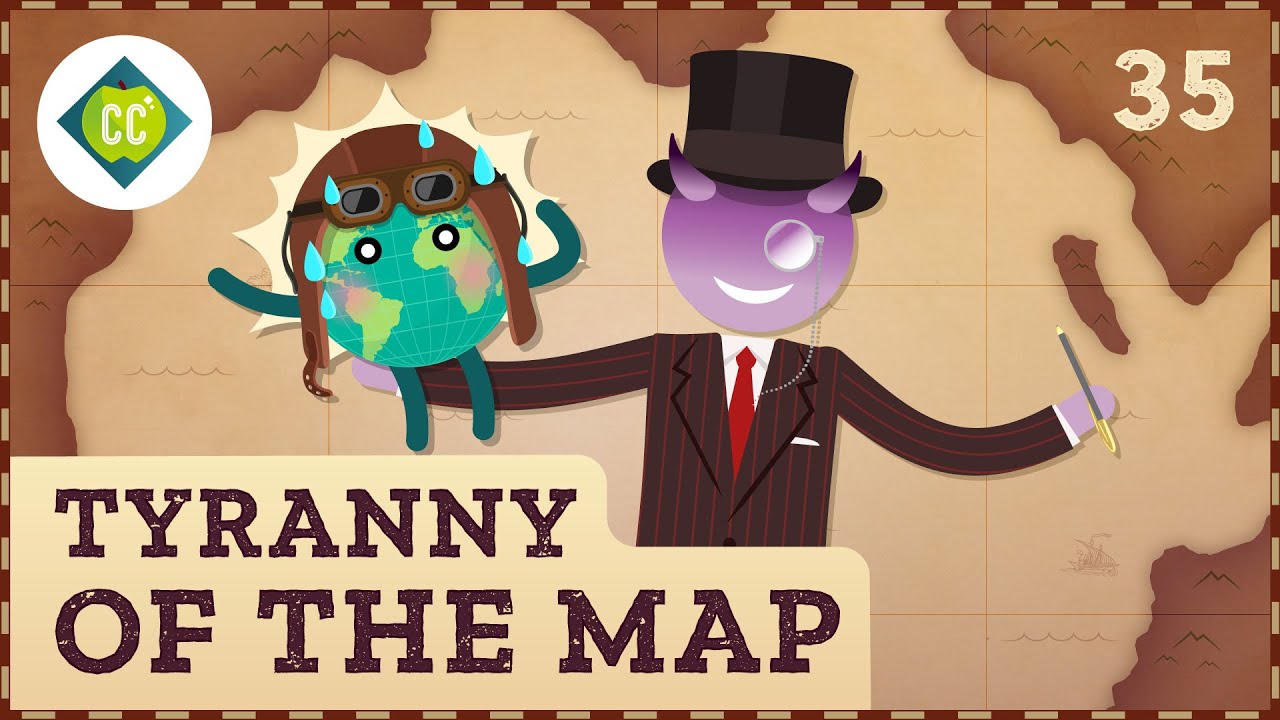
Tyranny of the Map: Crash Course Geography #35
video description
Date: 2022-04-04
Related videos


Comments and reviews: 10
SN
How would it be better to have more countries, with more homogenous populations, but re so small they can't advocate for their own interests effectively due to the small scale of the society they would control if borders more consistently corresponded to the parameters of homogenous culturral grops.
This video talks like the arbitrary character of borders is some random anomaly, or an easily avoidable mistake. The -tyranny of the map- pretends that inanimate objects like maps have magical powers to shape human social life, instead of different social actors have different interests and act on those interests in competition with each other.
The claim that the # of states will likely grow, could be true, but it will be reflection of the down-scaling of the global economy and polity in response to the global crisis of resource bottle necks due to supply side shortages associated with climate change and mass species extinction in the next 100.
Maps serve the interests of the powerful, they are just artifacts of people. The whole marginalization thing is just preening. Which exactly -traditional- names should I be using? I live in the Great Lakes region. Most of the last inidigines here right as whites became hegemonic were themselves refugees ihnto the region as they were fleeing the Iroquis imperialism.
reply
How would it be better to have more countries, with more homogenous populations, but re so small they can't advocate for their own interests effectively due to the small scale of the society they would control if borders more consistently corresponded to the parameters of homogenous culturral grops.
This video talks like the arbitrary character of borders is some random anomaly, or an easily avoidable mistake. The -tyranny of the map- pretends that inanimate objects like maps have magical powers to shape human social life, instead of different social actors have different interests and act on those interests in competition with each other.
The claim that the # of states will likely grow, could be true, but it will be reflection of the down-scaling of the global economy and polity in response to the global crisis of resource bottle necks due to supply side shortages associated with climate change and mass species extinction in the next 100.
Maps serve the interests of the powerful, they are just artifacts of people. The whole marginalization thing is just preening. Which exactly -traditional- names should I be using? I live in the Great Lakes region. Most of the last inidigines here right as whites became hegemonic were themselves refugees ihnto the region as they were fleeing the Iroquis imperialism.
reply
RO
Such a tragically neglected topic. But this video ignores the extent to which even supposedly -homogenous- nation states like Iceland (or indeed most of Europe) required substantial and deliberate campaigns of cultural homogenisation (sometimes quite violent) like those mentioned elsewhere in the video in order to reify their -borders-. That-s not unique to Africa at all. It-s just most odiously obvious when looking at Africa.
I think a lot of the confusion begins when (as this video does) the term -nation- gets conflated with culture or ethnic group. When in fact -nations- are very specific historical constructs arising out of the very process of border engineering described here
reply
Such a tragically neglected topic. But this video ignores the extent to which even supposedly -homogenous- nation states like Iceland (or indeed most of Europe) required substantial and deliberate campaigns of cultural homogenisation (sometimes quite violent) like those mentioned elsewhere in the video in order to reify their -borders-. That-s not unique to Africa at all. It-s just most odiously obvious when looking at Africa.
I think a lot of the confusion begins when (as this video does) the term -nation- gets conflated with culture or ethnic group. When in fact -nations- are very specific historical constructs arising out of the very process of border engineering described here
reply
MrBattlecharge
Honestly, the best way to govern ourselves politically would be if every city was it's own state. That way, the people living in the city can determine for themselves what is best for them.
The main problem with this though would be big businesses, who could use their immense powers to bully cities. So you would need to have one large overhead group with enough power to keep the businesses in check.
But then you would need a way to keep that group in check too, and what you end up with looks a lot like the current government systems we have today.
reply
Honestly, the best way to govern ourselves politically would be if every city was it's own state. That way, the people living in the city can determine for themselves what is best for them.
The main problem with this though would be big businesses, who could use their immense powers to bully cities. So you would need to have one large overhead group with enough power to keep the businesses in check.
But then you would need a way to keep that group in check too, and what you end up with looks a lot like the current government systems we have today.
reply
Moritz
this is such a difficult issue to overcome. cause splitting up the countries in smaller more homogeneous countries, looses them what little power they have, but not doing so makes it hard to exert that power to solve the issues colonialism left behind.
i wish we could somehow clean up the mess our ancestors caused, but cause of obvious reasons, they won't trust us, to have their best interests in mind.
cause we probably don't.
even if the population at large just wants to help, there's just too much power at stake.
reply
this is such a difficult issue to overcome. cause splitting up the countries in smaller more homogeneous countries, looses them what little power they have, but not doing so makes it hard to exert that power to solve the issues colonialism left behind.
i wish we could somehow clean up the mess our ancestors caused, but cause of obvious reasons, they won't trust us, to have their best interests in mind.
cause we probably don't.
even if the population at large just wants to help, there's just too much power at stake.
reply
Theron
When I first heard about -Crash Course: Geography, - I thought, -This is going to be boring; I already know where all the countries are and the various biomes on the planet. - But even from the very beginning I have been BLOWN AWAY by how amazing this series has been! I never expected we would hearing about the difference between countries, nations, states, and nation-states! This quickly became one of my favorite -Crash Course- series. -
reply
When I first heard about -Crash Course: Geography, - I thought, -This is going to be boring; I already know where all the countries are and the various biomes on the planet. - But even from the very beginning I have been BLOWN AWAY by how amazing this series has been! I never expected we would hearing about the difference between countries, nations, states, and nation-states! This quickly became one of my favorite -Crash Course- series. -
reply
Antipius
Always a fascinating topic! But like all social sciences, human geography is a contentious field. Anyone digging further into the topic will find great amounts of nuance and debate, even on the basic points laid out in this video.
Good stuff, great way to get people interested
reply
Always a fascinating topic! But like all social sciences, human geography is a contentious field. Anyone digging further into the topic will find great amounts of nuance and debate, even on the basic points laid out in this video.
Good stuff, great way to get people interested
reply
Anonymous
-On a map, they look like the edges of wonky shapes. -
I would argue that straight lines are usually more indicative of tyranny than wonky shapes. Those are more likely -a complete disregard- than wonky shapes, which usually are, at worst, based on natural barriers/separators.
reply
-On a map, they look like the edges of wonky shapes. -
I would argue that straight lines are usually more indicative of tyranny than wonky shapes. Those are more likely -a complete disregard- than wonky shapes, which usually are, at worst, based on natural barriers/separators.
reply
Fang
Speaking of borders! China loves to bully the rest of SEA on its 9 Dash Line sea border, because it's called -The South China Sea- which is absolutely the most nonsensical way to say the map equates to the world. Petition to rename it to South East Asia Sea.
reply
Speaking of borders! China loves to bully the rest of SEA on its 9 Dash Line sea border, because it's called -The South China Sea- which is absolutely the most nonsensical way to say the map equates to the world. Petition to rename it to South East Asia Sea.
reply
Seth
Very good episode. Tons to unpack and explore. One 30, 000 ft view perspective I'd like to add. Humans incorrectly believe they own land. Land ownership is as absurd as one flea trading something to another flea for a piece of a dog's back.
reply
Very good episode. Tons to unpack and explore. One 30, 000 ft view perspective I'd like to add. Humans incorrectly believe they own land. Land ownership is as absurd as one flea trading something to another flea for a piece of a dog's back.
reply
eskualerritar
I love how this series started in the curious world of rocks and is now connecting to the fascinating world of political geography. Broad topics integrated in a beautiful way. The only good way to teach geography, thank you!
reply
I love how this series started in the curious world of rocks and is now connecting to the fascinating world of political geography. Broad topics integrated in a beautiful way. The only good way to teach geography, thank you!
reply
Add a review, comment
Other channel videos