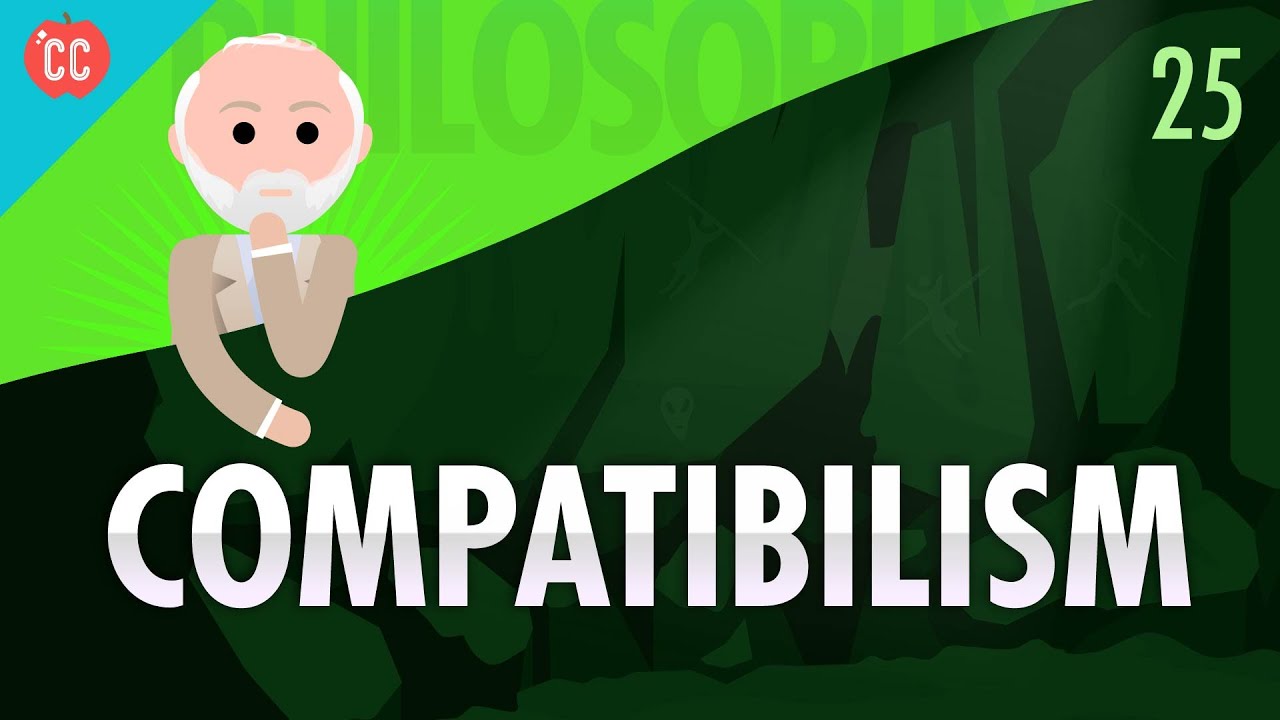
Compatibilism: Crash Course Philosophy #25
video description
Date: 2022-04-04
Related videos




Comments and reviews: 10
Red
I choose the chocolate cake over the vanilla cake because I like chocolate cake better. However, I can not _help_ the fact that I like chocolate cake better than vanilla cake. Even if I _decided_ I want to like vanilla cake better - I'd have a hard time getting my tastes to comply. Believe me - if it weren't this way, I would have a MUCH EASIER time getting myself to eat my vegetables.
But furthermore - - - - even if I _did_ have the ability to will myself to prefer vanilla cake over chocolate cake - - - - in order to _invoke_ that ability, I would have to _want_ to prefer vanilla cake over chocolate cake.
Interestingly - - - - I saw a video (wish I could remember its URL) suggesting one model of compatiblism that wasn't mentioned in this video - which I think is the best model of compatiblism. It suggests that the extent to which you regard an action as -free- should depend on how likely it is that holding yourself _accountable_ for the action will affect your _probability_ of acting in a favorable manner. It suggests using that as the _definition_ of free will.
Of course - - - the video that I'm thinking of (whose URL I don't have at my fingertips at the moment) was thinking about the context of criminal justice - - - but the same principle applies for smaller actions of personal responsibility.
reply
I choose the chocolate cake over the vanilla cake because I like chocolate cake better. However, I can not _help_ the fact that I like chocolate cake better than vanilla cake. Even if I _decided_ I want to like vanilla cake better - I'd have a hard time getting my tastes to comply. Believe me - if it weren't this way, I would have a MUCH EASIER time getting myself to eat my vegetables.
But furthermore - - - - even if I _did_ have the ability to will myself to prefer vanilla cake over chocolate cake - - - - in order to _invoke_ that ability, I would have to _want_ to prefer vanilla cake over chocolate cake.
Interestingly - - - - I saw a video (wish I could remember its URL) suggesting one model of compatiblism that wasn't mentioned in this video - which I think is the best model of compatiblism. It suggests that the extent to which you regard an action as -free- should depend on how likely it is that holding yourself _accountable_ for the action will affect your _probability_ of acting in a favorable manner. It suggests using that as the _definition_ of free will.
Of course - - - the video that I'm thinking of (whose URL I don't have at my fingertips at the moment) was thinking about the context of criminal justice - - - but the same principle applies for smaller actions of personal responsibility.
reply
Josephkerr101
Consider a consequentialist understanding of morality, a functionalist understanding of consciousness, determinist understanding of existence, behavioral plasticity, and reflective volition. Together we can retroactively train ourselves to follow planned impulse control. An ethical frame work can be rationalized and instilled upon the individual through practice and awareness of the impulses/urges that go contrary to the concluded societal moral actions.
This means that an individual who is not ignorant of the ethical nature of their action must work to control their impulsed behaviors. Killing for example is known to be unethical and must be avoided deliberately by the conscious agent. Both the individual and the society are such agents. This means that killing as an individual or as a society is bad. Efforts must be made to avoid it. Thus murder AND war are unethical behaviors. The consequence of such behaviors must be engaged with. The efforts needed most is preventative rather than reactionary.
This is why I have concluded to confront conflicts with rhetoric as far as can be engaged before violence. Pacifism. This makes me unpopular with those that carelessly engage with nazi's with a punch, unaware of the hypocrisy of fighting violent ideology with violent ideology.
reply
Consider a consequentialist understanding of morality, a functionalist understanding of consciousness, determinist understanding of existence, behavioral plasticity, and reflective volition. Together we can retroactively train ourselves to follow planned impulse control. An ethical frame work can be rationalized and instilled upon the individual through practice and awareness of the impulses/urges that go contrary to the concluded societal moral actions.
This means that an individual who is not ignorant of the ethical nature of their action must work to control their impulsed behaviors. Killing for example is known to be unethical and must be avoided deliberately by the conscious agent. Both the individual and the society are such agents. This means that killing as an individual or as a society is bad. Efforts must be made to avoid it. Thus murder AND war are unethical behaviors. The consequence of such behaviors must be engaged with. The efforts needed most is preventative rather than reactionary.
This is why I have concluded to confront conflicts with rhetoric as far as can be engaged before violence. Pacifism. This makes me unpopular with those that carelessly engage with nazi's with a punch, unaware of the hypocrisy of fighting violent ideology with violent ideology.
reply
Jeffrey
I guess Buddhists are compatibilists then. As a meditator I have noticed that as mindfulness gets stronger and the training becomes so natural that it fades into the background even while you go about your normal life day to day and as you get a taste, so to speak, for liberation, that is, true freedom - many if not most experienced meditators would say that they 1) never get or feel bored anymore, 2) are increasingly less reactive, less neurotic, and 3) appreciate how precious and rare true freedom really is. Freedom by itself is not the goal of Buddhist practice - the goal is wisdom, with wise actions defined as any action that has as its consequence a reduction in suffering. Sounds very utilitarian, no? Damn, now I have to find the CrashCourse video on Utilitarianism to see how it is different from compatibilism. Ciao for now.
reply
I guess Buddhists are compatibilists then. As a meditator I have noticed that as mindfulness gets stronger and the training becomes so natural that it fades into the background even while you go about your normal life day to day and as you get a taste, so to speak, for liberation, that is, true freedom - many if not most experienced meditators would say that they 1) never get or feel bored anymore, 2) are increasingly less reactive, less neurotic, and 3) appreciate how precious and rare true freedom really is. Freedom by itself is not the goal of Buddhist practice - the goal is wisdom, with wise actions defined as any action that has as its consequence a reduction in suffering. Sounds very utilitarian, no? Damn, now I have to find the CrashCourse video on Utilitarianism to see how it is different from compatibilism. Ciao for now.
reply
TheIoable
Well, all determinism is based upon -the universe is deterministic-, but in reality, it's probably not the case. Quantum physics(or at least one interpretation of it) says that many processes are, actually, random, at least on small scales. While you can't see it on scales on our size, in micro world, things are not determined. You can't say exact moment when 1 uranium atom will turn in another element, but for 1 kg of uranium you can say approximate time then half of it will undergo radioctive decay. So we, actually, have no idea, how much such small quantum fluctuations affect our brain and thoughts. Or, at least, we can make decisions based on quantum-based random things, and those decisions will have true random nature therefore will be like free will.
reply
Well, all determinism is based upon -the universe is deterministic-, but in reality, it's probably not the case. Quantum physics(or at least one interpretation of it) says that many processes are, actually, random, at least on small scales. While you can't see it on scales on our size, in micro world, things are not determined. You can't say exact moment when 1 uranium atom will turn in another element, but for 1 kg of uranium you can say approximate time then half of it will undergo radioctive decay. So we, actually, have no idea, how much such small quantum fluctuations affect our brain and thoughts. Or, at least, we can make decisions based on quantum-based random things, and those decisions will have true random nature therefore will be like free will.
reply
3-me1
Proof that free will is real:
Humans have a consciousness, a feeling of -here and now-
Consciousness is variable: a fetus has less consciousness than an adult, but a drunk person has less consciousness than a sober one
When consciousness is higher, men are more controlling of their actions: a drunk person tends to drive recklessly
Therefore free will exists from the fact that we have a feeling of consciousness.
Also, the feeling of being alive, or consciousness, would be unnecessary if we didn-t have free will because we would not have to use it to make decisions out of free will.
The brain could still function normally yet without giving us the feeling of being alive.
reply
Proof that free will is real:
Humans have a consciousness, a feeling of -here and now-
Consciousness is variable: a fetus has less consciousness than an adult, but a drunk person has less consciousness than a sober one
When consciousness is higher, men are more controlling of their actions: a drunk person tends to drive recklessly
Therefore free will exists from the fact that we have a feeling of consciousness.
Also, the feeling of being alive, or consciousness, would be unnecessary if we didn-t have free will because we would not have to use it to make decisions out of free will.
The brain could still function normally yet without giving us the feeling of being alive.
reply
Mariam
Dude, factors don't cause actions, think of factors as input in which we process(think of and choose) and then give output (decisions) amongst millions of options, our free will doesn't lie in controlling the factors but in processing them, in fact if we can change our beliefs, if we can influence our desires and temparments, doesn't that free us from being driven by factors by using our thoughtful processes, the point is we can't make a thoughtful process without input but we can manipulate and integrate that input according to our own will, and if these factors can be changed according to ur own words they're not determined anymore
reply
Dude, factors don't cause actions, think of factors as input in which we process(think of and choose) and then give output (decisions) amongst millions of options, our free will doesn't lie in controlling the factors but in processing them, in fact if we can change our beliefs, if we can influence our desires and temparments, doesn't that free us from being driven by factors by using our thoughtful processes, the point is we can't make a thoughtful process without input but we can manipulate and integrate that input according to our own will, and if these factors can be changed according to ur own words they're not determined anymore
reply
Aubrie
I mostly agree with the idea that free will is sort of a very convincing illusion. I think we can have moral responsibility in a similarly illusionary way. All of our decisions are caused, but our -free- decisions (those not directly caused by major external factors) are incredibly complex, and the causes (our personalities and beliefs, for example) are so intrinsic to our own identities, that in a way the causes of our actions are more or less -ourselves. -
reply
I mostly agree with the idea that free will is sort of a very convincing illusion. I think we can have moral responsibility in a similarly illusionary way. All of our decisions are caused, but our -free- decisions (those not directly caused by major external factors) are incredibly complex, and the causes (our personalities and beliefs, for example) are so intrinsic to our own identities, that in a way the causes of our actions are more or less -ourselves. -
reply
Connor
-Are you still responsible for an action even though you could not have done otherwise? -
The problem with the question comes in the definition not of responsibility, but of the presumption that the -You- is a meaningful character in the story. The sense of self is derived entirely from physical events occurring within the brain giving rise to our conscious selves, but even those events are pre-determined, giving no meaning to the event of -you-.
reply
-Are you still responsible for an action even though you could not have done otherwise? -
The problem with the question comes in the definition not of responsibility, but of the presumption that the -You- is a meaningful character in the story. The sense of self is derived entirely from physical events occurring within the brain giving rise to our conscious selves, but even those events are pre-determined, giving no meaning to the event of -you-.
reply
Jo
For the guy with the impulse control issues, if he had the awareness of the shift in his behavior, then he should have isolated himself and sought help. We all have impulses that may hurt others but we are responsible for our actions. If you find your self unable to control your impulses, then you should find someone who can help you. If he had got the brain scan at the start, he could have prevented abusing and traumatizing his stepdaughter.
reply
For the guy with the impulse control issues, if he had the awareness of the shift in his behavior, then he should have isolated himself and sought help. We all have impulses that may hurt others but we are responsible for our actions. If you find your self unable to control your impulses, then you should find someone who can help you. If he had got the brain scan at the start, he could have prevented abusing and traumatizing his stepdaughter.
reply
Siiro
Humans and robots run on electricity; humans and robots have circuits; humans and robots have software; software dictates robotic actions and decisions while mental states (may or may not be knowledge, wisdom, skill, and biological stuff (like hormones, etc) dictates human actions and decisions.
reply
Humans and robots run on electricity; humans and robots have circuits; humans and robots have software; software dictates robotic actions and decisions while mental states (may or may not be knowledge, wisdom, skill, and biological stuff (like hormones, etc) dictates human actions and decisions.
reply
Add a review, comment
Other channel videos