Introduction to Urban Goods Movement
video description
In Germany we have these lockers as well, but you already have to address the package to the locker's adress, if you want it shipped there. In China, you use your ordinary address, the delivery driver will try to call you first if you're at home, and IF NOT then place the package in the locker. This is imho the only way it makes sense.
Date: 2022-08-26
Related videos




Comments and reviews: 14
Matt0Lee
I'm a truck driver, collecting bins with foodwast exchanging them for clean ones. The foodwaste will be used to create electricety and bio diesel.
I'm driving a lot in Bremen. The stop intervals there are so dense that you could never make the route in a small delivery timeslots. In a many car free city cores delivery vehicles exceed the delivery times and get out an hour late.
In our companys case we help ourselfs with being there early. We also don't have the same rights and reccources as the local trash collection. Starting as 2pm is common. But one problem with such early delivery is the noise. A lot of streets are narrow and build up. Reverb of the ratteling truck sometimes causes people to wake up in summertime when they sleep with their windows open. Loading and unloading also isn't always silent. We sometimes get complaints. I also drive this early, otherwise i whould have to park rediculously far away from my 160kg 240l foodwast bin.
You also have to be there early because in many parts the street is shared with the extensive streetcar network. You have to look up when a streetcar is coming, wait for it, let it pass and then you can start to load. At night the interval of trams is between 10 and 30 minutes while during the day there can be streetcars every two minutes.
In these streets there are often spots reserved for delivery. Aside from one part of the city these are almost always blocked by parked cars.
Cars also are a problem. If you drive here more often you'll learn all the streets you can use reliably with a truck, but sometimes cusomers are in streets where space is tight. Cars are parked on both sides, sometimes on the sindwalk sometimes not. Often after you squeesed youself throu there you'll find someone parked in the intersection. Cars can pass but firefighters will have a tough time. In the worst case you'll have to reverse out again. It's also gotten more difficult over time. Cars gotten bigger and the people care less. Not every one parks up to the curb with their shiny alloy wheels. One Van, one SUV can make it impossible to reach you destination.
What's your source on the traffic cells in Bremen? I think I know what you're talking about but i never seen anything official.
Btw the airshot of Bremen you used acctually was of Bremerhaven, a smaller city down the river Weser 60km away from the Bremen. But who cares honestly
reply
I'm a truck driver, collecting bins with foodwast exchanging them for clean ones. The foodwaste will be used to create electricety and bio diesel.
I'm driving a lot in Bremen. The stop intervals there are so dense that you could never make the route in a small delivery timeslots. In a many car free city cores delivery vehicles exceed the delivery times and get out an hour late.
In our companys case we help ourselfs with being there early. We also don't have the same rights and reccources as the local trash collection. Starting as 2pm is common. But one problem with such early delivery is the noise. A lot of streets are narrow and build up. Reverb of the ratteling truck sometimes causes people to wake up in summertime when they sleep with their windows open. Loading and unloading also isn't always silent. We sometimes get complaints. I also drive this early, otherwise i whould have to park rediculously far away from my 160kg 240l foodwast bin.
You also have to be there early because in many parts the street is shared with the extensive streetcar network. You have to look up when a streetcar is coming, wait for it, let it pass and then you can start to load. At night the interval of trams is between 10 and 30 minutes while during the day there can be streetcars every two minutes.
In these streets there are often spots reserved for delivery. Aside from one part of the city these are almost always blocked by parked cars.
Cars also are a problem. If you drive here more often you'll learn all the streets you can use reliably with a truck, but sometimes cusomers are in streets where space is tight. Cars are parked on both sides, sometimes on the sindwalk sometimes not. Often after you squeesed youself throu there you'll find someone parked in the intersection. Cars can pass but firefighters will have a tough time. In the worst case you'll have to reverse out again. It's also gotten more difficult over time. Cars gotten bigger and the people care less. Not every one parks up to the curb with their shiny alloy wheels. One Van, one SUV can make it impossible to reach you destination.
What's your source on the traffic cells in Bremen? I think I know what you're talking about but i never seen anything official.
Btw the airshot of Bremen you used acctually was of Bremerhaven, a smaller city down the river Weser 60km away from the Bremen. But who cares honestly
reply
Miner
Male announcer: The white zone is for immediate loading and unloading of passengers only. There is no stopping in the red zone.
Female announcer: The white zone is for immediate loading and unloading of passengers only. There is no stopping in the red zone.
Male announcer: [later] The red zone is for immediate loading and unloading of passengers only. There is no stopping in the white zone.
Female announcer: No, the white zone is for loading of passengers and there is no stopping in a RED zone.
Male announcer: The red zone has always been for loading and unloading of passengers. There's never stopping in a white zone.
Female announcer: Don't you tell me which zone is for loading, and which zone is for stopping!
Male announcer: Listen Betty, don't start up with your white zone shit again.
[Later]
Male announcer: There's just no stopping in a white zone.
Female announcer: Oh really, Vernon? Why pretend, we both know perfectly well what this is about. You want me to have an abortion.
Male announcer: It's really the only sensible thing to do, if its done properly. Therapeutically there's no danger involved.
// Airplane! (1980)
reply
Male announcer: The white zone is for immediate loading and unloading of passengers only. There is no stopping in the red zone.
Female announcer: The white zone is for immediate loading and unloading of passengers only. There is no stopping in the red zone.
Male announcer: [later] The red zone is for immediate loading and unloading of passengers only. There is no stopping in the white zone.
Female announcer: No, the white zone is for loading of passengers and there is no stopping in a RED zone.
Male announcer: The red zone has always been for loading and unloading of passengers. There's never stopping in a white zone.
Female announcer: Don't you tell me which zone is for loading, and which zone is for stopping!
Male announcer: Listen Betty, don't start up with your white zone shit again.
[Later]
Male announcer: There's just no stopping in a white zone.
Female announcer: Oh really, Vernon? Why pretend, we both know perfectly well what this is about. You want me to have an abortion.
Male announcer: It's really the only sensible thing to do, if its done properly. Therapeutically there's no danger involved.
// Airplane! (1980)
reply
Ashley
With regards to truck-to-building freight, I think reusing an old format could work out well, if of course one major company proves it first. When walking in a former industrial and warehouse part of my city (R-street, Sacramento, I see high platforms paralleling the road where boxcars once did deliveries. If a modern city did these in alleyways, the trucks would both be out of the way, and once converted to side-door loading, wouldn't need to do tricky maneuvering to get lined up to the dock in a limited space.
Of course, this could be refitted if cities decided to return to street-running electric freight rail, which I think would be a vast improvement on pretty much every front. However, at that point cities, counties, and councils of government may as well manage the rail within their borders as a public good like their passenger transit systems are. I don't expect it to happen anytime soon though.
reply
With regards to truck-to-building freight, I think reusing an old format could work out well, if of course one major company proves it first. When walking in a former industrial and warehouse part of my city (R-street, Sacramento, I see high platforms paralleling the road where boxcars once did deliveries. If a modern city did these in alleyways, the trucks would both be out of the way, and once converted to side-door loading, wouldn't need to do tricky maneuvering to get lined up to the dock in a limited space.
Of course, this could be refitted if cities decided to return to street-running electric freight rail, which I think would be a vast improvement on pretty much every front. However, at that point cities, counties, and councils of government may as well manage the rail within their borders as a public good like their passenger transit systems are. I don't expect it to happen anytime soon though.
reply
ve5vv
1- any solution requiring more delivery people ( like bikes ) is economically unsustainable as the entire industry is moving to free delivery, meaning you have to drive down the delivery costs not up!
2- cars park in marked delivery zones because people can not find other places to park the car they use because public transit was not a viable option for them and short term parking spaces are not a solution because people need a place to park for more than 15 minutes ( you dont eat lunch or buy a suit in 15 minutes and the people who sell you those things want you to be able to come to there place of business and buy there stuff ).
3- when you slow down vehicles that has a name TRAFFIC CONGESTION, he wants to create traffic congestion the slower vehicles sped more time on the road where other vehicles could be if only they could get to there destination at reasonable speeds
reply
1- any solution requiring more delivery people ( like bikes ) is economically unsustainable as the entire industry is moving to free delivery, meaning you have to drive down the delivery costs not up!
2- cars park in marked delivery zones because people can not find other places to park the car they use because public transit was not a viable option for them and short term parking spaces are not a solution because people need a place to park for more than 15 minutes ( you dont eat lunch or buy a suit in 15 minutes and the people who sell you those things want you to be able to come to there place of business and buy there stuff ).
3- when you slow down vehicles that has a name TRAFFIC CONGESTION, he wants to create traffic congestion the slower vehicles sped more time on the road where other vehicles could be if only they could get to there destination at reasonable speeds
reply
Diametheus
Replacing a truck with a few rickshaws and pages does nothing for the rent arbitrage going on here.
The former postal truck is now a qualitatively different beast: a retail space on wheels. It stores its goods on public streets instead of paying local rent and taxes, blocking traffic for free. We treat businesses with lesser externalities like taxis and hot dog stands with medallions and 200k licenses; it only seems appropriate licensing these vehicles should carry analogous costs, which will moderate their usage and offset lost city revenue.
And this is demand we don't want to induce because, given the near infinite credit access of the benefitting megacorps, local retail thins. This de-densifying makes cities less desirable, and the streets less observed/safe.
reply
Replacing a truck with a few rickshaws and pages does nothing for the rent arbitrage going on here.
The former postal truck is now a qualitatively different beast: a retail space on wheels. It stores its goods on public streets instead of paying local rent and taxes, blocking traffic for free. We treat businesses with lesser externalities like taxis and hot dog stands with medallions and 200k licenses; it only seems appropriate licensing these vehicles should carry analogous costs, which will moderate their usage and offset lost city revenue.
And this is demand we don't want to induce because, given the near infinite credit access of the benefitting megacorps, local retail thins. This de-densifying makes cities less desirable, and the streets less observed/safe.
reply
fallenshallrise
The delivery part of this would change super quickly if the shipping companies would mark your address as a gold star address or whatever if your building provides a code or key fob and there is a package drop-off location provided. Maybe you get points or the vendor and you get a discount on the shipping cost. I know someone who has this at their building so the delivery people never have to go past the lobby but the shipping companies don't give any reward for the extra effort.
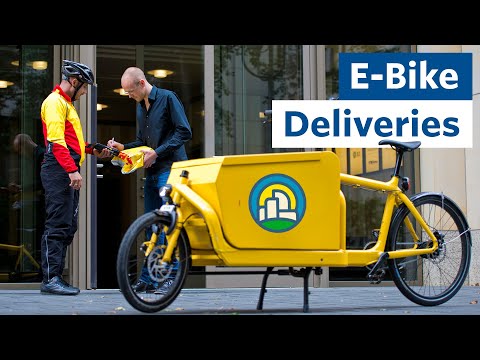
I also like how UPS puts a big box on the bike to protect the packages from the weather but nothing for the employee. Would be so easy to add a little cover.
reply
The delivery part of this would change super quickly if the shipping companies would mark your address as a gold star address or whatever if your building provides a code or key fob and there is a package drop-off location provided. Maybe you get points or the vendor and you get a discount on the shipping cost. I know someone who has this at their building so the delivery people never have to go past the lobby but the shipping companies don't give any reward for the extra effort.
I also like how UPS puts a big box on the bike to protect the packages from the weather but nothing for the employee. Would be so easy to add a little cover.
reply
Adam
I'm surprised you didn't bring it up. But Urban Freight rail was incredibly common in the world at one point. They used to run Cargo Trams and even full sized trains throughout cities to deliver goods, sometimes with these trains going inside urban warehouses where cargo bikes where waiting for local delivery. I feel like all this focus on expensive, polluting, and in efficient trucks is not a good idea when the past had so many viable solutions that didn't need cars/trucks.
reply
I'm surprised you didn't bring it up. But Urban Freight rail was incredibly common in the world at one point. They used to run Cargo Trams and even full sized trains throughout cities to deliver goods, sometimes with these trains going inside urban warehouses where cargo bikes where waiting for local delivery. I feel like all this focus on expensive, polluting, and in efficient trucks is not a good idea when the past had so many viable solutions that didn't need cars/trucks.
reply
AD53
I think it is important to look for ways of sustainable transport infrastructure. I recently saw a package locker, but that begs the question if not placed in a central location, do the people put out more CO2 than the delivery across a certain region. Furthermore, in my country the use of different sizes for delivery vehicles improves the where and how it can be delivered. I did a thesis about it and it was quite interesting to look at the many options.
reply
I think it is important to look for ways of sustainable transport infrastructure. I recently saw a package locker, but that begs the question if not placed in a central location, do the people put out more CO2 than the delivery across a certain region. Furthermore, in my country the use of different sizes for delivery vehicles improves the where and how it can be delivered. I did a thesis about it and it was quite interesting to look at the many options.
reply
Casey
Somehow I'm not surprised that the University of Washington has an urban freight lab. They have so many random labs there. The Psychology department has both a bar lab and a bat lab. The bar lab is a lab that is also a fully-stocked bar, and is used to study human behavior in the bar environment. The bat lab is a lab that studies bats. Not sure how they resist the urge to hire only student assistants named Robin.
reply
Somehow I'm not surprised that the University of Washington has an urban freight lab. They have so many random labs there. The Psychology department has both a bar lab and a bat lab. The bar lab is a lab that is also a fully-stocked bar, and is used to study human behavior in the bar environment. The bat lab is a lab that studies bats. Not sure how they resist the urge to hire only student assistants named Robin.
reply
Brian
Ironically yesterday I had to wait for a handicapped parking spot because it was being used by a delivery truck in front of the private package and mail business I wanted to access. The irritation was compounded by his blockage of the ONLY TWO handicapped parking spots in that strip mall business park. This strip mall has huge areas of parking available and yet the number of handicapped spots are very minimal.
reply
Ironically yesterday I had to wait for a handicapped parking spot because it was being used by a delivery truck in front of the private package and mail business I wanted to access. The irritation was compounded by his blockage of the ONLY TWO handicapped parking spots in that strip mall business park. This strip mall has huge areas of parking available and yet the number of handicapped spots are very minimal.
reply
Phalaenopsisify
In Sweden nearly all packages are delivered to your nearest convenience store or a package locker. It's only recently we have gotten more home deliveries. And honestly I think walking five minutes to pick up my delivery myself is much better, who has time to stay home for deliveries all the time? Hugely inconvenient for ordinary people who have work, school and other things to do.
reply
In Sweden nearly all packages are delivered to your nearest convenience store or a package locker. It's only recently we have gotten more home deliveries. And honestly I think walking five minutes to pick up my delivery myself is much better, who has time to stay home for deliveries all the time? Hugely inconvenient for ordinary people who have work, school and other things to do.
reply
Philipp
There is just one problem with those delivery boxes: It's only for one specific purpose, or one specific provider. So, what's the point for me to register to all of these services? It's just annoying, and not all of them provide that service.
There has to be one box for all of them. Ohterwise this system is just way to complicated and is not going to work.
reply
There is just one problem with those delivery boxes: It's only for one specific purpose, or one specific provider. So, what's the point for me to register to all of these services? It's just annoying, and not all of them provide that service.
There has to be one box for all of them. Ohterwise this system is just way to complicated and is not going to work.
reply
travel
7: 11 This isn't the city of Bremen, it's Bremerhaven, which is 60 Km further north.
Both are part of the same city state. which is also called Bremen.
To deffirentiate we simply say city of Bremen vs city state Bremen. But if someone just says Bremen, it's almost always reffered to the former designation.
reply
7: 11 This isn't the city of Bremen, it's Bremerhaven, which is 60 Km further north.
Both are part of the same city state. which is also called Bremen.
To deffirentiate we simply say city of Bremen vs city state Bremen. But if someone just says Bremen, it's almost always reffered to the former designation.
reply
Bart
I'm not a huge fan of cargo bikes on bike paths: they are big and heavy and can feel quite dangerous if there are multiple mixing in same busy traffic flow. Here it is getting chaotic on the bike paths with the e-bikes and deliveries adding a lot of size and speed differences.
reply
I'm not a huge fan of cargo bikes on bike paths: they are big and heavy and can feel quite dangerous if there are multiple mixing in same busy traffic flow. Here it is getting chaotic on the bike paths with the e-bikes and deliveries adding a lot of size and speed differences.
reply
Add a review, comment
Other channel videos