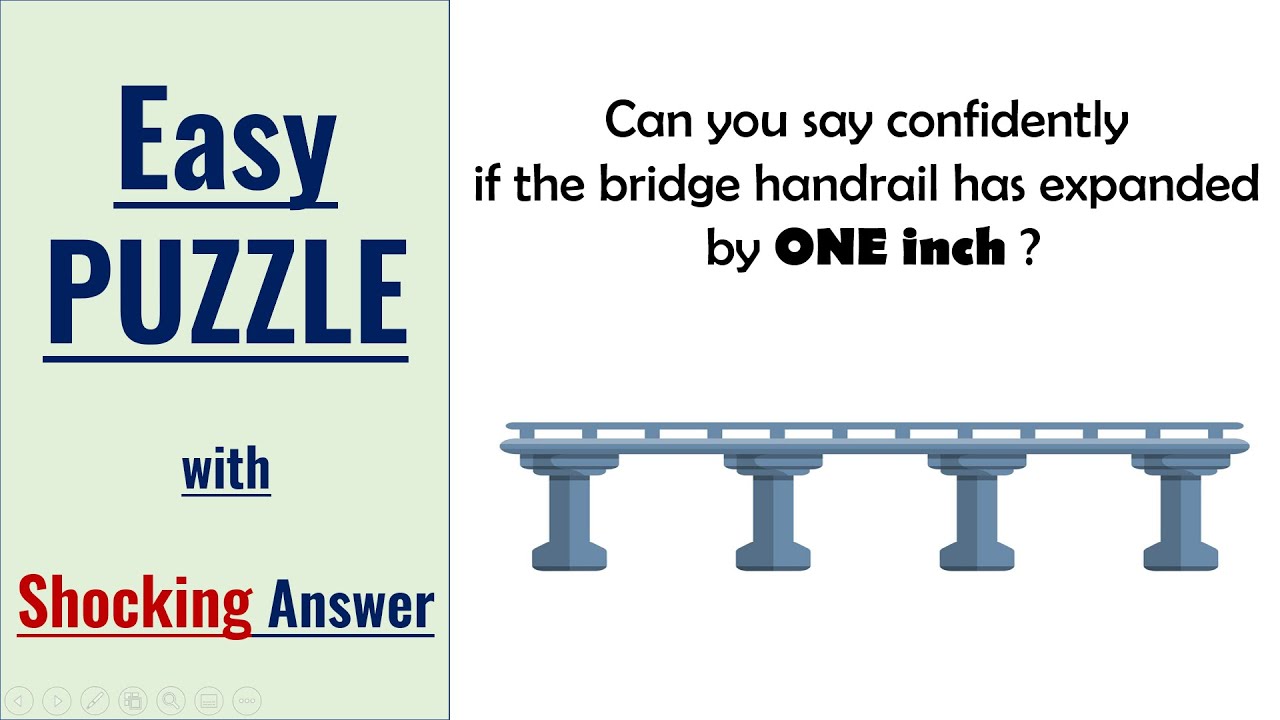
90% fail: The Easiest Puzzle in the world Longest Bridge Surprising Answer
video description
.
The Earth's circumference is only 24, 901 miles (laterally at the equator; only 24, 860 miles vertically)-- that bridge 4000 miles long would curve to match the curvature of the Earth, not be a straight line. (Perhaps it is a tunnel bridge that goes under the water and comes back up? The imagery suggests a suspension bridge though) We can determine the straight line distance from fixed points A and B at the end of the 4000 mile bridge, based on the Earth's circumference. We can determine the radius of a smaller circle, where the same fixed distance between A and B when going around the circumference is 4000 miles plus 1 inch. We can then calculate the high point of the arches away from the straight line from A to B, to see how high the handrail raises.
.
But that isn't the real issue.
.
What is making the handrail go up into the air? Assuming the handrail is periodically attached to the bridge by vertical posts, the extra length would attempt to sag but then be pushed laterally by the posts holding it up. We would see a rail that might curve outward past the edge of the bridge, inward toward the pedestrian walkways of the bridge, or even both in a chaotic zig-zagging pattern. Now we are looking at some complex physics problems. What will the handrail do, based on the bridge's construction? Let's assume that the support posts holding up the handrail are rigid, and are a full 10 feet apart. This means that each section between the posts bows either inward or outward as it expands in the summer heat and seeks to sag due to gravity. There are 5280 feet in a mile, so we are looking at 528 gaps per mile post to post along the 4000 mile long bridge. That's 2, 112, 000 gaps -- with the extra inch of length divided equally among all of them. There is a 1/2, 112, 000th of an inch bow inward or outward, between each post as the pedestrian walks along. Safe to say, a pedestrian walking on this bridge would NOT notice an expansion difference of only 1 inch. They will not see it, and they will not feel it.
.
The reality of course is that bridges are typically much smaller than 4000 miles, meaning A to B across the bridge is closer to a flat line. Also, a 4000 mile long metal handrail will expand in length much more than just 1 inch -- the exact degree it will expand depends on the metal used in its construction, which is again information we have not been given. The extreme values used in the puzzle made it impossible to solve logically. We had to make many faulty assumptions to arrive at the demonstrated answer, which is in fact not a real answer to the puzzle.
Date: 2023-11-15
Related videos






Comments and reviews: 29
Jordan
Mohammad, there are two problems with your solution:
1. The handrail would not form a triangle with a bend in the middle. If we assume ideal conditions, it would form a catenary arch. This doesn't change the answer much, though, since the height would still be -9750 inches.
2. More critically, 4000 miles is nearly 1/6th of the Earth's circumference. Thus neither the bridge nor the pre-expansion rail would be a straight line; they'd both be curved. Hell, at that scale you can't even treat gravity as a uniform force; the direction of 'down' changes by 57. 8 degrees between the ends of the bridge.
Calculating what the curved base does to the problem is beyond me, but it would reduce the height of the midpoint by a -lot. - For instance:
- Assume the Earth was smaller, such that its circumference was only 4000. 01 miles.
- This means the bridge starts at one support, goes all the way around the world, then reaches its other support only 50 feet short of where it started.
- Now assume the handrail expands by 1 inch.
- The handrail is close enough to a complete circle that we can approximate it as one.
- The circumference of a circle is 2 pi times its radius.
- Thus to increase the circumference of the railing by 1 inch, we need to increase its radius by 1/2pi inches.
- However, the handrail-circle is fixed on one side, where the start and end of the bridge are, so the other side will have to rise by twice that.
- Thus the handrail only lifts by 1/pi =-0. 31 inches. That's large enough to be easily measurable if you know how high the railing is supposed to be, but too small to be immediately obvious.
So, now we've got both an upper and lower bound on an approximation: if the bridge is straight, the height is -9750 inches; if its a complete circle, -0. 31 inches. My guess would be that for the real scenario, where the bridge is -1/6th of a circle, the railing would be high enough to be obvious, but not so high that a pedestrian can't touch it.
reply
Mohammad, there are two problems with your solution:
1. The handrail would not form a triangle with a bend in the middle. If we assume ideal conditions, it would form a catenary arch. This doesn't change the answer much, though, since the height would still be -9750 inches.
2. More critically, 4000 miles is nearly 1/6th of the Earth's circumference. Thus neither the bridge nor the pre-expansion rail would be a straight line; they'd both be curved. Hell, at that scale you can't even treat gravity as a uniform force; the direction of 'down' changes by 57. 8 degrees between the ends of the bridge.
Calculating what the curved base does to the problem is beyond me, but it would reduce the height of the midpoint by a -lot. - For instance:
- Assume the Earth was smaller, such that its circumference was only 4000. 01 miles.
- This means the bridge starts at one support, goes all the way around the world, then reaches its other support only 50 feet short of where it started.
- Now assume the handrail expands by 1 inch.
- The handrail is close enough to a complete circle that we can approximate it as one.
- The circumference of a circle is 2 pi times its radius.
- Thus to increase the circumference of the railing by 1 inch, we need to increase its radius by 1/2pi inches.
- However, the handrail-circle is fixed on one side, where the start and end of the bridge are, so the other side will have to rise by twice that.
- Thus the handrail only lifts by 1/pi =-0. 31 inches. That's large enough to be easily measurable if you know how high the railing is supposed to be, but too small to be immediately obvious.
So, now we've got both an upper and lower bound on an approximation: if the bridge is straight, the height is -9750 inches; if its a complete circle, -0. 31 inches. My guess would be that for the real scenario, where the bridge is -1/6th of a circle, the railing would be high enough to be obvious, but not so high that a pedestrian can't touch it.
reply
Spencer
WRONG. i was too lazy to solve it correctly. so obviously let down when you solved it the way i did. not only should you be calculating arc length, but 4000 miles is not a straight line either. my intuition leads me to believe not only that increasing by 1 inch wouldnt change much, but also that a 4000 mile handrail is way too short for a 4000 mile bridge if it is 3 feet off the ground. lets check.
a 3 foot tall rail is 4000. 00057 miles (3. 03 feet longer) long on a 4000 mile bridge. if the rail were to grow by 1 inch, it would get 1 inch taller in the center. i think you are part of that 90% that fail this. well, and to be fair, so am i since i assumed using triangles woul be a close approximation too.
reply
WRONG. i was too lazy to solve it correctly. so obviously let down when you solved it the way i did. not only should you be calculating arc length, but 4000 miles is not a straight line either. my intuition leads me to believe not only that increasing by 1 inch wouldnt change much, but also that a 4000 mile handrail is way too short for a 4000 mile bridge if it is 3 feet off the ground. lets check.
a 3 foot tall rail is 4000. 00057 miles (3. 03 feet longer) long on a 4000 mile bridge. if the rail were to grow by 1 inch, it would get 1 inch taller in the center. i think you are part of that 90% that fail this. well, and to be fair, so am i since i assumed using triangles woul be a close approximation too.
reply
Gary
4000 miles? Are you insane? The sun won't even be heating the thing evenly. That is 1/6 of the circumference of the Earth at the equator. Over that length the bridge is curved to follow the surface of the Earth. I think you need to check your calculations with a civil engineering textbook. Sounds totally bogus to me. In addition, the expanding handrail will put stress into the end supports. They will move as much as the handrail. And a 4000 miles handrail will expand much more than one inch. Short bridges of a few hundred yards have multiple expansion joints to prevent such thermal induced stresses. You fail this completely.
reply
4000 miles? Are you insane? The sun won't even be heating the thing evenly. That is 1/6 of the circumference of the Earth at the equator. Over that length the bridge is curved to follow the surface of the Earth. I think you need to check your calculations with a civil engineering textbook. Sounds totally bogus to me. In addition, the expanding handrail will put stress into the end supports. They will move as much as the handrail. And a 4000 miles handrail will expand much more than one inch. Short bridges of a few hundred yards have multiple expansion joints to prevent such thermal induced stresses. You fail this completely.
reply
Kippe
My City is in Germany, which is on Earth, there is Gravity here, Handrails are usually not that thick, i think thre might even be a NORM to it.
A Handrail out of Metal, i think some kind of Steel would not be able to buckle up 900+ feet. It probably curves multiple times.
It might very well be possible to touch the Center AND tell that it expanded.
Wanna see that Metal that can hold its own weight over 2000 Miles without curving at all.
You cant just take Metal and its property to expand under heat and silently exclude every other property.
reply
My City is in Germany, which is on Earth, there is Gravity here, Handrails are usually not that thick, i think thre might even be a NORM to it.
A Handrail out of Metal, i think some kind of Steel would not be able to buckle up 900+ feet. It probably curves multiple times.
It might very well be possible to touch the Center AND tell that it expanded.
Wanna see that Metal that can hold its own weight over 2000 Miles without curving at all.
You cant just take Metal and its property to expand under heat and silently exclude every other property.
reply
Francesco
This video is sponsored by: Metric System. The hell are you doing, Americans? 63, 360 inches times 4000 miles equals. are you mad?
Join Metric System today, and get a lifetime subscription to non-retarded unit conversions, non-unnecessarily-complicated multiplications and coherence with the rest of the world.
Your scientists and engineers are already using Metric System. And you?
Plus, with promo code EUROPE, get a conveniently sustainable healthcare today.
Metric System. Because we still don't understand what you waiting for.
reply
This video is sponsored by: Metric System. The hell are you doing, Americans? 63, 360 inches times 4000 miles equals. are you mad?
Join Metric System today, and get a lifetime subscription to non-retarded unit conversions, non-unnecessarily-complicated multiplications and coherence with the rest of the world.
Your scientists and engineers are already using Metric System. And you?
Plus, with promo code EUROPE, get a conveniently sustainable healthcare today.
Metric System. Because we still don't understand what you waiting for.
reply
Cigmorfil
At 4, 000 with the earth having a radius of nearly 4, 000 miles, assuming the centre of the bridge touches the earth, the ends of the bridge will be about 472 miles above the earth.
If the end of the bridge is on the earth, the centre of the bridge will be about 472 miles above the earth and it is unlikely than anyone would be walking on the centre to be able to attempt to hold any handrail.
Alternatively, if the bridge follows the curvature of the earth, pythagoras no longer holds.
reply
At 4, 000 with the earth having a radius of nearly 4, 000 miles, assuming the centre of the bridge touches the earth, the ends of the bridge will be about 472 miles above the earth.
If the end of the bridge is on the earth, the centre of the bridge will be about 472 miles above the earth and it is unlikely than anyone would be walking on the centre to be able to attempt to hold any handrail.
Alternatively, if the bridge follows the curvature of the earth, pythagoras no longer holds.
reply
Arthur
I get the idea of the puzzle.
But, it just says hold the center, not reach up and hold. So, barring any limiting criteria, there is no reason that with equipment a person couldn't make their way to the center of the hand rail and hold it.
You could argue that if the summer heat buclked the rail that much it would make it to hot to feel the rail.
reply
I get the idea of the puzzle.
But, it just says hold the center, not reach up and hold. So, barring any limiting criteria, there is no reason that with equipment a person couldn't make their way to the center of the hand rail and hold it.
You could argue that if the summer heat buclked the rail that much it would make it to hot to feel the rail.
reply
Oren
4, 000 miles is just less than a quarter of the earth's circumference.
I'm too lazy to figure out the puzzle with this information included.
Can you, Ammar, or anyone do it for me? - Thank you! :): ): )
P. S. miles, inches, feet, blah, blah, blah! Use The Metric System! 1, 000km bridge and 1cm expansion, for example.
reply
4, 000 miles is just less than a quarter of the earth's circumference.
I'm too lazy to figure out the puzzle with this information included.
Can you, Ammar, or anyone do it for me? - Thank you! :): ): )
P. S. miles, inches, feet, blah, blah, blah! Use The Metric System! 1, 000km bridge and 1cm expansion, for example.
reply
Doug
I imagined there was a road in the middle of the bridge, and that you were standing directly in the middle and thus at least 1 lane away from each of the handrails so you wouldn't be able to touch them. So I guess I was correct, even if not for the same reason given. No one would make a 4000-mile walking only bridge.
reply
I imagined there was a road in the middle of the bridge, and that you were standing directly in the middle and thus at least 1 lane away from each of the handrails so you wouldn't be able to touch them. So I guess I was correct, even if not for the same reason given. No one would make a 4000-mile walking only bridge.
reply
Carlos
Nope. It doesn't make sense.
Think logically: that section of the bridge handrail with 2000 miles long can't raise 938 feet without bending and collapsing due to its own weight. you're substituting real handrail pipes for lines on a piece of paper. that answer of 938 feet only exist in your mind.
reply
Nope. It doesn't make sense.
Think logically: that section of the bridge handrail with 2000 miles long can't raise 938 feet without bending and collapsing due to its own weight. you're substituting real handrail pipes for lines on a piece of paper. that answer of 938 feet only exist in your mind.
reply
Glenn
If it is possible to have a bridge 4, 000 miles long (which is roughly the distance from San Diego, CA to Lima, Peru, then it seems equally likely that there might be a person who is tall enough to reach 938 feet in the air. So the answer to the riddle should be -yes, but the person must be a giant. -
reply
If it is possible to have a bridge 4, 000 miles long (which is roughly the distance from San Diego, CA to Lima, Peru, then it seems equally likely that there might be a person who is tall enough to reach 938 feet in the air. So the answer to the riddle should be -yes, but the person must be a giant. -
reply
Alberto
Ok Ok Ok Pythagoras theorem- hahaha, but, that is not a logical test, it is a mathematical test. Thinking logically a bridge of that length is impossible due to the curvature of the earth and it would not deform in a triangular shape, so it is also a poorly formulated mathematical test.
reply
Ok Ok Ok Pythagoras theorem- hahaha, but, that is not a logical test, it is a mathematical test. Thinking logically a bridge of that length is impossible due to the curvature of the earth and it would not deform in a triangular shape, so it is also a poorly formulated mathematical test.
reply
Ryad
OK Ammar, once again the concept is good but when applied to a bridge and you want to think logically then logically the handrail will sag and then when could tighten, to add to that it would have supports which would also expand which would effect your original trigonometry equation.
reply
OK Ammar, once again the concept is good but when applied to a bridge and you want to think logically then logically the handrail will sag and then when could tighten, to add to that it would have supports which would also expand which would effect your original trigonometry equation.
reply
Marvin
Nonsense. The handrail starts as an arc covering more than 57 degrees of bend.
When it expands, it will not just kink in the middle, the whole arc will lift up by less than 1 part in 126720000 above its previous curvature position, which at the midpoint is only 0. 025 inch.
reply
Nonsense. The handrail starts as an arc covering more than 57 degrees of bend.
When it expands, it will not just kink in the middle, the whole arc will lift up by less than 1 part in 126720000 above its previous curvature position, which at the midpoint is only 0. 025 inch.
reply
john
The question isn-t whether a person can reach the hand rail. The actual question is whether once they touch the handrail can they tell if it expanded. So- the real answer. and also my big brain answer is; if the rail is warm to the touch the rail must also have expanded.
reply
The question isn-t whether a person can reach the hand rail. The actual question is whether once they touch the handrail can they tell if it expanded. So- the real answer. and also my big brain answer is; if the rail is warm to the touch the rail must also have expanded.
reply
Gary
Well, to be technical, since the given conditions state that the rail expands in summer, then the person at the center of the bridge, and indeed any other person who knows of the given conditions, can confidently say the rail has expanded, whether touching it or not.
reply
Well, to be technical, since the given conditions state that the rail expands in summer, then the person at the center of the bridge, and indeed any other person who knows of the given conditions, can confidently say the rail has expanded, whether touching it or not.
reply
xevira
That's a long ass bridge. That's basically the flight distance from Anchorage, Alaska to Miami, Florida. Ignoring the bridge for a moment, no handrail would be that long without being broken up into sections since it would need supports as it would sag otherwise.
reply
That's a long ass bridge. That's basically the flight distance from Anchorage, Alaska to Miami, Florida. Ignoring the bridge for a moment, no handrail would be that long without being broken up into sections since it would need supports as it would sag otherwise.
reply
phunkydroid
Triangles? Wrong. On earth, a 4000 mile bridge is curved around the shape of the earth, and an arc with 1 inch more length has 1/pi more radius. Could the pedestrian detect the handrail height changing by less than a third of an inch?
reply
Triangles? Wrong. On earth, a 4000 mile bridge is curved around the shape of the earth, and an arc with 1 inch more length has 1/pi more radius. Could the pedestrian detect the handrail height changing by less than a third of an inch?
reply
Armynyus
More realistic: 1km total length, 1cm expansion => well over 2 meters height. Crazy.
Reminds me on: Rope around the earth, make it 1 meter longer -> its well above the ground (leave it 2 u to calc; -) )
reply
More realistic: 1km total length, 1cm expansion => well over 2 meters height. Crazy.
Reminds me on: Rope around the earth, make it 1 meter longer -> its well above the ground (leave it 2 u to calc; -) )
reply
Wyatt
Here's what I did: (2000 mi+0. 5 in)-2= (2000 mi)-2+x-2 (x is the height, the 938-foot value) but I imagined that happening to the entire bridge! In the version I accidentally tried, I would say yes to both. -
reply
Here's what I did: (2000 mi+0. 5 in)-2= (2000 mi)-2+x-2 (x is the height, the 938-foot value) but I imagined that happening to the entire bridge! In the version I accidentally tried, I would say yes to both. -
reply
Speedy
This is assuming the pedestrian who is walking across a 4000 mile bridge isn't already a giant at least 1000 feet tall. Otherwise it really wouldn't be practical to have that long of a pedestrian bridge.
reply
This is assuming the pedestrian who is walking across a 4000 mile bridge isn't already a giant at least 1000 feet tall. Otherwise it really wouldn't be practical to have that long of a pedestrian bridge.
reply
Saurabh
Hi Amaar, your videos are amazing!
Probably late to comment, however, you made the assumption that the dent will be caused at the center, I think the dent will be caused near the extreme ends.
reply
Hi Amaar, your videos are amazing!
Probably late to comment, however, you made the assumption that the dent will be caused at the center, I think the dent will be caused near the extreme ends.
reply
Vitus
99% of people fail to realize that metal can be compressed and there would be no change in all for the pedestrian. The rail ist just a little more stressed. The 1% of people are civil engineers; )
reply
99% of people fail to realize that metal can be compressed and there would be no change in all for the pedestrian. The rail ist just a little more stressed. The 1% of people are civil engineers; )
reply
car0lm1k3
yeah, i would have failed this one about 4 ways. Curve of earth, compression of metal, assuming multidimensional expansions, what happens in winter with contraction, dL/L doesnt discriminate
reply
yeah, i would have failed this one about 4 ways. Curve of earth, compression of metal, assuming multidimensional expansions, what happens in winter with contraction, dL/L doesnt discriminate
reply
Rupert
given that the bridge is 16% of the way around the world, the answer would need to be calculated on an arc, not a straight line. And the handrail might be attached at more than the two ends.
reply
given that the bridge is 16% of the way around the world, the answer would need to be calculated on an arc, not a straight line. And the handrail might be attached at more than the two ends.
reply
Unformed
It's actually not an accurate answer, because handrail wil not have perfect angle at the center, it will curve, but for an aproximate measurement it's ok. Solved it. Good puzzle. Thx.
reply
It's actually not an accurate answer, because handrail wil not have perfect angle at the center, it will curve, but for an aproximate measurement it's ok. Solved it. Good puzzle. Thx.
reply
Animal
Why will the railing buckle up and not bend? 1 inch expansion in 4000 mile long railing and it buckles upward. That thing would weigh millions of tonnes and it goes up? Lol. Nice logic
reply
Why will the railing buckle up and not bend? 1 inch expansion in 4000 mile long railing and it buckles upward. That thing would weigh millions of tonnes and it goes up? Lol. Nice logic
reply
Ben
The answer is YES because the handrail won't have expanded.
This is because summer has only just arrived and so it has not been hot enough for long enough to cause any deformation.
reply
The answer is YES because the handrail won't have expanded.
This is because summer has only just arrived and so it has not been hot enough for long enough to cause any deformation.
reply
harry
Lmao I guessed the answer would be no since the effect of one inch on all 4 miles would be insignificant smh. My dumb ass thought that all of the handrail just expanded by one inch
reply
Lmao I guessed the answer would be no since the effect of one inch on all 4 miles would be insignificant smh. My dumb ass thought that all of the handrail just expanded by one inch
reply
Add a review, comment
Other channel videos