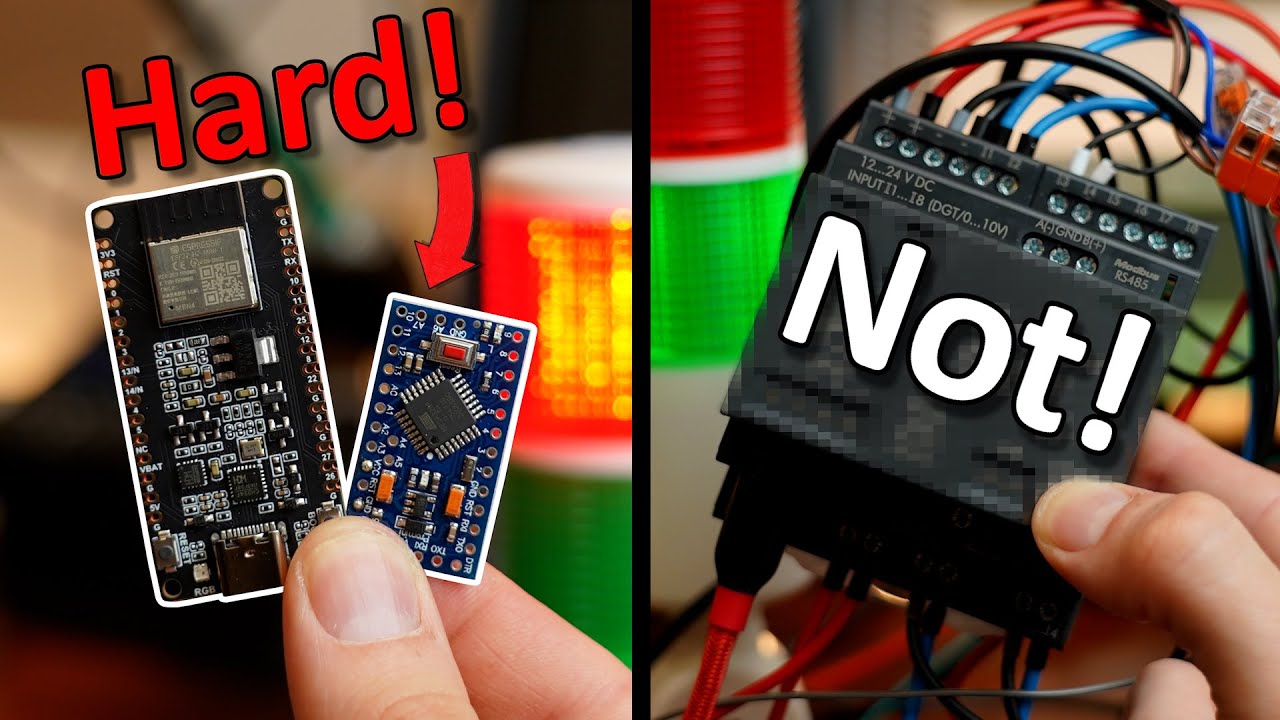
Not a Microcontroller. This is Better!
video description
Date: 2025-04-20
Related videos



Comments and reviews: 20
Absalon68
Those PLC are damned expensive, and offer a whole lot less due to their manufactured intent for heavy industrial usage. not intended for Developing or Hobby Crafting. They're basically the result of a finished developed product with a bracketed set of reduced options intended for a hard-set production run. The PLC is a Cut Down with Limited Essential in different, selectable aspects to increase the devices durability, and reduce it's complexity basically comprised of only switches, timers and counters. My little Toshiba PLC is still sitting on the shelf, looking way lonely for the last 10 years. Cool yes. But they just don't Fit unless your bloody Rich, and want to perform more tricks, (with extra things, just to do what the little ESP32 does in it's sleep. It's doable, but not really worth the effort and expense nowadays. Besides, most PLCs have their own software, language, program, which is mostly Propriety. It's designed as a Hard-Core protection to prevent any expansion to a second computer, and basically takes full and absolute Ownership over the designated programming computer, rendering it useless for any other task or programing. In short, when you buy a PLC, you ALSO Purchase Another Laptop, Just For that single, unique, PLC's manufactures programing software. Rockwell, Toshiba, Eaton, Cutler Hammer, and whoever; nobody talks with each other and Everybody is paranoidal towards everyone else in the industry. They're all sneak-thieves unto their own so they act accordingly. But instead of making their niche secure, they charge more due to their acrobatic paranoia antics than the item in question. Their moto could honestly be: If you want it, Jump! Here's my ring of fire TOAD, get hopping or go away! And that's how they roll. Every last one of them.
reply
Those PLC are damned expensive, and offer a whole lot less due to their manufactured intent for heavy industrial usage. not intended for Developing or Hobby Crafting. They're basically the result of a finished developed product with a bracketed set of reduced options intended for a hard-set production run. The PLC is a Cut Down with Limited Essential in different, selectable aspects to increase the devices durability, and reduce it's complexity basically comprised of only switches, timers and counters. My little Toshiba PLC is still sitting on the shelf, looking way lonely for the last 10 years. Cool yes. But they just don't Fit unless your bloody Rich, and want to perform more tricks, (with extra things, just to do what the little ESP32 does in it's sleep. It's doable, but not really worth the effort and expense nowadays. Besides, most PLCs have their own software, language, program, which is mostly Propriety. It's designed as a Hard-Core protection to prevent any expansion to a second computer, and basically takes full and absolute Ownership over the designated programming computer, rendering it useless for any other task or programing. In short, when you buy a PLC, you ALSO Purchase Another Laptop, Just For that single, unique, PLC's manufactures programing software. Rockwell, Toshiba, Eaton, Cutler Hammer, and whoever; nobody talks with each other and Everybody is paranoidal towards everyone else in the industry. They're all sneak-thieves unto their own so they act accordingly. But instead of making their niche secure, they charge more due to their acrobatic paranoia antics than the item in question. Their moto could honestly be: If you want it, Jump! Here's my ring of fire TOAD, get hopping or go away! And that's how they roll. Every last one of them.
reply
sgctactics
As an industrial maintenance technician, I honestly never really understood the whole Arduino obsession. Don't get me wrong, I've used microcontrollers for plenty of home projects, but for the hassle of programming them, the only advantage of them are the price comparison. Plus, besides Allen Bradley's, they're damn near indestructible. (AB has a tendency to brick themselves for many reasons depending on specific model and programmer experience. Here's looking at you, micro800 series)
Now, this is obviously just my own opinion, but it's honestly more rewarding to use a PLC to supplement analog circuits. There's just something satisfying about making a fancy box and discreet components act almost as if it were its own self sufficient natural entity.
Overall, good presentation nonetheless, you did a good job at showcasing many devices that I deal with on a daily basis. All of those components are used in such a vast array of applications that it can be mind boggling sometimes, but it always feels serendipitous when you come up with a new way to apply them.
That's why I think more people should pursue maintenance tech jobs. There's an endless range of things to do with industrial legos, not to mention it's never a boring day as long as they keep hiring idiot operators. And whenever things change around the shop, upper management typically tells you to get rid of those rather spendy components instead of pay extra to dispose of them.
reply
As an industrial maintenance technician, I honestly never really understood the whole Arduino obsession. Don't get me wrong, I've used microcontrollers for plenty of home projects, but for the hassle of programming them, the only advantage of them are the price comparison. Plus, besides Allen Bradley's, they're damn near indestructible. (AB has a tendency to brick themselves for many reasons depending on specific model and programmer experience. Here's looking at you, micro800 series)
Now, this is obviously just my own opinion, but it's honestly more rewarding to use a PLC to supplement analog circuits. There's just something satisfying about making a fancy box and discreet components act almost as if it were its own self sufficient natural entity.
Overall, good presentation nonetheless, you did a good job at showcasing many devices that I deal with on a daily basis. All of those components are used in such a vast array of applications that it can be mind boggling sometimes, but it always feels serendipitous when you come up with a new way to apply them.
That's why I think more people should pursue maintenance tech jobs. There's an endless range of things to do with industrial legos, not to mention it's never a boring day as long as they keep hiring idiot operators. And whenever things change around the shop, upper management typically tells you to get rid of those rather spendy components instead of pay extra to dispose of them.
reply
Paxmax
PLC and FBD has an extremely fast learning curve! I loved it to bits from the get-go! My first time ever coming in contact with PLC I built a fictive heat counter. Made to observe 36 high current (0-160A) carrying wires using AC current transformers connected to PLC analog inputs (thru an bespoke MUX and peak detection PCB. When current X10 is On the potential heat rises in cables and connectors, stored/incremented in an PLC accumulator variable, when current is below X the equipment is potentially cooling down. Worst case conditions was pre-measured thru practical experiments to then worked out and set X (steady state capacity, measured value multiplier and time-factor. This was free standing solution made to monitor an equipment that had a nasty tendency(and capacity) to overheat various equipment connected down stream. PLC read which equipment was connected and set limits to match. You know, just like milk boils over when you turn you back to, in same fashion was that famous operator dreaded sentence delivered thru phone way too many times before this: I was away less than a minute, I promise. When that overheat situation was about to happen the PLC just sounded and flashed an alarm. If no-one managed the situation in time the emergency stop was pulled. Saved hours of equipment repair monthly (aka my time) but in worst case stopped production for a few minutes while equipment was in an un-restartable cool down mode.
Good times
reply
PLC and FBD has an extremely fast learning curve! I loved it to bits from the get-go! My first time ever coming in contact with PLC I built a fictive heat counter. Made to observe 36 high current (0-160A) carrying wires using AC current transformers connected to PLC analog inputs (thru an bespoke MUX and peak detection PCB. When current X10 is On the potential heat rises in cables and connectors, stored/incremented in an PLC accumulator variable, when current is below X the equipment is potentially cooling down. Worst case conditions was pre-measured thru practical experiments to then worked out and set X (steady state capacity, measured value multiplier and time-factor. This was free standing solution made to monitor an equipment that had a nasty tendency(and capacity) to overheat various equipment connected down stream. PLC read which equipment was connected and set limits to match. You know, just like milk boils over when you turn you back to, in same fashion was that famous operator dreaded sentence delivered thru phone way too many times before this: I was away less than a minute, I promise. When that overheat situation was about to happen the PLC just sounded and flashed an alarm. If no-one managed the situation in time the emergency stop was pulled. Saved hours of equipment repair monthly (aka my time) but in worst case stopped production for a few minutes while equipment was in an un-restartable cool down mode.
Good times
reply
CharlesVanNoland
Most industrial automation employs PLCs instead of anything as powerful as an MCU. I watched my late father design and build all kinds of machines for processing huge numbers of precision parts back in the 90s. I've always felt that most of what people would tend to use an Arduino or MCU for, where it's just some basic logic to turn on/off some lights and buzzers and motors and actuators in response to various combinations of sensors being active, and some overall sequential process to be followed, is way overkill. I've even seen products that use an actual Arduino inside of them - instead of the engineers/designers using an off-the-shelf MCU IC on a custom PCB designed just for their purpose. Seems like such a waste! Arduinos are supposed to be like a developer board for figuring out what you want to do, and getting it to work, or for one-off projects where there's only going to ever be one of the thing (or a few, at the most. For something you make and sell, definitely don't put a whole dang Arduino in the thing. An 8-bit PIC chip or a PLC will probably be able to do most of what you need unless you need network/audio/video on there - then you'll need something with some more heft, but if you don't need those things then use the cheapest thing there is - and it's not hard at all to build a circuit around an MCU IC. Waste not, want not!
reply
Most industrial automation employs PLCs instead of anything as powerful as an MCU. I watched my late father design and build all kinds of machines for processing huge numbers of precision parts back in the 90s. I've always felt that most of what people would tend to use an Arduino or MCU for, where it's just some basic logic to turn on/off some lights and buzzers and motors and actuators in response to various combinations of sensors being active, and some overall sequential process to be followed, is way overkill. I've even seen products that use an actual Arduino inside of them - instead of the engineers/designers using an off-the-shelf MCU IC on a custom PCB designed just for their purpose. Seems like such a waste! Arduinos are supposed to be like a developer board for figuring out what you want to do, and getting it to work, or for one-off projects where there's only going to ever be one of the thing (or a few, at the most. For something you make and sell, definitely don't put a whole dang Arduino in the thing. An 8-bit PIC chip or a PLC will probably be able to do most of what you need unless you need network/audio/video on there - then you'll need something with some more heft, but if you don't need those things then use the cheapest thing there is - and it's not hard at all to build a circuit around an MCU IC. Waste not, want not!
reply
4a4a4a5a
I think honestly this goes back to the big, expensive reliable thing versus dirt cheap thing that breaks, but you can just buy five of them and make them agree/vote argument. I think the dirt cheap Arduino just can't be beat for price, and for reliability you just use more of them. Sure, the learning curve is higher (depending on whether you come from an electronics or a software background) and there's some special considerations, but once you learn, all of your future projects come with a nice discount in both price and small form factor--and you don't have vendor lock-in since there's so many Arduino clones and you can even go pure Atmel or PIC. I want to like PLCs, but unless you're prototyping something extremely niche (ex: designing a custom CPU, it's usually way easier to lean on the tried and true things like the Uno or even a Pi Zero. Bigger support community, cheaper, smaller, easier to replace if you accidentally break it, etc.
reply
I think honestly this goes back to the big, expensive reliable thing versus dirt cheap thing that breaks, but you can just buy five of them and make them agree/vote argument. I think the dirt cheap Arduino just can't be beat for price, and for reliability you just use more of them. Sure, the learning curve is higher (depending on whether you come from an electronics or a software background) and there's some special considerations, but once you learn, all of your future projects come with a nice discount in both price and small form factor--and you don't have vendor lock-in since there's so many Arduino clones and you can even go pure Atmel or PIC. I want to like PLCs, but unless you're prototyping something extremely niche (ex: designing a custom CPU, it's usually way easier to lean on the tried and true things like the Uno or even a Pi Zero. Bigger support community, cheaper, smaller, easier to replace if you accidentally break it, etc.
reply
309electronic5
Basically the comparison between a industrial grade upgraded beefed up (macro)microcontroller system (with some extra stuff added to make it commercial grade and to upgrade the puny IO outputs to some industrial level compatible ones, and a regular puny bare microcontroller (board) : )
But i, myself who is student hobbying with electronics and coding, it would be nice for other beginners and inbetween people to have a gui based coding software. I started programming this way when i was young, but with lego mindstorms and the microbit using blocks of code. I learn and perform the best in graphical and logical things
And also a plc is handy because its basically a beefed up microcontroller and thus accidentally frying it by connecting a pin to the wrong spot is low chance, and you can drive certain devices directly while with a mcu you often need a transistor or mosfet or relay cause of the weak io pins.
reply
Basically the comparison between a industrial grade upgraded beefed up (macro)microcontroller system (with some extra stuff added to make it commercial grade and to upgrade the puny IO outputs to some industrial level compatible ones, and a regular puny bare microcontroller (board) : )
But i, myself who is student hobbying with electronics and coding, it would be nice for other beginners and inbetween people to have a gui based coding software. I started programming this way when i was young, but with lego mindstorms and the microbit using blocks of code. I learn and perform the best in graphical and logical things
And also a plc is handy because its basically a beefed up microcontroller and thus accidentally frying it by connecting a pin to the wrong spot is low chance, and you can drive certain devices directly while with a mcu you often need a transistor or mosfet or relay cause of the weak io pins.
reply
GabrieleOrsani
Dear Scott, another interesting video, but this time i would say it does not give a correct idea about difference between plc and micro. Tipically who makes plc program can have an easy and straight forward one, but he can have even very complex and big program made by several colleagues. Thousands of i/o points digital or analog. It's even right that microcontrollers ARE inside a PLC, and they can be deterministic and perform higher speed. But in my opinion here you should explain difference between firmware and software, between one program made for dedicated low level very important task (like a firmware for a brushless motor drive) or a high level general purpose task, example a software for monitoring several motors and appliances which can change configuration or behaviour between similar devices or after some time.
Thanks for your literally GreatScott's videos!
reply
Dear Scott, another interesting video, but this time i would say it does not give a correct idea about difference between plc and micro. Tipically who makes plc program can have an easy and straight forward one, but he can have even very complex and big program made by several colleagues. Thousands of i/o points digital or analog. It's even right that microcontrollers ARE inside a PLC, and they can be deterministic and perform higher speed. But in my opinion here you should explain difference between firmware and software, between one program made for dedicated low level very important task (like a firmware for a brushless motor drive) or a high level general purpose task, example a software for monitoring several motors and appliances which can change configuration or behaviour between similar devices or after some time.
Thanks for your literally GreatScott's videos!
reply
testman9541
I learned PLC quite a while and altough it felt nice for some process, I find the debug stage way too complex. On code you just go debug, put a breakpoint, some watch variable and can go deep down the process to any step required. Here sometimes on PLC you are stuck, you are limited to the external view of things and need to infer things based on perceived behavior and not reality of things like: values and code. PLC tend to have proprietary tools that are limited to the manufacturer's good will of the day and cost you an arm. It means people are very specific on a given PLC context. Working with code you can use open source IDE and get it done from scratch if required. Two different world perspective. But with tools like Node RED and esphome, and MCU based hardware DIN mountable off the shelf I don't feel any need to go down the PLC road again.
reply
I learned PLC quite a while and altough it felt nice for some process, I find the debug stage way too complex. On code you just go debug, put a breakpoint, some watch variable and can go deep down the process to any step required. Here sometimes on PLC you are stuck, you are limited to the external view of things and need to infer things based on perceived behavior and not reality of things like: values and code. PLC tend to have proprietary tools that are limited to the manufacturer's good will of the day and cost you an arm. It means people are very specific on a given PLC context. Working with code you can use open source IDE and get it done from scratch if required. Two different world perspective. But with tools like Node RED and esphome, and MCU based hardware DIN mountable off the shelf I don't feel any need to go down the PLC road again.
reply
jeffspaulding9834
Most PLCs have modules available for things like PWM and high-speed counting, so you're not limited by your scan cycle speed.
The big advantage of PLCs is that they're part of what AvE calls industrial Lego. If you build out things with microcontrollers, you're basically building a custom machine that requires specialized training to maintain. With industrial systems, any industrial electrician can perform maintenance and spare parts are usually available for a couple decades. Everything is modular and you can replace one part without having to redesign everything from scratch.
I do think that the cost of PLCs isn't well presented here. That PLC is on the extreme cheap end of the price spectrum. I regularly work with PLCs that cost tens or hundreds of thousands of dollars.
reply
Most PLCs have modules available for things like PWM and high-speed counting, so you're not limited by your scan cycle speed.
The big advantage of PLCs is that they're part of what AvE calls industrial Lego. If you build out things with microcontrollers, you're basically building a custom machine that requires specialized training to maintain. With industrial systems, any industrial electrician can perform maintenance and spare parts are usually available for a couple decades. Everything is modular and you can replace one part without having to redesign everything from scratch.
I do think that the cost of PLCs isn't well presented here. That PLC is on the extreme cheap end of the price spectrum. I regularly work with PLCs that cost tens or hundreds of thousands of dollars.
reply
flyviawall4053
I wonder if this is a real PLD/FPGA implemented PLC. Since programming PLD/FPGA is actually describing hardware(HDL) vs microcontrollers use procedural programming. One is more or less stateless(unless you explicitly buffer something) vs always stateful.
This two things are nit comparable in terms of programming. HDL is very superior when you need clock accurate application but a complex state machine, HDL just nowhere near. In fact in many ASIC people would include a small general purpose CPU(implemented by HDL)to bootstrap/assist something imply they both good at something that peer dont. So there’s no easy to program objectively. It’s opinion.
Nevertheless, my naive guess is this PLC is just yet another CPU emulating HDL, since it only gives you 100Hz clock.
reply
I wonder if this is a real PLD/FPGA implemented PLC. Since programming PLD/FPGA is actually describing hardware(HDL) vs microcontrollers use procedural programming. One is more or less stateless(unless you explicitly buffer something) vs always stateful.
This two things are nit comparable in terms of programming. HDL is very superior when you need clock accurate application but a complex state machine, HDL just nowhere near. In fact in many ASIC people would include a small general purpose CPU(implemented by HDL)to bootstrap/assist something imply they both good at something that peer dont. So there’s no easy to program objectively. It’s opinion.
Nevertheless, my naive guess is this PLC is just yet another CPU emulating HDL, since it only gives you 100Hz clock.
reply
evilrslade
As a PLC systems Engineer of nearly 35 years now, PLC's are physically much more optimised for Industrial use, as well as hardware optimisation for things like high speed interrupts and encoder control and safety applications. If they support IEC 61131-3 then you have the five different ways to program, as well as choice between relay output and transistor output. Then there's specialist expansion units for a multitude of different applications, temperature control, motor control and so on. Definitely for me the limiting factor for microcontrollers is the voltage/amps they can handle, so they are of limited use in an industrial environment. They are good fun and cheap, and at the moment i'm looking to implement some in a laboratory environment. Good video, as usual!
reply
As a PLC systems Engineer of nearly 35 years now, PLC's are physically much more optimised for Industrial use, as well as hardware optimisation for things like high speed interrupts and encoder control and safety applications. If they support IEC 61131-3 then you have the five different ways to program, as well as choice between relay output and transistor output. Then there's specialist expansion units for a multitude of different applications, temperature control, motor control and so on. Definitely for me the limiting factor for microcontrollers is the voltage/amps they can handle, so they are of limited use in an industrial environment. They are good fun and cheap, and at the moment i'm looking to implement some in a laboratory environment. Good video, as usual!
reply
pastek957
I must be missing something but honestly I never got the point of PLCs. I get that microcontrollers have too many requirements for simple setups like automation, plus switching mains voltage requires an output stage. But the relative simplicity of PLCs does NOT justify its 100x price increase, especially with the limited features.
And I've tried ladder logic for a bit and for big systems it becomes almost as complex as C code.
Get a MCU that you can use block programming with, a 5$ power supply module, a few relays with driver transistors and you've got a 10$ PLC
EDIT: I just read ToukoMies' comment about on-the-fly reprogramming to keep the factory running, tho it can be worked-around and doesn't justify the price, that's a good point!
reply
I must be missing something but honestly I never got the point of PLCs. I get that microcontrollers have too many requirements for simple setups like automation, plus switching mains voltage requires an output stage. But the relative simplicity of PLCs does NOT justify its 100x price increase, especially with the limited features.
And I've tried ladder logic for a bit and for big systems it becomes almost as complex as C code.
Get a MCU that you can use block programming with, a 5$ power supply module, a few relays with driver transistors and you've got a 10$ PLC
EDIT: I just read ToukoMies' comment about on-the-fly reprogramming to keep the factory running, tho it can be worked-around and doesn't justify the price, that's a good point!
reply
MrShwaggins
There is a great older program you can buy called LogixPro for ladder logic programming PLCs. Its got conveyors that you have to fill from a silo along with different modes in a virtual environment. One of the first lessons is programming a garage door that has a motor, sensors, safety along with lights and buttons. For 40USD and lifetime access, its a great affordable tool to start diving into industrial automation. If you are a visual person versus a code language syntax then I would def take a chance with learning ladder logic. Some solutions for LogixPro are on YT, but not too many. One guy really holds your hand while figuring out practice problems that are in the documentation.
reply
There is a great older program you can buy called LogixPro for ladder logic programming PLCs. Its got conveyors that you have to fill from a silo along with different modes in a virtual environment. One of the first lessons is programming a garage door that has a motor, sensors, safety along with lights and buttons. For 40USD and lifetime access, its a great affordable tool to start diving into industrial automation. If you are a visual person versus a code language syntax then I would def take a chance with learning ladder logic. Some solutions for LogixPro are on YT, but not too many. One guy really holds your hand while figuring out practice problems that are in the documentation.
reply
arjanvuik2004
I am a PLC-programmer and I would call this a smart relais, like a Siemens Logo! or similar.
Don't get me wrong, this has it's used cases, but I have programmed complete green house logistics and I would not choose this for that task.
That said, I love the fact that you went outside your normal subjects to tell about automation and why PLC's are perfect for that. And the fact that Arduino went out of their way to get all the standards right and support all 5 61131 languages, instead of only ladder, as most cheap PLC's (smart relais) do, is certainly worth mentioning and fits their curriculum of learning. I realy hope it gets kids to become interested in industrial automation.
reply
I am a PLC-programmer and I would call this a smart relais, like a Siemens Logo! or similar.
Don't get me wrong, this has it's used cases, but I have programmed complete green house logistics and I would not choose this for that task.
That said, I love the fact that you went outside your normal subjects to tell about automation and why PLC's are perfect for that. And the fact that Arduino went out of their way to get all the standards right and support all 5 61131 languages, instead of only ladder, as most cheap PLC's (smart relais) do, is certainly worth mentioning and fits their curriculum of learning. I realy hope it gets kids to become interested in industrial automation.
reply
justben27
As a PLC programmer of over 15yrs I actually hate my industry and job, the industry is generally a high cost to entry on most of the well known brands, it promotes bad software practices, most developments are monoliths with a single engineer to a project, it doesn’t pay well compared to traditional software roles, you generally have to understand the system as a whole and know how to interpret electrical and hydraulic drawings, there’s very little cross vendor collaboration so dev methods and implementations between vendors is vastly different, support is poor, vendors put out unfinished/untested software (Siemens Unified) don’t get me started on the state of HMI development!
reply
As a PLC programmer of over 15yrs I actually hate my industry and job, the industry is generally a high cost to entry on most of the well known brands, it promotes bad software practices, most developments are monoliths with a single engineer to a project, it doesn’t pay well compared to traditional software roles, you generally have to understand the system as a whole and know how to interpret electrical and hydraulic drawings, there’s very little cross vendor collaboration so dev methods and implementations between vendors is vastly different, support is poor, vendors put out unfinished/untested software (Siemens Unified) don’t get me started on the state of HMI development!
reply
TheFlash8889
I am an automation Engineer since 4 years now. In school, in my first lessens on Siemens-PLC's we used FUP as programmming langauge too. While studying we switched over to Codesys and ST (structured text) which is kind of like a object oriented programming language. Once you got used to it you never want to switch back In the company I work I am pretty happy we do not use Siemens PLC's, but Beckhoff instead. Their IDE is free to use too and the support does not cost any money either, which is super helpful in your every day job, when you come across problems you can't solve on your own.
reply
I am an automation Engineer since 4 years now. In school, in my first lessens on Siemens-PLC's we used FUP as programmming langauge too. While studying we switched over to Codesys and ST (structured text) which is kind of like a object oriented programming language. Once you got used to it you never want to switch back In the company I work I am pretty happy we do not use Siemens PLC's, but Beckhoff instead. Their IDE is free to use too and the support does not cost any money either, which is super helpful in your every day job, when you come across problems you can't solve on your own.
reply
ericseidel4940
Not surprised that Arduino and Finder try to push their Opta again. Compared to existing Micro PLC like Siemens LOGO for example, the OPTA is 30% more expensive at equivalent I/O, has no builtin screen and only one button, so you can't use it on the field without a PC. And for a small automatic system it is very useful to be able to diplay some values or messages even on a tiny screen to see what's going on with the machine. If OPTA remains the same, I don't think it has a chance on this market. Not a question of quality but features and functions to price ratio.
reply
Not surprised that Arduino and Finder try to push their Opta again. Compared to existing Micro PLC like Siemens LOGO for example, the OPTA is 30% more expensive at equivalent I/O, has no builtin screen and only one button, so you can't use it on the field without a PC. And for a small automatic system it is very useful to be able to diplay some values or messages even on a tiny screen to see what's going on with the machine. If OPTA remains the same, I don't think it has a chance on this market. Not a question of quality but features and functions to price ratio.
reply
lucemiserlohn
PLCs have a number of disadvantages that should not be omitted.
They're proprietary, you are tied to the programming tools of the manufacturer, and if those don't exist for your preferred OS, you're screwed. If the development tools need to be activated or registered during installation, in a few years, when those tools are deprecated, you're screwed.
PLCs are quite limited in what you can do with them compared to fully programmable microcontrollers.
If you're used to real programming, the PLC programming tools are more akin to toys rather than tools.
reply
PLCs have a number of disadvantages that should not be omitted.
They're proprietary, you are tied to the programming tools of the manufacturer, and if those don't exist for your preferred OS, you're screwed. If the development tools need to be activated or registered during installation, in a few years, when those tools are deprecated, you're screwed.
PLCs are quite limited in what you can do with them compared to fully programmable microcontrollers.
If you're used to real programming, the PLC programming tools are more akin to toys rather than tools.
reply
histreeonics7770
This is like comparing an automobile to an engine.
The difference between PLC's and microcontrollers is whether or not you have full access to the microcontroller's capabilities. The PLC programming system limits you to a very narrow, albeit often very useful, programming paradigm, and most often languages that are more primitive than assembly code.
What you are buying with the Arduino PLC is a mechanical package with level translators on the microcontroller I/O pins, and a library that you can write yourself with little work.
reply
This is like comparing an automobile to an engine.
The difference between PLC's and microcontrollers is whether or not you have full access to the microcontroller's capabilities. The PLC programming system limits you to a very narrow, albeit often very useful, programming paradigm, and most often languages that are more primitive than assembly code.
What you are buying with the Arduino PLC is a mechanical package with level translators on the microcontroller I/O pins, and a library that you can write yourself with little work.
reply
R. Daneel
Here's a story; my PLC code kept running a 120 tonne industrial hoist into the end of the rails at full speed. Sounded like a car crash and shook the whole building. Several sleepless nights pouring over my code later - I figured out a helpful contractor had replaced some of our station markers with stainless steel because the originals were rusting. Yeah - the inductive sensor we were using couldn't see stainless, so lost track of where the hoist was. Fun times. If you're Canadian, you've definitely used the products that process made.
reply
Here's a story; my PLC code kept running a 120 tonne industrial hoist into the end of the rails at full speed. Sounded like a car crash and shook the whole building. Several sleepless nights pouring over my code later - I figured out a helpful contractor had replaced some of our station markers with stainless steel because the originals were rusting. Yeah - the inductive sensor we were using couldn't see stainless, so lost track of where the hoist was. Fun times. If you're Canadian, you've definitely used the products that process made.
reply
Add a review, comment
Other channel videos